


Floor Drain Strainers
In industrial and commercial facilities, the integrity of the drainage system is fundamental to operational continuity and environmental compliance. Floor drain strainers serve as the primary mechanical barrier, preventing solids, debris, and contaminants from entering the wastewater stream. While often perceived as simple components, the engineering behind these strainers determines the efficiency of fluid management, the frequency of maintenance cycles, and the protection of downstream plumbing and treatment equipment.
For engineers and facility managers, selecting the appropriate filtration component requires a balance between flow rate requirements and the physical characteristics of the waste being managed. As part of a comprehensive range of Strainers & Baskets, floor drain strainers must be specified based on material compatibility, mechanical load ratings, and filtration precision to ensure long-term reliability in demanding environments.
The Engineering Role of Floor Drain Strainers
Floor drain strainers are designed to intercept solid matter at the point of entry into the drainage network. In sectors such as food and beverage processing, chemical manufacturing, and pharmaceuticals, these components are critical for preventing pipe blockages that can lead to costly downtime or sanitary hazards.
From a technical perspective, a strainer is defined by its ability to allow maximum fluid throughput while retaining particles above a specific size. This is achieved through various media types, including perforated plates or woven wire mesh. The choice between these depends on the required filtration accuracy. While standard commercial drains may use cast iron or plastic, industrial-grade floor drain strainers are almost exclusively fabricated from stainless steel to withstand corrosive cleaning agents, high-temperature washdowns, and heavy mechanical loads.
Material Selection: Why Stainless Steel is Standard
Material science is the foundation of industrial filtration. In most B2B applications, the environment is characterized by exposure to moisture, fluctuating pH levels, and abrasive particles. Consequently, stainless steel is the preferred material for floor drain strainers due to its inherent resistance to oxidation and chemical degradation.
Grade 304 Stainless Steel
This is the most common material for general industrial use. It offers excellent corrosion resistance and mechanical strength. It is suitable for most food processing environments and general manufacturing facilities where the exposure to highly corrosive chlorides or acids is limited.
Grade 316 Stainless Steel
For more aggressive environments, such as chemical processing plants, pharmaceutical labs, or facilities near coastal areas, Grade 316 is the engineering standard. The addition of molybdenum provides enhanced resistance to pitting and crevice corrosion, particularly in the presence of chlorides and industrial solvents.
By utilizing high-grade alloys, manufacturers like Kaifil ensure that the strainers do not become a point of failure due to structural thinning or stress corrosion cracking over time.
Key Design Parameters for Industrial Strainers
When specifying floor drain strainers, engineers must evaluate several design parameters to ensure the component meets the application's hydraulic and mechanical demands.
1. Open Area Ratio
The open area ratio is the percentage of the total surface area that consists of openings (perforations or mesh gaps). A higher open area reduces the pressure drop across the strainer and allows for higher flow rates. However, it must be balanced against the mechanical strength of the component. If the open area is too high, the strainer may deform under the weight of facility traffic or high-pressure fluid surges.
2. Filtration Accuracy (Micron Rating vs. Perforation Size)
Filtration accuracy is determined by the size of the openings. For heavy-duty floor drains, perforated metal is often used for its structural rigidity, with hole sizes typically ranging from 1/8 inch to 1/2 inch. For applications requiring finer filtration—such as capturing small seeds or plastic pellets—a secondary layer of stainless steel wire mesh can be integrated into the basket design.
3. Load Ratings and Structural Integrity
In many industrial settings, floor drains are located in areas subject to forklift traffic, heavy pallets, or foot traffic. The strainer and its housing must be rated for these loads. Engineers typically refer to standards such as ASME A112.6.3, which categorizes drains from "Light Duty" (pedestrian) to "Special Duty" (heavy industrial equipment).
Types of Strainers & Baskets for Floor Drainage
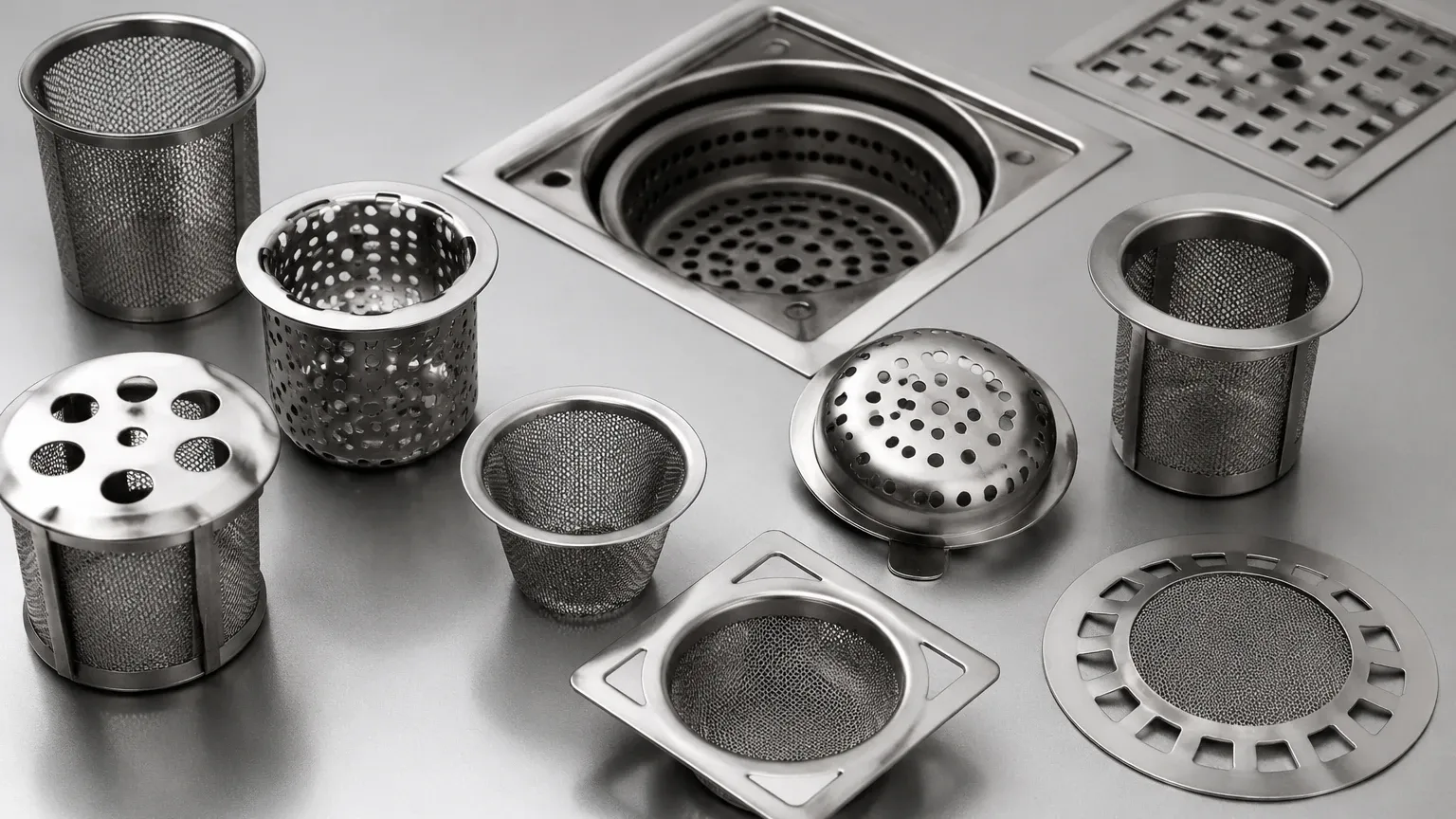
Depending on the volume of solids expected, different configurations of strainers are employed. The two primary designs are flat strainers and basket strainers.
Flat Strainers
Flat strainers are used in areas where solid accumulation is minimal. They sit flush with the floor surface and are primarily intended to prevent large objects from entering the drain. They are easy to clean but have a lower capacity for holding debris before flow is restricted.
Basket Strainers
In environments where high volumes of solids are common—such as vegetable processing or commercial kitchens—basket strainers are the preferred solution. These components extend into the drain body, providing a larger surface area for filtration and a significant volume for debris collection. This design allows for longer intervals between cleanings without compromising the flow rate. Many industrial basket strainers include a handle for easy removal and disposal of captured waste.
Performance Expectations and Maintenance Cycles
The performance of floor drain strainers is directly linked to the maintenance regimen. A clogged strainer increases the risk of floor flooding, which can lead to slip-and-fall accidents and microbial growth.
Calculating Replacement and Cleaning Cycles
Facility engineers should establish cleaning protocols based on the "clogging factor." This involves monitoring the time it takes for the strainer to reach a point where flow is noticeably restricted. In high-solids environments, this may be daily; in cleaner environments, it may be weekly.
Total cost considerations should include not just the initial purchase price, but the labor costs associated with cleaning and the potential costs of pipe remediation if a low-quality strainer fails. Investing in high-quality stainless steel components reduces the frequency of replacements and ensures the strainer remains easy to clean throughout its service life.
Customization and OEM Solutions
Standard off-the-shelf strainers often fail to meet the specific requirements of specialized industrial equipment or unique facility layouts. This is where customized filtration solutions become essential. Customization allows for the optimization of several factors:
* Dimensional Precision: Ensuring a perfect fit within existing drain housings to prevent bypass (where fluid and debris leak around the edges of the strainer).
* Specific Hole Patterns: Tailoring the perforation size and shape (round, square, or slotted) to the specific type of debris being managed.
* Integrated Features: Adding specialized handles, locking mechanisms, or reinforced rims for high-stress applications.
As a professional manufacturer, Kaifil specializes in these custom stainless steel filtration solutions. By working closely with engineers, we develop floor drain strainers that align with specific hydraulic profiles and mechanical constraints, ensuring that the filtration system supports rather than hinders facility operations.
Common Risks of Substandard Filtration
Choosing inadequate floor drain strainers can lead to several operational risks:
1. Bypass: If the strainer does not fit securely, debris will bypass the filter media, leading to downstream blockages.
2. Corrosion: Using low-grade materials in chemical environments leads to structural failure and the release of metal fragments into the wastewater.
3. Deformation: Under-engineered strainers can buckle under load, creating trip hazards and allowing unfiltered waste to enter the system.
4. Flow Restriction: Incorrectly calculated open areas can cause water to back up, leading to unsanitary conditions and potential damage to floor finishes.
Conclusion: Selecting the Right Partner
Selecting the right floor drain strainers is a critical engineering decision that impacts the safety, hygiene, and efficiency of an industrial facility. By focusing on material quality, precise design parameters, and the specific needs of the application, engineers can ensure their drainage systems remain clear and functional.
For those seeking reliable, high-performance filtration components, it is essential to partner with a manufacturer that understands the technical nuances of industrial environments. Whether you require standard replacements or fully customized designs, high-quality stainless steel construction remains the benchmark for durability and performance in the field of industrial strainers.
