


Julep Strainers
In the landscape of industrial liquid-solid separation, the geometry and material integrity of a filtration component dictate its efficiency and service life. While many technical professionals are familiar with large-scale pressure filters or complex housing systems, precision manual filtration tools—such as julep strainers—play a critical role in specialized food and beverage processing, laboratory sampling, and small-batch chemical refinement. As a subset of the broader category of Strainers & Baskets, these perforated metal tools are engineered to provide consistent particulate retention while maintaining high flow rates and structural durability under repetitive use.
For engineers and procurement teams, selecting the correct strainer involves more than identifying a shape; it requires an understanding of metallurgy, perforation patterns, and sanitary design standards. This guide explores the technical specifications of julep strainers and their application within industrial and commercial filtration workflows.
Engineering Fundamentals of Perforated Bowl Strainers
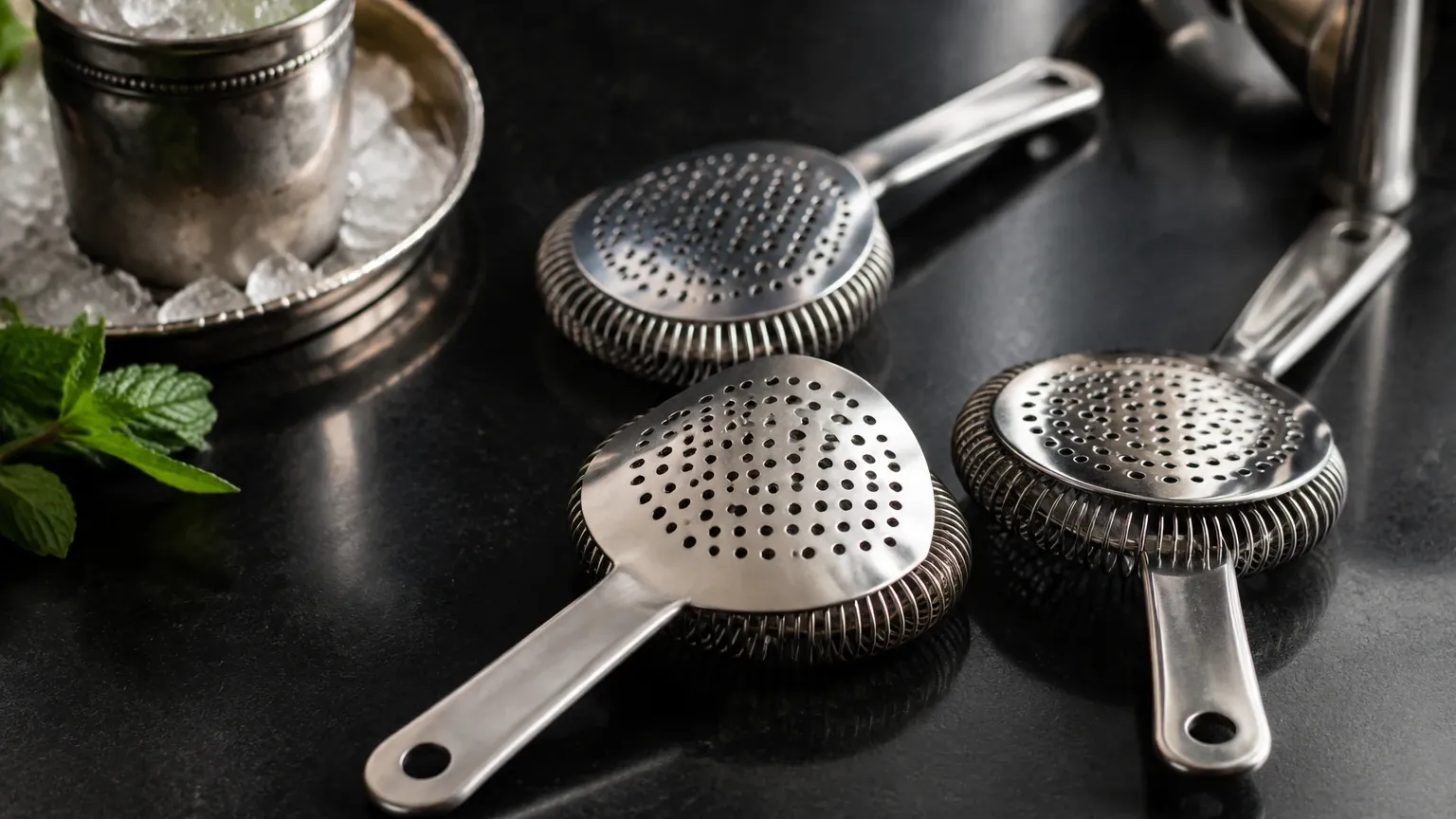
The julep strainer is defined by its bowl-shaped, perforated design, typically featuring a handle for manual operation or placement within a vessel. Unlike spring-loaded Hawthorne strainers or fine-mesh wire filters, the julep strainer relies on fixed-diameter perforations in a rigid metal sheet. This design offers several mechanical advantages in an industrial context:
1. Structural Rigidity: Because the filtration media is a solid sheet of stainless steel rather than a woven mesh, it is highly resistant to deformation. This is essential when dealing with high-viscosity fluids or when mechanical pressure is applied to the solids being retained.
2. Laminar Flow Control: The concave shape of the bowl is engineered to direct fluid flow toward the center, reducing splashing and ensuring that the liquid passes through the perforations at a controlled velocity. This is particularly important in precision dosing or sampling applications.
3. Ease of Sterilization: The absence of coils, springs, or tight wire intersections makes these strainers ideal for Sanitary (Hygienic) applications. There are no "dead zones" where organic matter or chemicals can accumulate, facilitating simplified Clean-in-Place (CIP) or autoclave sterilization processes.
Material Selection: SS304 vs. SS316L
In B2B procurement, material selection is the primary factor in determining the total cost of ownership. For julep strainers used in industrial environments, stainless steel is the industry standard due to its corrosion resistance and mechanical strength.
Stainless Steel 304
Grade 304 is the most common choice for general food and beverage applications. It provides excellent resistance to atmospheric corrosion and is suitable for most aqueous solutions. However, in environments with high chloride concentrations or exposure to harsh sanitizing chemicals, 304 may be susceptible to pitting.
Stainless Steel 316L
For pharmaceutical processing or applications involving acidic fruit juices and brines, SS316L is the preferred specification. The addition of molybdenum enhances its resistance to chloride-induced corrosion. The "L" designation (low carbon) is critical for components that require welding during the manufacturing process, as it prevents carbide precipitation and ensures the integrity of the handle-to-bowl joint.
Precision Perforation and Filtration Accuracy
The performance of julep strainers is measured by their ability to retain specific particulate sizes while allowing the filtrate to pass without excessive backpressure. Engineering teams must evaluate the following perforation metrics:
* Hole Diameter: Standard industrial julep strainers typically feature hole diameters ranging from 1.5mm to 3.0mm. Smaller perforations provide finer filtration but may increase the risk of clogging (blinding) if the fluid contains high concentrations of solids.
* Open Area Percentage: This refers to the ratio of the total area of the holes to the total area of the bowl. A higher open area percentage reduces flow resistance, which is vital for high-volume manual processing. However, if the open area is too high, the structural integrity of the stainless steel sheet may be compromised.
* Pattern Distribution: Staggered hole patterns are generally preferred over straight-line patterns. Staggering increases the number of holes per square inch, optimizing the filtration surface and ensuring that the fluid does not "channel" through specific sections of the strainer.
Integration into Industrial Workflows
While often viewed as standalone tools, julep strainers are frequently integrated into larger Strainers & Baskets systems as secondary or tertiary filtration stages. Their utility spans several sectors:
Food and Beverage Manufacturing
In the production of botanical extracts, syrups, and craft beverages, these strainers are used to remove large organic solids (seeds, leaves, or pulp) before the liquid moves to fine-mesh or membrane filtration. The rigid bowl allows operators to press the solids, extracting maximum yield without damaging the filter media.
Pharmaceutical and Laboratory Use
Laboratories utilize precision-engineered strainers for gravity-fed filtration of coarse precipitates. Because they can be manufactured to strict Ra (roughness average) standards through electropolishing, they meet the requirements for non-reactive, non-contaminating equipment in sensitive chemical environments.
Small-Batch Chemical Processing
For specialty chemicals where batch sizes do not justify automated filtration systems, manual perforated strainers provide a cost-effective and reliable method for removing impurities or recovering catalysts.
Manufacturing and Customization Capabilities
Kaifil specializes in the OEM manufacturing of filtration components, allowing for the customization of julep strainers to meet specific engineering requirements. Customization options often include:
* Handle Ergonomics and Length: For use in deep industrial vats or specialized mixing vessels, handle lengths can be extended or reinforced with heavy-duty mounting brackets.
* Surface Finishes: Beyond standard polishing, we offer electropolishing to achieve a mirror finish. This process removes microscopic peaks and valleys on the metal surface, significantly improving the component's resistance to bacterial growth and chemical adhesion.
* Custom Hole Sizes: If a standard 2mm perforation does not meet the particle retention requirements of a specific process, custom CNC punching or laser drilling can be employed to achieve precise micron-equivalent ratings.
* Reinforced Rims: To prevent warping under heavy mechanical loads, the outer rim of the strainer bowl can be thickened or reinforced with a secondary stainless steel ring.
Selection Criteria for Purchasing Teams
When evaluating suppliers for industrial strainers, purchasing teams should confirm the following technical details to ensure the product is fit for purpose:
1. Compliance Standards: Does the strainer meet FDA or 3A sanitary standards? This is non-negotiable for food and pharmaceutical applications.
2. Durability Testing: What is the gauge of the stainless steel sheet? For industrial use, a thickness of 0.8mm to 1.2mm is typically required to prevent denting and bending.
3. Connection Integrity: In B2B environments, the point where the handle meets the bowl is a common failure point. Look for full-circumference welding or heavy-duty spot welding that has been smoothed to eliminate crevices.
4. Total Cost Considerations: While a lower-grade alloy may reduce initial costs, the frequency of replacement due to corrosion or mechanical failure often makes high-grade SS316L more cost-effective over the long term.
Maintenance and Replacement Cycles
To maintain the efficiency of Strainers & Baskets, a standardized maintenance protocol is required. Julep strainers should be inspected regularly for:
* Perforation Blinding: Over time, mineral deposits or organic fats can build up inside the holes. Regular ultrasonic cleaning or chemical descaling is recommended to restore the open area percentage.
* Stress Cracking: Repetitive mechanical pressure can lead to fatigue at the handle joint. Visual inspections should look for hairline fractures that could harbor contaminants.
* Surface Degradation: If the surface becomes scratched or pitted, its sanitary properties are compromised. Components with visible surface damage should be decommissioned and replaced to ensure batch consistency and safety.
Conclusion
Julep strainers represent a critical intersection of traditional design and modern industrial engineering. By focusing on material quality, precision perforation, and sanitary manufacturing techniques, Kaifil provides filtration solutions that withstand the rigors of demanding industrial environments. Whether used in a laboratory setting or as part of a large-scale food production line, these components ensure that liquid-solid separation is achieved with accuracy and reliability. For technical teams seeking to optimize their filtration processes, understanding these engineering nuances is the first step toward achieving superior performance and long-term durability.
