


Liquid Strainers Filters
In industrial fluid handling, the integrity of downstream equipment—such as pumps, flow meters, valves, and heat exchangers—is directly tied to the quality of the primary filtration stage. Liquid strainers filters serve as the essential first line of defense, removing macroscopic solids and contaminants from process streams. While the terms "strainer" and "filter" are often used interchangeably in casual conversation, in an engineering context, liquid strainers filters specifically refer to components designed to remove larger particles, typically measured in mesh sizes or microns, to prevent mechanical damage and maintain system efficiency.
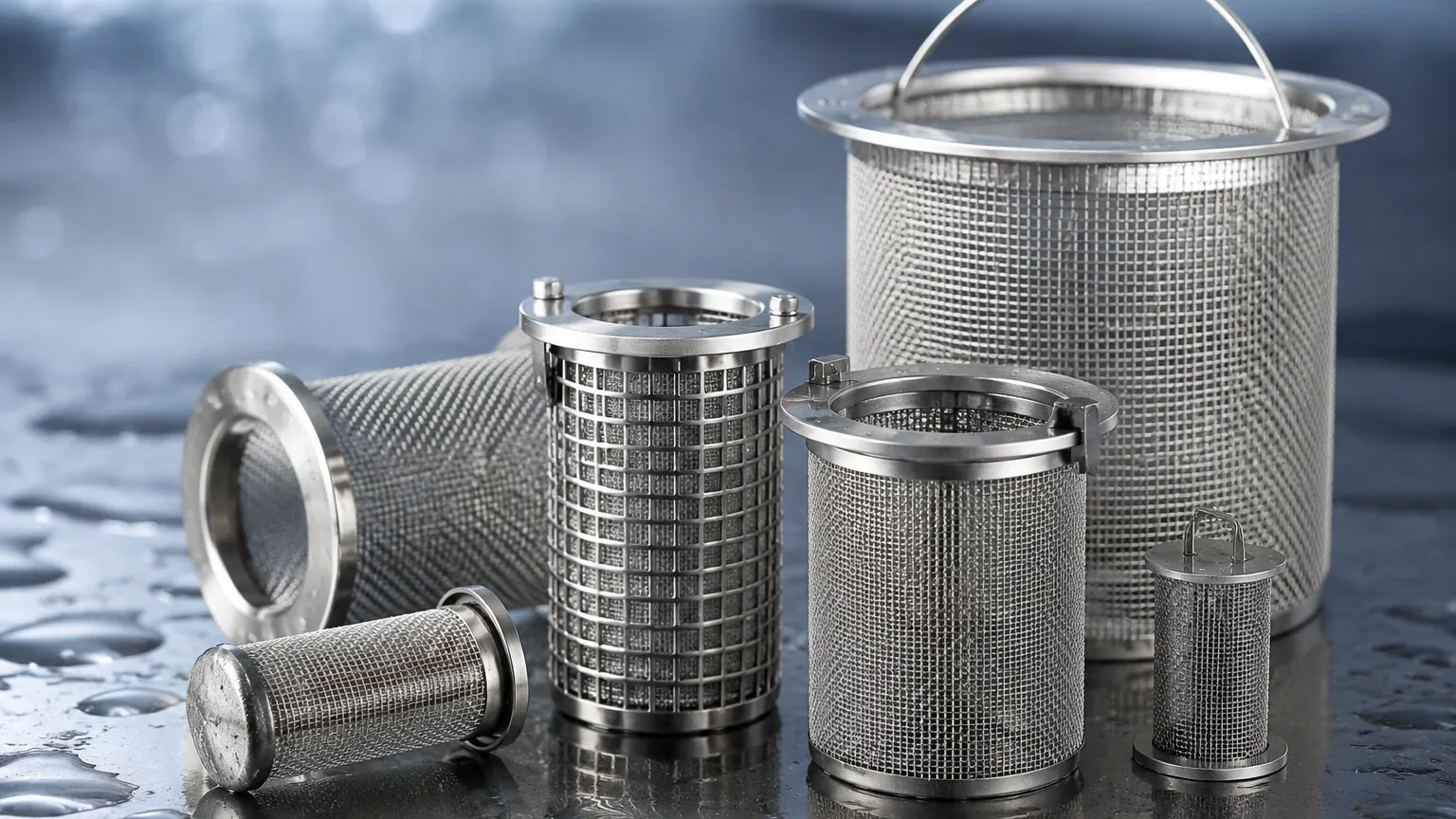
Selecting the correct Strainers & Baskets requires a deep understanding of fluid dynamics, material compatibility, and the specific mechanical requirements of the application. For engineers and procurement teams, the goal is to balance effective particle capture with minimal pressure drop and long-term durability.
The Engineering Distinction Between Straining and Filtration
To optimize a system, it is necessary to distinguish between straining and filtration. Straining is generally defined as the removal of larger particles (typically 40 microns and above) from a liquid using a perforated screen or wire mesh. This process is often characterized by a high flow rate and low pressure drop. Filtration, conversely, usually involves the removal of much smaller particles (often sub-micron) using disposable media or specialized membranes.
In most B2B industrial environments, liquid strainers filters are permanent or semi-permanent installations. The internal element, often a basket or a screen, is designed to be cleaned and reused rather than replaced after every cycle. This makes the selection of the base material and the structural design of the basket critical to the total cost of ownership (TCO).
Core Types of Industrial Strainers and Baskets
The geometry of a strainer determines its suitability for specific piping layouts and flow requirements. Understanding these configurations is the first step in technical selection.
Simplex Basket Strainers
Simplex strainers are used in systems where the flow can be interrupted for cleaning. They feature a single basket chamber. When the pressure differential reaches a predetermined limit, the system is shut down, the chamber is opened, and the basket is removed for cleaning. These are ideal for batch processing or systems with redundant piping loops.
Duplex (Twin) Strainers
For continuous processes where downtime is not an option—such as in chemical plants or power generation—duplex strainers are required. These units consist of two separate strainer chambers connected by a diversion valve. When one basket becomes clogged, the flow is diverted to the clean chamber, allowing the operator to service the dirty basket without stopping the process.
Y-Strainers
Y-strainers are characterized by their compact, "Y" shaped design. They are typically used for applications with low concentrations of solids, such as steam or gas lines, or where space is severely limited. While they offer a lower holding capacity than basket strainers, they are highly effective for protecting sensitive equipment in high-pressure environments.
Custom Basket Inserts
Many industrial applications require bespoke Strainers & Baskets designed to fit existing housings. Customization often involves modifying the handle design for easier extraction, adding magnetic inserts to capture fine ferrous particles, or reinforcing the mesh with perforated metal to withstand high-velocity flow or pressure surges.
Material Selection and Chemical Compatibility
The performance of liquid strainers filters is heavily dependent on the metallurgy of the filter element. In industrial filtration, stainless steel is the standard due to its mechanical strength and resistance to corrosion.
1. Stainless Steel 304: The most common grade, offering excellent durability and resistance to atmospheric corrosion. It is suitable for water treatment, food and beverage, and general industrial applications.
2. Stainless Steel 316/316L: Contains molybdenum, which provides superior resistance to chlorides and acids. This is the preferred choice for chemical processing, pharmaceutical manufacturing, and marine environments where 304-grade steel might suffer from pitting.
3. Specialty Alloys: For highly aggressive environments involving high temperatures or extreme pH levels, alloys like Monel, Hastelloy, or Inconel may be required to prevent premature failure of the mesh.
When specifying materials, engineers must consider the fluid's pH, temperature, and the potential for galvanic corrosion if the strainer basket material differs significantly from the housing or piping material.
Technical Parameters: Mesh, Micron, and Open Area Ratio
Defining the "tightness" of a strainer is a critical engineering decision. Over-filtering (selecting a mesh that is too fine) leads to frequent clogging and excessive pressure drop, while under-filtering allows damaging debris to pass through.
Mesh vs. Micron
* Mesh Size: Refers to the number of openings per linear inch. A higher mesh count indicates smaller openings.
* Micron Rating: Refers to the actual size of the particles that can pass through the mesh (1 micron = 0.001 mm).
The Importance of Open Area Ratio (OAR)
The Open Area Ratio is the relationship between the total area of the openings in the strainer basket and the cross-sectional area of the inlet pipe. A well-designed strainer should have an OAR of at least 6:1 or 8:1. A high OAR ensures that even as the basket begins to collect debris, the pressure drop remains low, and the interval between cleanings is maximized. If the OAR is too low, the fluid velocity through the mesh increases, which can cause particle bypass or even structural collapse of the basket.
Engineering Considerations for High-Pressure Applications
In hydraulic systems or high-pressure chemical lines, liquid strainers filters are subjected to significant mechanical stress. Standard wire mesh may not have the structural integrity to withstand the differential pressure ($\\Delta P$) that occurs when the basket is nearly full.
To address this, industrial baskets are often constructed using a multi-layer approach:
* Support Layer: A heavy-duty perforated metal cylinder provides the primary structural strength.
* Filtration Layer: A fine stainless steel wire mesh is sintered or mechanically fastened to the support layer to provide the required micron rating.
* Outer Guard: In some cases, an outer layer of mesh or perforated metal is added to protect the fine filtration layer during handling and cleaning.
Engineers must calculate the "burst pressure" of the basket to ensure that even under maximum pump pressure, the strainer will not fail and send shards of metal or accumulated debris downstream.
Maintenance, Replacement Cycles, and TCO
The Total Cost of Ownership (TCO) of liquid strainers filters is not defined by the initial purchase price, but by the operational costs associated with cleaning, downtime, and equipment protection.
Monitoring Pressure Drop
The most effective way to manage maintenance is through differential pressure monitoring. By installing pressure gauges upstream and downstream of the strainer, operators can identify exactly when the basket needs cleaning. A common rule of thumb is to clean the basket when the pressure drop reaches 5-10 psi over the clean-start pressure.
Cleaning Procedures
Stainless steel baskets are typically cleaned using ultrasonic baths, high-pressure water jets, or chemical cleaning (backwashing). It is vital to ensure that the cleaning method does not damage the wire mesh. For example, using a wire brush on fine mesh can distort the openings, effectively changing the micron rating of the filter.
When to Replace
While stainless steel baskets are durable, they are not infinite. Signs that a basket requires replacement include:
* Visible deformation or "bowing" of the basket walls.
* Frayed wires or broken welds in the mesh.
* Persistent clogging that cannot be removed by standard cleaning methods (blinding).
Customization: Solving Specific Filtration Challenges
Standard off-the-shelf liquid strainers filters often fail to meet the nuances of specialized industrial processes. Custom manufacturing allows for the optimization of every component. For instance, in the food and beverage industry, baskets must feature sanitary welds and polished surfaces to prevent bacterial growth. In the oil and gas sector, baskets might need to be designed with reinforced handles to allow for extraction via overhead cranes.
Customization also extends to the filtration media itself. Depending on the particle shape (e.g., long fibers vs. spherical beads), different weave patterns such as plain weave, twilled weave, or Dutch weave can be employed to optimize capture efficiency and release characteristics during cleaning.
Selection Checklist for Purchasing Teams
Before finalizing a specification for Strainers & Baskets, technical teams should confirm the following data points:
1. Fluid Properties: Viscosity, density, and chemical composition.
2. Flow Conditions: Minimum, normal, and maximum flow rates.
3. Operating Pressure & Temperature: Both normal operating and maximum design limits.
4. Contaminant Profile: Type of solids, particle size distribution, and expected loading (ppm).
5. Target Particle Size: The maximum allowable particle size that can safely pass downstream.
6. Connection Standards: Flanged (ANSI, DIN, JIS), NPT, or socket weld.
7. Space Constraints: Horizontal vs. vertical installation and clearance for basket removal.
By addressing these factors during the design phase, industrial facilities can ensure that their liquid strainers filters provide reliable protection, minimize energy consumption through low pressure drops, and contribute to a more stable and predictable production environment.
