


Liquid Strainers
In industrial fluid handling, the integrity of downstream equipment—such as pumps, valves, flow meters, and heat exchangers—depends heavily on the efficiency of primary filtration. Liquid strainers serve as the critical first line of defense, mechanically removing unwanted solids from process streams. While often categorized generally with filters, strainers are specifically engineered to handle larger particulate loads and are typically designed for easy maintenance and reuse.
For engineers and procurement professionals, selecting the appropriate Strainers & Baskets involves more than matching pipe diameters. It requires a comprehensive understanding of fluid dynamics, material compatibility, and the specific debris profile of the application. This guide examines the technical nuances of liquid strainers, providing the factual foundation necessary for informed industrial selection.
Understanding the Role of Liquid Strainers in Industrial Systems
Liquid strainers are closed vessels with a cleanable screen or basket designed to remove and retain foreign particles. The primary distinction between a strainer and a filter is the size of the particles removed. Strainers typically address particles visible to the naked eye (75 microns and larger), whereas filters target microscopic contaminants.
In a B2B context, liquid strainers are essential for protecting high-value assets. For example, in a cooling water loop, a basket strainer prevents scale and pipe rust from entering a heat exchanger, which would otherwise lead to fouling and reduced thermal efficiency. In chemical processing, they ensure that raw materials are free of clumps before entering a reactor. The goal is not necessarily to achieve high-purity fluid, but to ensure the "mechanical cleanliness" of the system.
Key Types of Strainers and Baskets
The geometry of a strainer determines its capacity, pressure drop characteristics, and ease of maintenance. Choosing the right configuration is the first step in engineering a reliable filtration solution.
Y-Strainers
Named for their shape, Y-strainers are typically used in applications where the amount of material to be removed is small, and where frequent cleanout is not required. They are compact and can be installed in either horizontal or vertical positions. Because the debris collection leg is angled, Y-strainers are often preferred for high-pressure liquid or steam lines. However, their dirt-holding capacity is lower than that of basket designs.
Simplex Basket Strainers
Simplex strainers feature a vertical cylinder that houses a removable basket. These are the workhorses of liquid filtration in the food and beverage and water treatment sectors. They offer a much larger surface area than Y-strainers, resulting in a lower initial pressure drop and longer intervals between cleanings. A simplex strainer requires the flow to be shut down or diverted during basket maintenance.
Duplex Basket Strainers
For processes that cannot be interrupted, duplex strainers provide a continuous filtration solution. These units consist of two separate strainer chambers connected by a diverter valve. When one basket becomes clogged, the operator can switch the flow to the clean chamber without stopping the process. This is critical in hydraulic systems, fuel oil lines, and continuous chemical production where downtime is cost-prohibitive.
Technical Specifications and Material Selection
The performance of liquid strainers is inextricably linked to the materials used in their construction. Industrial environments often involve corrosive fluids, high temperatures, or strict sanitary requirements, making material selection a primary engineering hurdle.
Stainless Steel Construction
Stainless steel is the industry standard for high-performance liquid strainers. Grade 304 stainless steel offers excellent general corrosion resistance and is suitable for most water and food-grade applications. For more aggressive environments, such as those involving chlorides or acidic chemicals, Grade 316 stainless steel is preferred due to the addition of molybdenum, which enhances pitting resistance.
Mesh and Perforation Standards
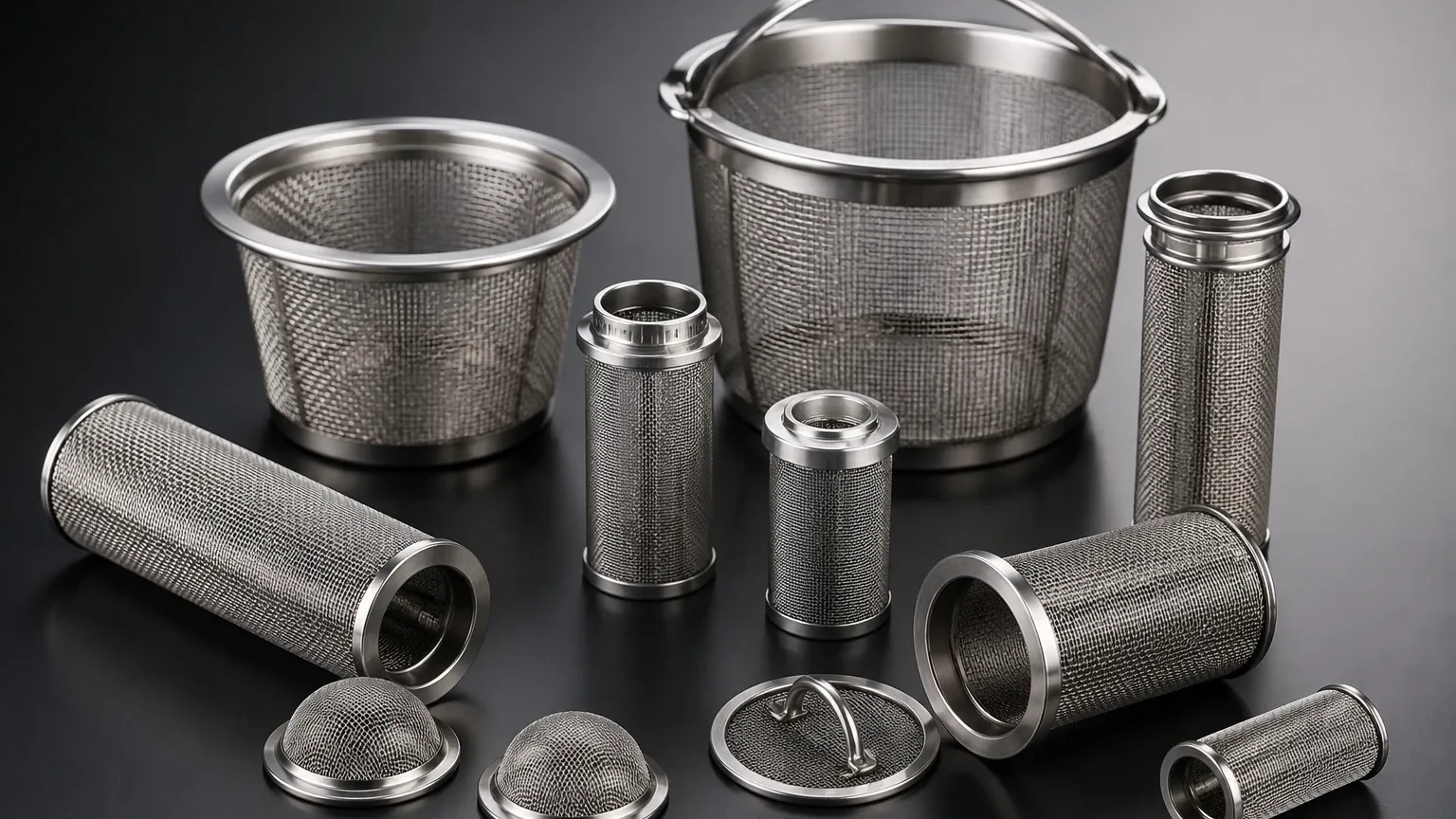
The internal element—the basket—is usually constructed from perforated metal or wire mesh. Perforated plate provides structural rigidity and is used for coarse straining. For finer filtration, a wire mesh lining is added to the interior of the perforated basket. Engineers must specify the "open area ratio," which is the ratio of the total area of the holes to the total area of the screen. A higher open area ratio leads to a lower pressure drop and longer service life.
Gasket and Seal Compatibility
The choice of sealing material is as important as the metal housing. Common options include:
* EPDM: Excellent for water and dilute acids.
* Viton (FKM): Preferred for high temperatures and hydrocarbon-based fluids.
* PTFE: Used for extreme chemical resistance across a wide temperature range.
Evaluating Filtration Performance: Mesh Size vs. Micron Rating
One of the most common points of confusion in specifying liquid strainers is the relationship between mesh count and micron rating.
* Mesh Count: Refers to the number of openings per linear inch. As the mesh count increases, the size of the openings decreases. For instance, a 20-mesh screen has larger openings than a 100-mesh screen.
* Micron Rating: Defines the actual size of the particles that can pass through the screen. 1 micron is equal to one-thousandth of a millimeter.
When selecting a strainer basket, engineers must define the "allowable particle size." If the downstream equipment can tolerate particles up to 200 microns, selecting a 50-micron strainer is counterproductive, as it will clog too quickly and increase maintenance costs without providing additional protection. The objective is to select the coarsest possible screen that still protects the downstream components.
Operational Considerations: Pressure Drop and Flow Velocity
Every liquid strainer introduces a restriction into the piping system, resulting in a pressure drop ($ΔP$). This is a critical factor in system design, as excessive pressure drop can lead to cavitation in pumps or insufficient flow at the point of use.
The Clean Pressure Drop
This is the $ΔP$ across a brand-new or freshly cleaned strainer. It is influenced by the fluid's viscosity, density, and flow velocity. As a rule of thumb, the clean pressure drop should not exceed 2 psi (0.14 bar) for most industrial liquid applications.
The Dirty Pressure Drop
As debris accumulates in the basket, the available open area decreases, and the pressure drop rises exponentially. Most industrial strainers are equipped with differential pressure gauges. A common industry standard is to clean or replace the basket when the pressure drop reaches 10-15 psi above the clean reading. Operating beyond this point risks collapsing the basket or forcing contaminants through the mesh.
Flow Velocity Limits
To prevent erosion of the strainer housing and to ensure efficient particle separation, liquid velocities should generally be kept below 10 feet per second (3 meters per second). High-velocity flow can also cause "particle bypass," where flexible or soft contaminants are forced through the mesh openings by the sheer force of the fluid.
Customization and OEM Solutions for Demanding Applications
Standard off-the-shelf strainers often fail to meet the specific needs of specialized industrial processes. This is where custom manufacturing and OEM expertise become vital. Customization options for liquid strainers include:
1. Non-Standard Dimensions: Modifying face-to-face lengths to fit into existing piping footprints without requiring extensive plumbing changes.
2. Reinforced Baskets: For high-pressure applications where the differential pressure might cause a standard basket to buckle, heavy-duty support cages or thicker perforated plates are utilized.
3. Specialized Coatings: Applying PTFE or epoxy linings to carbon steel housings to provide chemical resistance at a lower cost than solid stainless steel.
4. Heating Jackets: In applications involving viscous fluids like bitumen or chocolate, steam or electric heating jackets ensure the fluid remains at a temperature that allows it to flow easily through the strainer.
By working with a manufacturer that understands these variables, engineers can develop filtration components that are optimized for the specific rheology of their process fluid.
Maintenance Protocols and Replacement Cycles
The longevity of Strainers & Baskets is largely dependent on the rigor of the maintenance program. Unlike disposable filters, strainer baskets are designed to be cleaned and reused, but they are not indestructible.
Cleaning Procedures
Baskets should be cleaned using methods that do not damage the wire mesh. High-pressure water jets or ultrasonic cleaning are effective for removing stubborn debris. Wire brushes should be used with caution, as they can fray the mesh or enlarge the openings, compromising the filtration accuracy.
Inspection for Wear
During every cleaning cycle, the basket should be inspected for:
* Broken Welds: Especially at the seam or where the mesh attaches to the flange.
* Thinning Metal: Signs of erosion or corrosion that might lead to structural failure.
* Gasket Integrity: Hardened or cracked gaskets must be replaced immediately to prevent bypass leakage.
Total Cost of Ownership (TCO)
While the initial purchase price of a high-quality stainless steel liquid strainer is higher than that of plastic or carbon steel alternatives, the TCO is often lower. Stainless steel's durability reduces the frequency of basket replacements and prevents unplanned downtime. Furthermore, a well-designed strainer with a low pressure drop reduces the energy requirements of the system's pumps over the life of the installation.
Critical Information for Procurement and Engineering Teams
Before finalizing a specification for liquid strainers, technical teams should confirm the following data points to ensure application compatibility:
* Fluid Properties: Specific gravity, viscosity at operating temperature, and chemical composition.
* Operating Conditions: Maximum operating pressure, design temperature, and flow rate (minimum, normal, and maximum).
* Debris Characteristics: The nature of the solids (hard, soft, fibrous), the expected concentration (ppm), and the required particle retention size.
* Connection Standards: Flanged (ANSI, DIN, JIS), NPT threaded, or socket weld.
* Certification Requirements: Does the application require ASME code stamping, FDA compliance for food contact, or specific material traceability (MTRs)?
By addressing these factual boundaries, organizations can ensure that their liquid strainers provide reliable, long-term protection for their industrial infrastructure. Precise filtration is not merely about removing solids; it is about maintaining the operational equilibrium of the entire fluid system.
