


Strainer Line
In industrial fluid handling, a strainer line represents a critical defensive infrastructure designed to protect downstream equipment from damage caused by particulate matter. Whether in chemical processing, water treatment, or food production, the integration of a well-engineered strainer line ensures the longevity of pumps, valves, heat exchangers, and flow meters. Unlike fine filtration systems that target microscopic contaminants, industrial strainers are primarily utilized to remove larger solids that could cause mechanical failure or process contamination.
Selecting the correct components for a strainer line requires a deep understanding of fluid dynamics, material compatibility, and the specific mechanical requirements of the application. As a specialized manufacturer of stainless steel filtration solutions, Kaifil emphasizes the importance of precision engineering in the design and implementation of these systems.
Understanding the Role of a Strainer Line in Industrial Systems
A strainer line is an assembly of piping and specialized straining components installed to intercept debris within a process flow. The primary objective is to prevent "tramp" solids—such as pipe scale, welding slag, or foreign objects—from reaching sensitive mechanical components.
The distinction between a strainer and a filter is often defined by the size of the particles removed and the frequency of service. Strainers are typically designed for high-flow applications where the pressure drop must be kept to a minimum, and the particulates being captured are relatively coarse. In many heavy industrial environments, the strainer line serves as the first stage of protection, followed by finer filtration stages if necessary.
For engineers, the design of a strainer line involves balancing the need for effective particle removal with the requirement for continuous system operation. A failure to correctly size or specify the strainer can lead to excessive pressure drops, cavitation in pumps, or frequent system shutdowns for cleaning.
Key Configurations: Y-Strainers, Simplex, and Duplex Systems
The architecture of a strainer line is dictated by the process requirements and the physical space available in the facility. There are three primary configurations used in industrial settings:
Y-Strainers
These are the most common components in a strainer line where space is limited and the amount of material to be removed is relatively small. The "Y" shape allows for the collection of debris in a leg that can be blown down or cleaned without removing the entire unit from the line. They are frequently used in steam, gas, or liquid lines where high pressure is a factor.
Simplex Basket Strainers
For applications requiring higher dirt-holding capacity, simplex basket strainers are the standard choice. These units feature a top-loading basket that provides a significantly larger surface area than a Y-strainer. A simplex unit is ideal for batch processes where the strainer line can be temporarily shut down for basket cleaning. When evaluating Strainers & Baskets, engineers must consider the ease of access for maintenance to minimize downtime.
Duplex (Twin) Strainers
In critical processes that cannot be interrupted, a duplex strainer line is essential. These systems consist of two separate strainer chambers connected by a diverter valve. When one basket becomes clogged, the flow is switched to the second chamber, allowing the first to be cleaned while the process continues at full capacity. This is common in hydraulic systems, cooling water loops, and continuous chemical manufacturing.
Material Selection and Engineering Specifications
The durability of a strainer line depends heavily on the materials used in its construction. In demanding industrial environments, stainless steel is the preferred material due to its mechanical strength and resistance to corrosion.
1. Stainless Steel 304: Suitable for general industrial use, offering good corrosion resistance and cost-effectiveness for water and mildly corrosive fluid applications.
2. Stainless Steel 316/316L: The industry standard for chemical processing, pharmaceuticals, and marine environments. The addition of molybdenum provides superior resistance to chlorides and pitting.
3. Specialty Alloys: For highly aggressive environments involving concentrated acids or high temperatures, materials like Monel or Hastelloy may be integrated into the strainer line components.
Beyond the housing material, the internal straining element—the basket or screen—must be engineered to withstand the differential pressure ($ΔP$) generated as it collects debris. Kaifil utilizes advanced manufacturing techniques to ensure that the mesh or perforated metal used in these baskets maintains its structural integrity under high-stress conditions.
Calculating Performance: Pressure Drop and Flow Capacity
One of the most critical aspects of designing a strainer line is calculating the allowable pressure drop. Every component in the line introduces a degree of resistance to the flow. As the strainer basket fills with debris, this resistance increases.
The Open Area Ratio (OAR)
The Open Area Ratio is the relationship between the total area of the openings in the strainer element and the internal cross-sectional area of the inlet pipe. A high-quality strainer line should typically aim for an OAR of at least 4:1. This ensures that even when the basket is 50% clogged, the pressure drop remains within acceptable limits. A lower ratio results in higher velocity through the mesh, which can lead to particle bypass or structural failure of the basket.
Viscosity and Specific Gravity
The physical properties of the fluid significantly impact the performance of the strainer line. High-viscosity fluids (such as heavy oils or syrups) require larger mesh openings or oversized strainer housings to prevent excessive pressure loss. Engineers must account for these variables during the selection process to ensure the system operates efficiently across all temperature ranges.
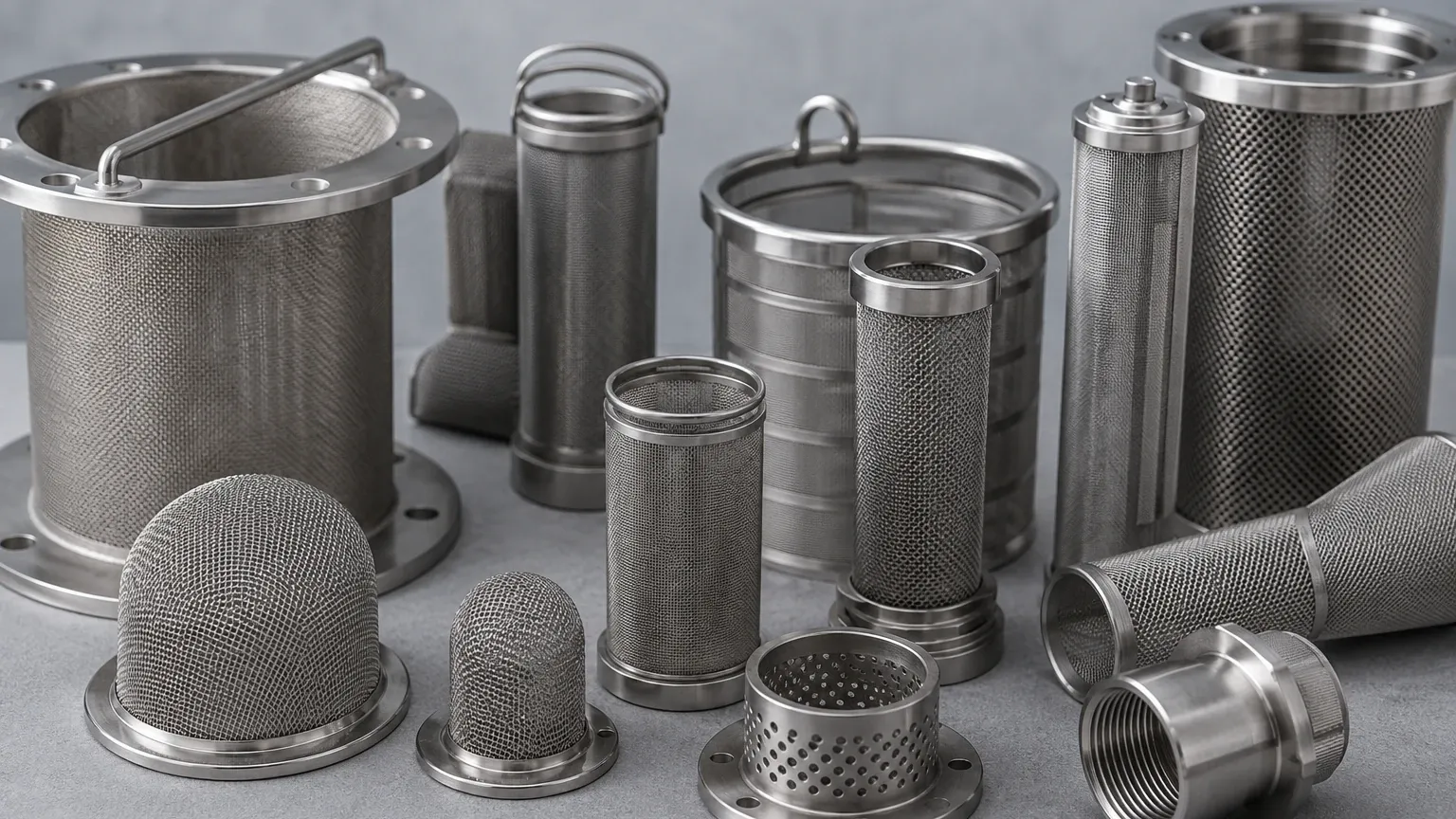
Selection Criteria for Industrial Strainers & Baskets
When specifying components for a strainer line, purchasing teams and engineers should confirm several technical parameters to ensure the solution is fit for purpose:
* Micron or Mesh Rating: The size of the smallest particle that must be captured. Using a mesh that is too fine will lead to rapid clogging, while a mesh that is too coarse will fail to protect downstream equipment.
* Connection Type: Whether the strainer line requires flanged, threaded, or socket-weld connections to match existing piping standards (e.g., ANSI, DIN, or JIS).
* Seal Compatibility: The choice of gaskets and O-rings (Viton, EPDM, PTFE) must be compatible with the chemical composition and temperature of the process fluid.
* Design Pressure and Temperature: The strainer housing must be rated for the maximum possible pressure and temperature of the system, including potential surges.
Customization is often required for unique applications. Kaifil provides OEM capabilities to modify basket designs, add magnetic inserts for ferrous metal removal, or apply specialized coatings for enhanced wear resistance.
Maintenance Protocols and Total Cost of Ownership
The effectiveness of a strainer line is only as good as its maintenance regime. A neglected strainer can become a bottleneck, causing pump cavitation or even rupturing, which allows contaminants to flood the downstream system.
Differential Pressure Monitoring
Installing pressure gauges upstream and downstream of the strainer is the most effective way to monitor its condition. A clear protocol should be established: for example, the basket must be cleaned when the differential pressure reaches 5-10 psi above the clean-start pressure.
Cleaning and Inspection
During maintenance, baskets should be inspected for signs of wire fatigue, corrosion, or bypass. In a stainless steel strainer line, the baskets are reusable and can be cleaned using ultrasonic baths, high-pressure washing, or chemical cleaning, depending on the nature of the debris. Regular inspection ensures that the Strainers & Baskets continue to perform at their original design specifications.
Total Cost of Ownership (TCO)
While the initial purchase price is a factor, the TCO of a strainer line includes maintenance labor, replacement parts, and the cost of potential downtime. Investing in high-quality stainless steel components reduces the frequency of replacements and ensures a longer service life, providing better value over the life of the plant.
Conclusion
A robust strainer line is an indispensable part of modern industrial fluid systems. By selecting the appropriate configuration, materials, and sizing parameters, engineers can significantly reduce the risk of equipment failure and process interruptions. Whether implementing a simple Y-strainer for a steam line or a complex duplex system for chemical manufacturing, understanding the technical nuances of fluid straining is essential for operational excellence. Kaifil continues to support global industries by providing precision-engineered filtration and straining solutions tailored to the most demanding applications.
