


Basket Strainers
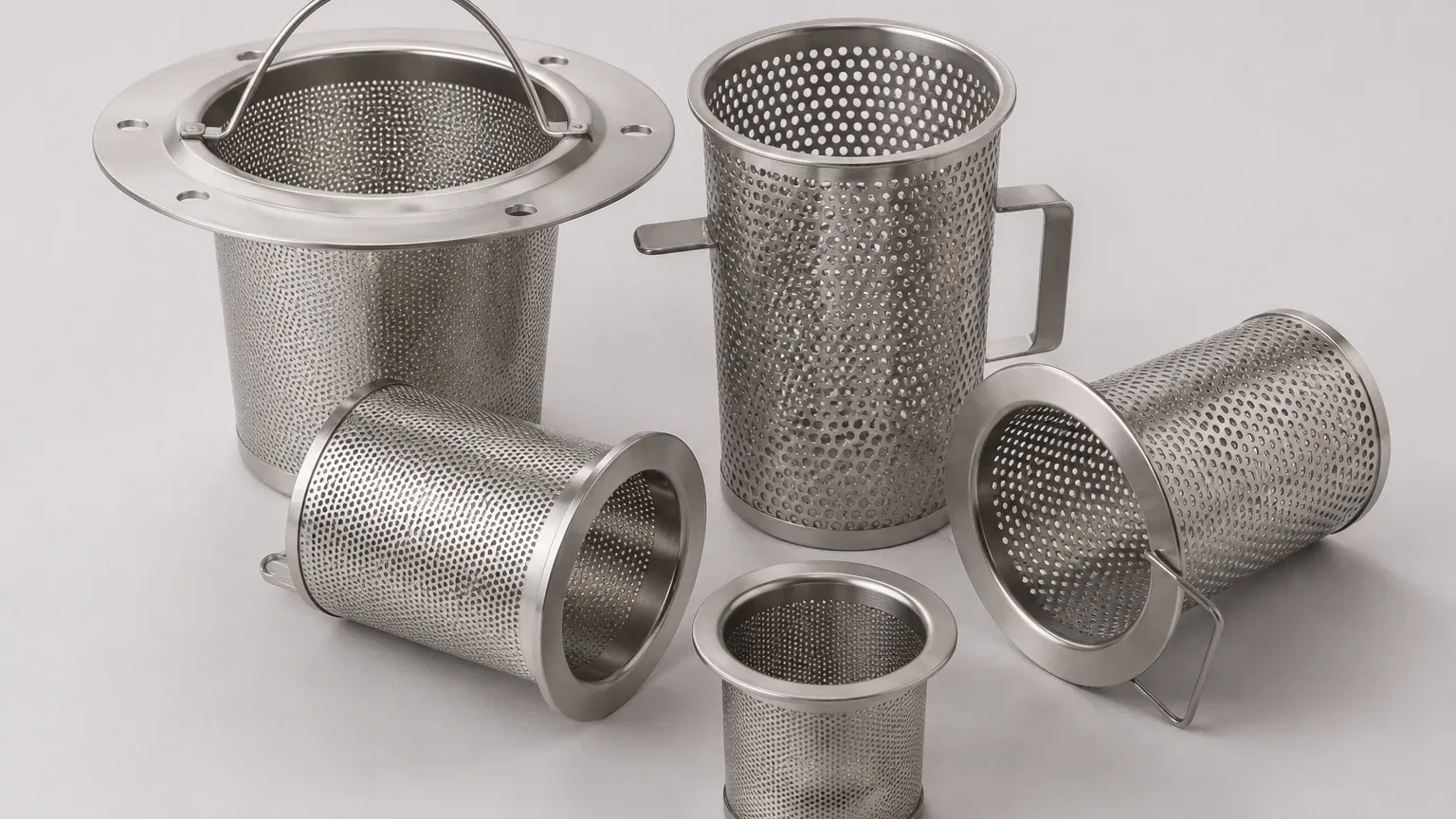
In industrial fluid handling systems, the protection of downstream equipment is a critical engineering priority. Basket strainers serve as the primary line of defense against particulate contamination, scale, and debris that can compromise the integrity of pumps, valves, meters, and spray nozzles. Unlike simpler Y-strainers, basket strainers are designed for applications requiring higher debris-holding capacity and easier maintenance access. As a specialized manufacturer of stainless steel filtration solutions, Kaifil provides engineered Strainers & Baskets that meet the rigorous demands of chemical processing, pharmaceutical production, and hydraulic systems.
Understanding the technical nuances of basket strainers—from material compatibility to flow dynamics—is essential for engineers and procurement teams tasked with optimizing system uptime and reducing the total cost of ownership (TCO).
The Functional Role of Basket Strainers in Industrial Piping
Basket strainers are closed vessels containing a removable screen or basket that intercepts solid particles from a flowing liquid or gas. Their primary advantage lies in their internal volume. Because the basket is typically much larger than the pipe diameter, it offers a significantly greater surface area for filtration than other strainer types. This results in a lower initial pressure drop and longer intervals between cleaning cycles.
From an engineering perspective, the efficiency of a basket strainer is defined by its ability to remove solids while maintaining a consistent flow rate. When fluid enters the strainer housing, it is directed into the basket. The solids are trapped within the basket, while the clean fluid passes through the mesh or perforated metal and exits through the outlet. This "top-in" or "side-in" configuration ensures that debris is contained within the basket, preventing it from falling back into the pipeline when the housing is opened for maintenance.
Material Selection and Chemical Compatibility
The performance and longevity of basket strainers are heavily dependent on the materials used for both the housing and the internal filtration element. In industrial environments, stainless steel is the standard due to its mechanical strength and resistance to corrosion.
Stainless Steel Grades
Kaifil specializes in custom stainless steel solutions, primarily utilizing 304 and 316 grades.
- Type 304 Stainless Steel: Suitable for general-purpose applications, including water treatment and food and beverage processing where moderate corrosion resistance is required.
- Type 316 Stainless Steel: Contains molybdenum, providing superior resistance to chlorides and acids. This is the preferred choice for pharmaceutical and chemical processing where aggressive cleaning agents or corrosive process fluids are present.
Gasket and Seal Selection
While the metal components provide structural integrity, the seals ensure the system remains leak-proof. Engineers must specify gasket materials based on the chemical nature of the fluid and the operating temperature. Common options include:
- EPDM: Excellent for water and steam applications.
- Viton (FKM): High-temperature resistance and compatibility with oils and chemicals.
- PTFE: Nearly universal chemical resistance, though with less elasticity than elastomers.
Evaluating Simplex vs. Duplex Basket Strainer Configurations
One of the most important decisions in the procurement process is determining whether the application requires a simplex or duplex configuration. This choice is dictated by the system's tolerance for downtime.
Simplex Basket Strainers
Simplex strainers consist of a single basket chamber. They are ideal for batch processes or systems where the flow can be temporarily halted to remove and clean the basket. They are cost-effective and have a smaller footprint. However, if the process requires continuous operation, a simplex strainer may become a bottleneck, as cleaning requires a complete system shutdown.
Duplex (Twin) Basket Strainers
For critical infrastructure where flow cannot be interrupted—such as cooling water for power plants or continuous chemical reactors—duplex basket strainers are necessary. These systems consist of two separate strainer chambers connected by a diverter valve. When one basket becomes clogged, the flow is diverted to the clean chamber, allowing the operator to service the dirty basket without stopping the process. This ensures 100% uptime and protects sensitive downstream components from the risks associated with flow surges or restarts.
Technical Parameters for Proper Sizing and Selection
Selecting the correct basket strainer involves more than matching the pipe size. Engineers must calculate several variables to ensure the unit performs as expected under operational loads.
1. Open Area Ratio (OAR)
The OAR is the ratio of the total open area of the strainer basket to the internal cross-sectional area of the inlet pipe. A higher OAR (e.g., 6:1 or 8:1) indicates that the strainer can handle more debris before the pressure drop becomes critical. For viscous fluids, a higher OAR is essential to prevent excessive flow restriction.
2. Micron and Mesh Ratings
The filtration accuracy is determined by the mesh size of the basket.
- Mesh Count: The number of openings per linear inch.
- Micron Rating: The actual size of the particles the mesh can intercept.
Kaifil provides customized mesh linings, ranging from coarse perforated plates for large debris to fine wire mesh for precision filtration. It is vital to select a mesh that is fine enough to protect equipment but not so fine that it clogs prematurely.
3. Clean Pressure Drop (ΔP)
Every strainer introduces some resistance to flow. The "clean pressure drop" is the loss in pressure when the basket is empty. If the initial ΔP is too high, it limits the available pressure for the rest of the system. Sizing should generally aim for a clean pressure drop of less than 2 psi (0.14 bar) at the design flow rate.
Maintenance Protocols and Operational Longevity
The primary cause of failure in basket strainers is neglected maintenance. As debris accumulates, the differential pressure increases. If the pressure exceeds the structural limits of the basket, it can collapse (burst), sending both the debris and fragments of the basket into the downstream equipment.
Differential Pressure Monitoring
Installing differential pressure (DP) gauges across the inlet and outlet of the strainer is the most effective way to monitor basket condition. Operators should establish a "red-line" pressure (typically 5 to 10 psi above clean pressure) at which the basket must be cleaned.
Cleaning Procedures
When servicing a basket strainer, the following steps are critical for safety and performance:
1. Isolation: Close the inlet and outlet valves.
2. Venting: Relieve internal pressure through the vent valve before opening the cover.
3. Draining: Use the drain plug to empty the fluid from the housing.
4. Inspection: After cleaning the basket, inspect the mesh for tears or signs of fatigue. A damaged basket should be replaced immediately rather than repaired, as patches can create flow imbalances.
Custom Engineering and OEM Solutions for Specialized Applications
Standard off-the-shelf strainers often fail to meet the specific requirements of complex industrial environments. Customization is where Kaifil’s manufacturing expertise provides the most value. Engineers can specify various modifications to optimize performance:
- Magnetic Inserts: For applications involving hydraulic oils or metalworking fluids, magnetic rods can be placed inside the basket to capture fine iron and steel particles that might otherwise pass through the mesh.
- Reinforced Baskets: In high-pressure systems or applications with high-velocity slugs of fluid, baskets can be reinforced with heavier perforated metal backings to prevent deformation.
- Custom Dimensions: When retrofitting existing plants, standard face-to-face dimensions may not fit. Custom-fabricated housings can be designed to match existing piping layouts precisely.
- Specialized Coatings: For extreme chemical environments, stainless steel baskets can be treated or coated to provide additional layers of protection against pitting and crevice corrosion.
Conclusion: Selecting the Right Filtration Partner
The selection of Strainers & Baskets is a balance between filtration efficiency, flow requirements, and maintenance practicalities. By focusing on high-quality stainless steel construction and precise engineering specifications, industrial operators can ensure the long-term reliability of their fluid handling systems.
Kaifil supports engineers and purchasing teams by offering technical guidance on material selection, filtration accuracy, and custom design. Whether the application involves protecting a high-pressure hydraulic pump or ensuring the purity of a pharmaceutical batch, the right basket strainer configuration is fundamental to operational success. When evaluating options, always confirm the chemical compatibility of all wetted parts, the required micron rating for downstream protection, and the expected debris load to determine the optimal cleaning frequency and strainer size.
