


Permanent Wire Strainers
In industrial fluid handling, the protection of downstream equipment—such as pumps, valves, flow meters, and heat exchangers—is a critical engineering priority. Permanent wire strainers serve as the primary line of defense, designed for long-term installation within a piping system to remove coarse particles and debris from liquids and gases. Unlike temporary start-up strainers, which are removed after the initial system flush, permanent wire strainers are engineered for durability, repeated cleaning cycles, and sustained performance under varying pressure and temperature conditions.
For engineers and procurement teams, selecting the correct strainer configuration requires a deep understanding of fluid dynamics, material science, and the specific requirements of the application. Whether the process involves chemical processing, food and beverage production, or hydraulic systems, the choice of a permanent wire strainer impacts both operational efficiency and the total cost of ownership.
Understanding the Role of Permanent Wire Strainers in Industrial Systems
Permanent wire strainers are stationary components integrated into pipelines to mechanically separate solids from a flowing medium. Their primary function is to prevent oversized particles from reaching sensitive components where they could cause mechanical wear, blockages, or process contamination.
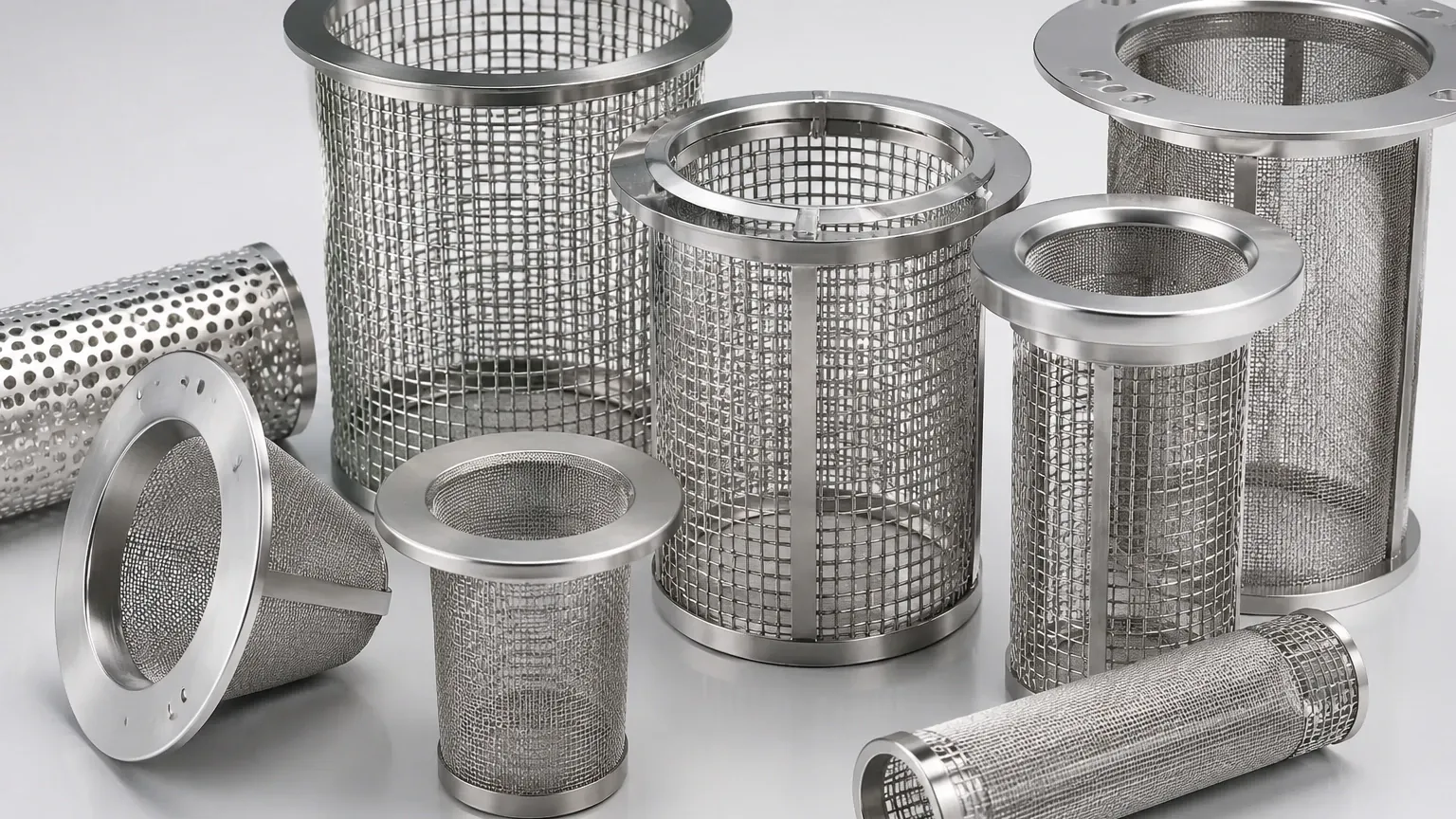
The term "permanent" distinguishes these components from conical or plate strainers used during the commissioning phase of a plant. While temporary strainers are often made of lighter materials and have limited dirt-holding capacity, permanent wire strainers feature robust housings and reinforced internal elements. These elements, often referred to as Strainers & Baskets, are designed to be serviced, cleaned, and reused throughout the lifespan of the facility.
In high-demand sectors like pharmaceutical manufacturing or water treatment, the reliability of these components is paramount. A failure in the strainer mesh or a bypass caused by poor sealing can lead to catastrophic damage to high-value equipment downstream, resulting in expensive downtime and repair costs.
Core Components: The Engineering Behind Strainers & Baskets
The performance of a strainer is largely determined by the design of its internal element. Most permanent wire strainers utilize a combination of a perforated metal support and a fine wire mesh overlay. This dual-layer construction provides the necessary structural integrity to withstand high differential pressures while maintaining precise filtration accuracy.
Wire Mesh vs. Perforated Plate
When evaluating permanent wire strainers, it is essential to distinguish between the straining media. Perforated plates are typically used for removing larger debris (1/32" to 1/2" or larger). However, for finer applications requiring micron-level precision, stainless steel wire mesh is employed. This mesh is woven from high-quality wire and can achieve filtration ratings as fine as 5 microns.
The Importance of the Open Area Ratio
A critical engineering metric in the design of Strainers & Baskets is the "open area ratio." This is the ratio of the total area of the holes in the strainer element to the cross-sectional area of the inlet pipe. A common industry standard is a 4:1 ratio. A higher ratio ensures a lower initial pressure drop and extends the time between cleaning cycles by providing more surface area for debris accumulation.
Material Selection and Chemical Compatibility
Material selection is perhaps the most significant factor in ensuring the longevity of permanent wire strainers. Industrial environments often involve corrosive fluids, extreme temperatures, and high-pressure surges.
1. Stainless Steel 304: The standard choice for general-purpose industrial applications, providing good corrosion resistance and mechanical strength at a cost-effective price point.
2. Stainless Steel 316/316L: Preferred for chemical processing and marine environments. The addition of molybdenum enhances resistance to pitting and crevice corrosion, particularly in chloride-rich environments. 316L (low carbon) is used where welding is required to prevent carbide precipitation.
3. Specialty Alloys: For highly aggressive media, such as concentrated acids or high-temperature steam, alloys like Monel, Hastelloy, or Duplex stainless steel may be required to prevent premature failure.
Beyond the metal itself, engineers must consider the sealing materials (O-rings and gaskets). Common choices include Viton, EPDM, and PTFE, each selected based on its compatibility with the process fluid and the operating temperature range.
Evaluating Filtration Efficiency and Micron Ratings
Selecting the appropriate filtration level is a balance between protecting downstream equipment and minimizing flow restriction. If the mesh is too coarse, harmful particles pass through. If it is too fine, the strainer will clog rapidly, leading to frequent maintenance and excessive pressure drops.
* Micron Rating: This defines the size of the smallest particle the mesh can reliably trap. In B2B procurement, it is vital to specify whether a "nominal" or "absolute" rating is required.
* Mesh Count: This refers to the number of openings per linear inch. As the mesh count increases, the wire diameter usually decreases, and the filtration becomes finer.
For applications involving viscous liquids, such as heavy oils or syrups, a coarser mesh may be necessary to maintain flow, even if it means slightly less protection. Conversely, in hydraulic systems where precision tolerances are measured in microns, a multi-layered permanent wire strainer with high-efficiency mesh is indispensable.
Operational Considerations: Pressure Drop and Flow Dynamics
Every strainer introduced into a piping system creates a pressure drop (Delta P). This is caused by the physical obstruction of the flow and the friction of the fluid passing through the mesh.
Calculating Clean Pressure Drop
Engineers must calculate the "clean pressure drop" to ensure the pump system has sufficient head to overcome the resistance. As the permanent wire strainers collect debris, the available open area decreases, and the pressure drop increases exponentially.
Differential Pressure Monitoring
In sophisticated industrial setups, differential pressure gauges are installed across the strainer inlet and outlet. These gauges provide a real-time indication of the strainer’s condition. A standard rule of thumb is to clean or replace the basket when the pressure drop reaches 10-15 psi above the clean state. Ignoring these signals can lead to "basket burst," where the differential pressure exceeds the structural strength of the mesh, causing it to collapse and release all collected debris into the system.
Customization and OEM Integration for Specialized Applications
Standard off-the-shelf strainers do not always meet the rigorous demands of specialized industrial processes. This is where custom-engineered permanent wire strainers become necessary. Manufacturers like Kaifil specialize in providing OEM solutions that tailor the strainer’s dimensions, materials, and filtration characteristics to specific system requirements.
Custom Basket Designs
For high-viscosity fluids or high-flow applications, a standard basket may not provide enough surface area. Customizations can include pleated mesh designs, which significantly increase the surface area within the same footprint, or reinforced baskets with internal supports to handle high-pressure surges.
Connection Types
Depending on the piping standards, strainers can be manufactured with flanged, threaded (NPT/BSP), or socket-weld connections. In the food and pharmaceutical industries, sanitary (Tri-Clamp) fittings are used to ensure there are no "dead zones" where bacteria can accumulate, allowing for Clean-in-Place (CIP) operations.
Maintenance Protocols and Total Cost of Ownership
While the initial purchase price of permanent wire strainers is a factor, the total cost of ownership (TCO) is driven by maintenance requirements and durability. A well-designed strainer should be easy to service to minimize downtime.
* Quick-Opening Covers: For systems requiring frequent cleaning, covers with swing bolts or notched clamps allow operators to access the basket without specialized tools, reducing labor time.
* Cleaning Methods: Stainless steel wire mesh can be cleaned using ultrasonic baths, high-pressure water jets, or chemical cleaning, depending on the nature of the contaminant. Proper cleaning extends the life of the element and maintains the efficiency of the system.
* Replacement Cycles: While the housing may last for decades, the internal wire mesh elements are wear parts. Keeping a stock of replacement baskets is a best practice for avoiding extended outages during a cleaning failure.
Common Risks and Mitigation Strategies
One of the most common risks in industrial filtration is "media migration." This occurs when the wire mesh breaks due to fatigue or corrosion, and fragments of the mesh itself move downstream. To mitigate this, engineers should specify high-quality, sintered mesh or reinforced weaves that offer better mechanical stability.
Another risk is improper installation. For example, Y-strainers must be installed with the "leg" pointing downward in horizontal lines to ensure debris is trapped by gravity. In vertical lines, they should only be used for downward flow. Failure to follow these orientation guidelines can result in debris falling back into the pipe during maintenance or improper clearing of the mesh.
Conclusion: Selecting the Right Solution
Choosing the right permanent wire strainers is a technical decision that requires balancing filtration precision, flow capacity, and material durability. By focusing on the specific needs of the application—whether it is the high-purity requirements of a pharmaceutical line or the rugged demands of a chemical plant—engineers can ensure long-term system protection and optimized performance.
When evaluating suppliers, it is crucial to confirm technical specifications such as the micron rating, pressure class, and material certifications. For those requiring specialized configurations or high-performance components, exploring professional Strainers & Baskets options is the first step toward a reliable filtration strategy. By partnering with a manufacturer that understands the nuances of industrial filtration, procurement teams can secure components that not only fit their systems but also enhance their operational resilience.
