


Pipe Strainers
In industrial fluid handling, the integrity of downstream equipment is directly linked to the cleanliness of the process media. Pipe strainers serve as the fundamental mechanical components designed to remove unwanted solids from liquid, gas, or steam lines by means of a perforated or wire mesh straining element. Unlike filters, which are typically designed to remove microscopic particles and are often disposed of after use, pipe strainers are generally intended to capture larger debris and are designed for repeated cleaning and reuse.
For engineers and procurement professionals, selecting the correct Strainers & Baskets is a critical decision that impacts system downtime, maintenance costs, and the lifespan of expensive components such as pumps, control valves, and flow meters. This guide explores the technical nuances of pipe strainers, focusing on design variations, material science, and engineering considerations essential for industrial applications.
The Functional Role of Pipe Strainers in Industrial Processes
Pipe strainers are often referred to as the "insurance policy" of a piping system. Their primary function is to protect sensitive equipment from damage caused by scale, rust, weld beads, or other foreign contaminants. In a typical industrial circuit, even a small amount of debris can cause significant issues:
* Pump Protection: Solids entering a centrifugal pump can erode impellers or clog internal passages, leading to cavitation and mechanical seal failure.
* Valve Preservation: In control valves, particulates can score the valve seat or plug, preventing a tight shut-off and necessitating frequent repairs.
* Heat Exchanger Efficiency: Debris accumulation in heat exchanger tubes creates fouling, which reduces heat transfer efficiency and increases energy consumption.
By implementing robust pipe strainers at strategic points—usually upstream of pumps and sensitive instrumentation—facilities can transition from reactive maintenance to a more predictable, proactive operational model.
Primary Designs: Y-Strainers vs. Basket Strainers
While various specialized designs exist, the majority of industrial applications utilize either Y-strainers or basket strainers. The choice between these two depends on the nature of the fluid, the expected debris load, and the allowable pressure drop.
Y-Strainers
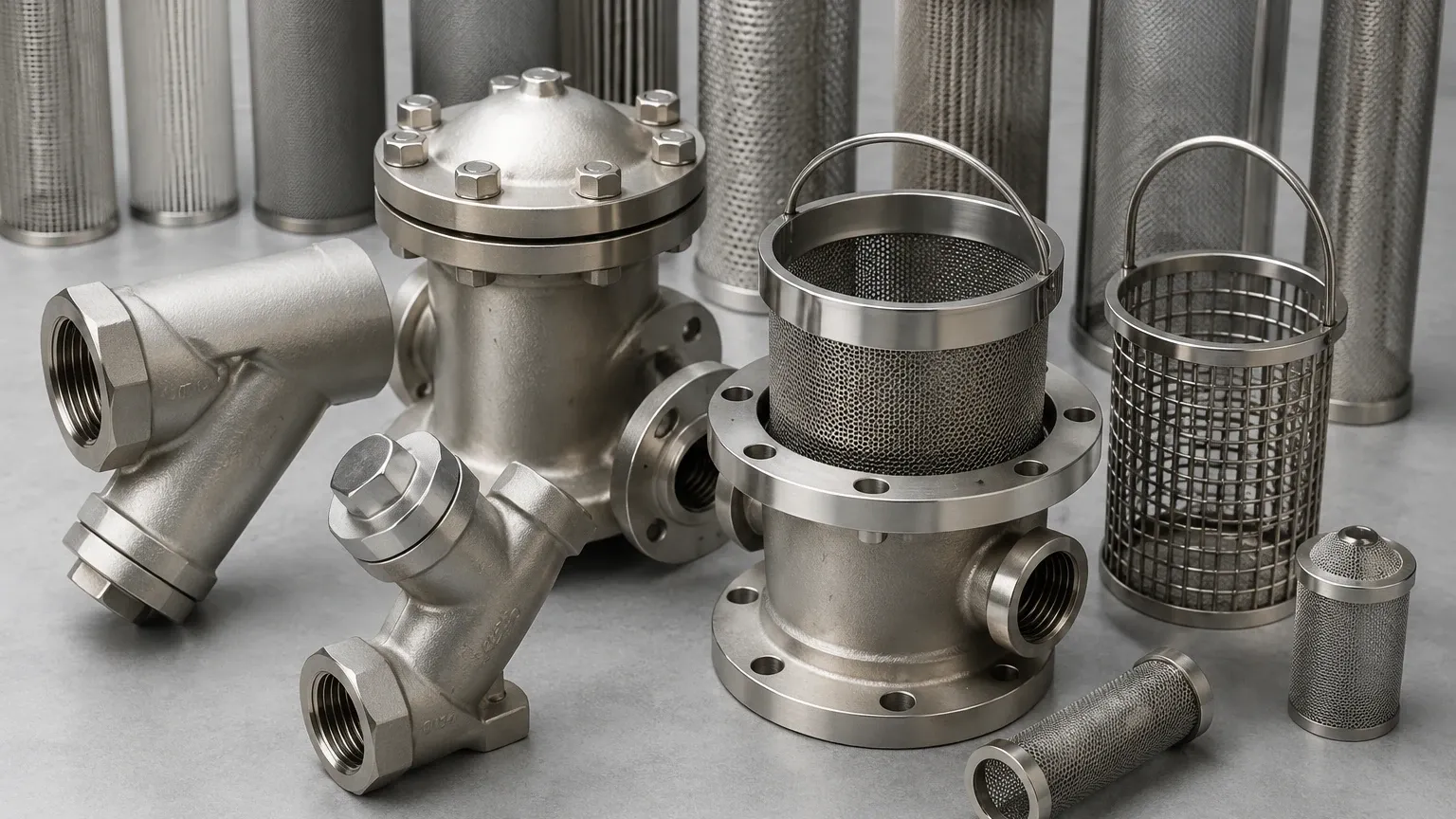
Named for their "Y" shape, these strainers are typically used in applications where the amount of material to be removed is small. They are characterized by a compact design and are often preferred for high-pressure systems, including steam, gas, and liquid lines. One of the primary advantages of the Y-strainer is its versatility in installation; it can be positioned horizontally or vertically, provided the "leg" of the Y points downward to collect debris.
Basket Strainers
Basket strainers, or Simplex strainers, feature a larger housing and a vertical cylinder that holds the straining element. Because the basket has a larger surface area than the screen in a Y-strainer, it can hold a significantly higher volume of debris before requiring cleaning. This makes them the standard choice for liquid applications with high flow rates or heavy particulate loads. Unlike Y-strainers, basket strainers are designed for horizontal piping and offer easier access for cleaning, as the top cover can usually be removed without disturbing the piping.
Duplex Strainers
In processes that cannot be shut down for maintenance, duplex strainers are employed. These consist of two separate basket chambers connected by a diverter valve. When one basket becomes clogged, the flow is switched to the clean chamber, allowing the operator to clean the dirty basket without interrupting the process flow. This is essential in chemical processing and hydraulic systems where continuous operation is mandatory.
Engineering Considerations: Mesh, Perforation, and Micron Ratings
The performance of pipe strainers is defined by the straining element. Selecting the right aperture size is a balance between protection and flow efficiency. If the openings are too large, harmful debris will pass through; if they are too small, the strainer will clog rapidly, causing an excessive pressure drop.
1. Perforated Plate: These are heavy-duty screens made by punching holes in a metal sheet. They are ideal for removing large debris and provide high structural strength. Common hole sizes range from 1/32" to 1/2".
2. Wire Mesh: For finer straining, a wire mesh is lined inside a perforated plate. Mesh is defined by the number of openings per linear inch. For example, a 40-mesh screen has 40 openings per inch.
3. Micron Rating: In precision applications, such as pharmaceutical or food processing, strainers are often specified by micron ratings (one micron is one-millionth of a meter).
Engineers must also consider the Open Area Ratio (OAR). The OAR is the relationship between the internal cross-sectional area of the pipe and the total open area of the holes in the strainer element. A common industrial standard is a 4:1 ratio, meaning the open area of the strainer is four times the area of the pipe inlet. This ensures that even as the strainer begins to fill with debris, the pressure drop remains within acceptable limits.
Material Selection for Durability and Compatibility
The material of the strainer housing and the internal basket must be compatible with the process fluid and the environmental conditions. While cast iron and carbon steel are common for water and oil services, stainless steel is the preferred material for demanding industrial environments.
* 304 Stainless Steel: Offers excellent corrosion resistance and is suitable for most general industrial applications, including water treatment and mildly corrosive chemicals.
* 316/316L Stainless Steel: Contains molybdenum, which provides superior resistance to chlorides and pitting. This is the standard for chemical processing, marine environments, and pharmaceutical applications.
* Sanitary Finishes: In the food and beverage industry, pipe strainers must meet stringent hygiene standards. This involves electro-polishing the stainless steel surfaces to a specific Ra (Roughness Average) to prevent bacterial growth and ensure easy cleaning (CIP/SIP processes).
Kaifil specializes in manufacturing these components using high-grade stainless steel, ensuring that the structural integrity of the strainer can withstand high differential pressures and corrosive chemical exposure over long service lives.
Calculating Pressure Drop and Flow Rates
A critical technical aspect of pipe strainers is the pressure drop ($ΔP$). Every strainer introduces some resistance to flow. As the strainer collects debris, the $ΔP$ increases. If the pressure drop becomes too high, it can lead to reduced flow rates, pump strain, or even the collapse of the strainer basket.
Engineers use the $C_v$ factor (flow coefficient) to calculate the pressure drop for a specific strainer. The formula is generally expressed as:
$$ΔP = (G / C_v)^2$$
Where $G$ is the flow rate in gallons per minute. When selecting a strainer, it is vital to review the manufacturer's flow curves to ensure the system's pump has sufficient head to overcome the initial (clean) pressure drop and the anticipated (dirty) pressure drop.
Application-Specific Requirements
Different industries impose unique demands on pipe strainers, necessitating customized engineering solutions.
Chemical Processing
In chemical plants, strainers must handle aggressive acids and bases. Material traceability is paramount here; engineers often require Mill Test Reports (MTRs) to verify the exact alloy composition of the stainless steel used in the pipe strainers.
Food and Beverage
For food-grade applications, the design must eliminate "dead legs"—areas where fluid can stagnate and spoil. Sanitary basket strainers often feature tri-clamp fittings for rapid disassembly and cleaning.
Oil and Gas
High-pressure ratings and the ability to handle viscous fluids are the primary concerns. Strainers in this sector are often designed to meet ASME B31.3 piping codes and may require specialized coatings or heavy-wall construction.
Hydraulic Systems
Precision hydraulic systems require extremely fine straining to protect sensitive servo valves. In these cases, stainless steel wire mesh baskets are engineered to withstand high-velocity fluid pulses without deforming.
Maintenance and Total Cost of Ownership (TCO)
While the initial purchase price of a pipe strainer is important, the Total Cost of Ownership (TCO) is driven by maintenance and downtime. A poorly designed strainer that is difficult to clean or frequently clogs will quickly become a financial burden.
Key maintenance indicators include:
* Differential Pressure Gauges: Installing gauges upstream and downstream of the strainer allows operators to monitor the $ΔP$ in real-time. A common rule of thumb is to clean the basket when the pressure drop reaches 5-10 psi over the clean reading.
* Ease of Access: For high-maintenance lines, quick-opening covers (such as swing bolts or k-knobs) are preferred over bolted flanges to reduce the time required for basket servicing.
* Replacement Cycles: While stainless steel baskets are durable, they are subject to fatigue from pressure cycling. Regular inspection for broken wires or distorted frames is necessary to prevent bypass.
Custom OEM Solutions and Engineering Support
Standard off-the-shelf strainers do not always meet the spatial or performance constraints of complex industrial skids. Customization is often required in terms of nozzle orientation, housing dimensions, and specialized filtration media.
Kaifil provides comprehensive OEM capabilities, working directly with engineering teams to develop bespoke filtration components. Whether the requirement is for a unique micron rating, a specific alloy like Duplex stainless steel, or a non-standard flange connection, custom manufacturing ensures that the pipe strainer integrates seamlessly into the existing infrastructure without requiring costly piping modifications.
Conclusion
Pipe strainers are indispensable for the reliable operation of industrial fluid systems. By understanding the differences between Y and basket designs, selecting the appropriate stainless steel grade, and accurately calculating flow requirements, engineers can significantly enhance system uptime. When evaluating Strainers & Baskets, focusing on the technical specifications—such as the open area ratio and the structural integrity of the mesh—ensures that the chosen solution provides long-term protection for the facility's most critical assets.
