


Pump Strainers
In industrial fluid handling systems, the pump is often the most critical and expensive component. Whether it is a centrifugal pump in a chemical processing plant or a high-pressure hydraulic pump in a manufacturing facility, the presence of solid contaminants can lead to catastrophic mechanical failure. Pump strainers serve as the primary mechanical barrier, designed to remove large particles and debris from the process fluid before they reach the pump’s internal components.
By integrating high-quality Strainers & Baskets into a system, engineers can significantly extend the mean time between failures (MTBF) for pumps, valves, and instrumentation. This article explores the technical nuances of pump strainers, covering engineering considerations, material selection, and the critical parameters required for optimal performance in demanding industrial environments.
The Engineering Function of Pump Strainers
The primary role of a pump strainer is protection. In new piping systems, construction debris such as weld slag, pipe scale, and even stray tools can easily enter the fluid stream. In established systems, corrosion products or process-related solids can pose a continuous threat.
When these solids enter a pump, they can cause several types of damage:
1. Impeller Erosion: High-velocity particles can erode the leading edges of impellers, leading to a loss of hydraulic efficiency and balance.
2. Seal Failure: Fine grit can find its way into mechanical seal faces, causing scoring and premature leakage.
3. Clogging: Large debris can physically block the pump inlet or internal passages, leading to cavitation or dry-running conditions.
Suction vs. Discharge Filtration
While filtration can occur at various points in a system, pump strainers are almost exclusively installed on the suction side (inlet). The challenge for engineers is balancing the need for fine filtration with the requirement to maintain a low pressure drop. If a suction strainer is too restrictive or becomes overly clogged, it can reduce the Net Positive Suction Head Available (NPSHA) to a level below the Net Positive Suction Head Required (NPSHR) by the pump. This imbalance triggers cavitation—the formation and collapse of vapor bubbles—which can destroy a pump's internal surfaces in a matter of hours.
Technical Classifications of Industrial Strainers
Selecting the correct configuration of pump strainers depends on the flow rate, the nature of the contaminants, and the permissible downtime for maintenance. Industrial strainers are generally categorized into three main designs.
1. Y-Strainers
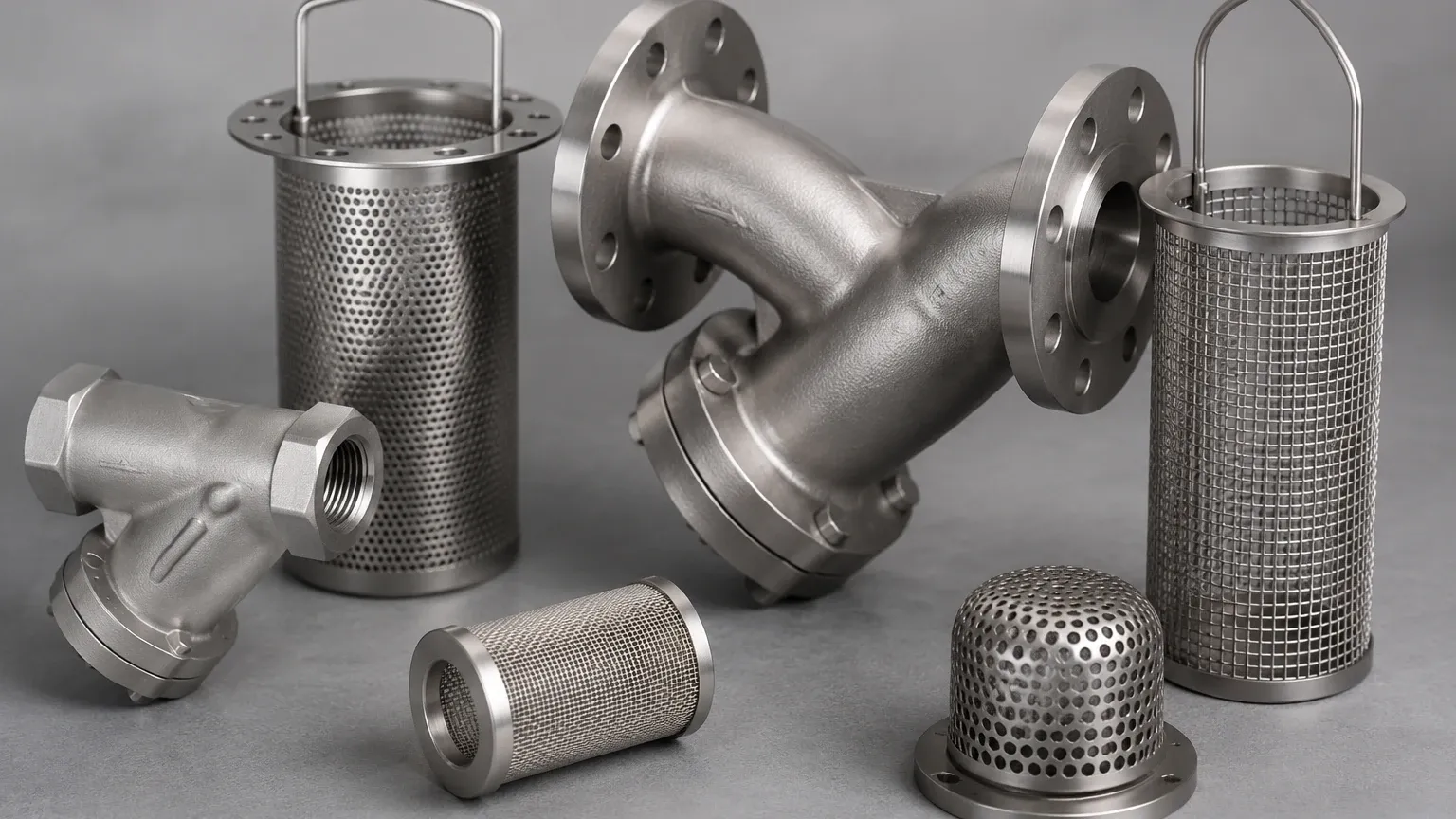
Y-strainers are characterized by their "Y" shaped body. They are typically used in applications where the amount of solids to be removed is relatively small. Their compact design makes them ideal for tight piping configurations. Y-strainers can be installed in either horizontal or vertical orientations, provided the "leg" of the Y points downward to collect debris via gravity. However, they generally have a smaller holding capacity and a higher pressure drop compared to basket designs.
2. Simplex Basket Strainers
Simplex basket strainers feature a vertical cylinder that houses a removable basket. These are the preferred choice for pump protection in high-flow applications. The basket design allows for a much larger surface area than a Y-strainer, which translates to a lower initial pressure drop and longer intervals between cleanings. Because the basket is accessed from the top, maintenance is straightforward, though the system must be shut down and the line depressurized before the basket can be removed.
3. Duplex Basket Strainers
In critical processes where flow cannot be interrupted, duplex strainers are required. These units consist of two separate strainer chambers connected by a diverted valve. When one basket becomes clogged, the operator can switch the flow to the clean chamber without stopping the pump. This allows for continuous operation in chemical processing, marine fuel systems, and power generation cooling loops.
Critical Engineering Parameters for Selection
When specifying pump strainers, engineers must look beyond simple pipe size. Several technical factors dictate whether a strainer will perform reliably or become a bottleneck in the system.
Micron Rating and Mesh Size
The filtration level is determined by the size of the openings in the strainer element. This is typically expressed in "mesh" (the number of openings per linear inch) or "microns" (the actual size of the opening). For pump protection, the goal is not necessarily to clarify the fluid but to remove particles larger than the internal clearances of the pump.
* Coarse Filtration: Often achieved with perforated metal plates (e.g., 1/8" or 1/16" holes).
* Fine Filtration: Achieved by lining a perforated basket with a fine stainless steel wire mesh.
The Open Area Ratio (OAR)
The Open Area Ratio is the relationship between the total area of the strainer openings and the internal cross-sectional area of the inlet pipe. A common industry standard for pump strainers is an OAR of 4:1 or 6:1. A higher OAR means the strainer can accumulate a significant amount of debris before the pressure drop begins to impact pump performance. Engineers should always request the OAR data from the manufacturer to ensure the component is appropriately sized for the expected solids loading.
Viscosity and Flow Velocity
Fluid viscosity significantly impacts pressure drop. Highly viscous fluids (such as heavy oils or resins) require larger strainer bodies and coarser mesh to prevent excessive resistance. Similarly, high flow velocities increase the risk of "media migration" or structural failure of the mesh if the strainer is not properly reinforced with a heavy-duty perforated backup tube.
Material Selection for Durability and Compatibility
Industrial pump strainers are subjected to high pressures, thermal cycling, and potentially corrosive media. Material selection is therefore a cornerstone of reliable filtration.
Stainless Steel (304 and 316)
Stainless steel is the industry standard for high-performance filtration components.
* Grade 304: Offers excellent strength and basic corrosion resistance for water and mild industrial fluids.
* Grade 316/316L: Contains molybdenum, which provides superior resistance to chlorides and pitting. This is essential for pharmaceutical, food and beverage, and marine applications.
At Kaifil, we specialize in manufacturing custom stainless steel filter cartridges and baskets that utilize advanced welding and assembly techniques. Stainless steel’s ability to withstand high temperatures and its ease of sterilization make it the preferred material for precision metal filter components.
Specialty Alloys and Coatings
For highly aggressive environments, such as concentrated acids or high-temperature petrochemical processing, specialty alloys like Monel, Hastelloy, or Duplex Stainless Steel may be required. Furthermore, the housing of the strainer must be compatible with the piping material to prevent galvanic corrosion.
Customization and OEM Capabilities
Off-the-shelf strainers often fail to meet the specific spatial or performance requirements of complex industrial skids. Custom-engineered pump strainers allow for optimized flow paths and specialized mounting configurations.
Key areas for customization include:
* Custom Dimensions: Adjusting the height or diameter of the basket to fit within existing equipment footprints.
* Reinforced Structures: Adding internal supports or outer shrouds to baskets to handle high differential pressures without collapsing.
* Connection Types: Providing flanged (ANSI, DIN, JIS), NPT threaded, or sanitary tri-clamp connections to match the specific piping standard of the facility.
* Magnetic Inserts: Integrating magnetic rods within the strainer basket to capture fine ferrous particles that might otherwise pass through a standard mesh.
As a professional manufacturer, Kaifil works closely with engineering teams to develop OEM solutions that integrate seamlessly into their equipment designs, ensuring that the filtration performance is matched exactly to the pump's requirements.
Maintenance, Monitoring, and Replacement Cycles
The effectiveness of a pump strainer is only as good as its maintenance regime. A clogged strainer is a liability, not an asset.
Differential Pressure Monitoring
The most reliable way to monitor a strainer is through differential pressure (DP) gauges. By measuring the pressure before and after the strainer, operators can determine the exact level of clogging.
* Clean DP: The pressure drop when the strainer is new or freshly cleaned.
* Alarm DP: The point at which the pressure drop threatens pump suction (NPSH).
* Terminal DP: The maximum pressure drop the internal basket can withstand before structural deformation occurs.
Cleaning Protocols
For reusable stainless steel baskets, cleaning methods vary by application. While manual hosing or brushing is common, some processes require ultrasonic cleaning or chemical baths to remove stubborn deposits from the wire mesh. It is vital to inspect the mesh for signs of fraying or bypass during every cleaning cycle.
Replacement Indicators
Strainer baskets are wear items. Over time, the repeated stress of flow and cleaning can fatigue the metal. Baskets should be replaced if there is any evidence of:
* Broken wires in the mesh lining.
* Deformation of the perforated support.
* Damage to the sealing surfaces or gaskets, which could allow fluid to bypass the filter media.
Total Cost of Ownership (TCO) in Filtration
When evaluating Strainers & Baskets, purchasing teams should look beyond the initial acquisition cost. The Total Cost of Ownership includes the price of the unit, the cost of replacement parts (gaskets and baskets), the labor required for cleaning, and the potential cost of system downtime.
Investing in a high-quality, properly sized stainless steel strainer often yields a significant return on investment by:
1. Reducing Pump Repairs: Preventing a single impeller replacement can often pay for the entire filtration system.
2. Energy Savings: A well-designed strainer with a high OAR maintains a lower pressure drop, reducing the energy consumption of the pump motor.
3. Process Consistency: Ensuring that downstream processes are not contaminated by particulate matter, thereby reducing product waste.
Conclusion
Pump strainers are a fundamental necessity for the longevity and efficiency of industrial fluid systems. By understanding the relationship between flow dynamics, material science, and mechanical design, engineers can select filtration solutions that provide robust protection without compromising system performance. Whether the application requires a standard Y-strainer or a highly customized duplex basket system, the focus must remain on precision, durability, and ease of maintenance.
For engineers and purchasing professionals seeking reliable, high-performance filtration components, partnering with a manufacturer that understands the complexities of industrial environments is essential. From material selection to final production, the right filtration partner ensures that your pumps remain protected against the unpredictable challenges of industrial processing.
