


Sea Strainers
In industrial and marine fluid management, the integrity of downstream equipment—such as heat exchangers, pumps, and cooling systems—depends heavily on the efficiency of the primary filtration stage. Sea strainers serve as the critical first line of defense, designed to remove large particulates, organic matter, and debris from raw water intakes. For engineers and procurement specialists, selecting the correct strainer configuration is not merely a matter of pipe sizing; it requires a detailed understanding of material science, fluid dynamics, and the specific mechanical demands of corrosive environments.
As systems become more complex and downtime more costly, the role of high-quality Strainers & Baskets has shifted from simple debris collection to a vital component of system-wide reliability. This article examines the engineering principles, material considerations, and selection criteria essential for implementing effective sea strainers in industrial applications.
The Role of Sea Strainers in Raw Water Systems
Sea strainers are installed in the suction side of a water circuit to protect the system from solids that could cause mechanical blockages or abrasive wear. In marine environments, this includes seaweed, shells, and sand; in industrial raw water applications, it may include scale, gravel, or biological growth.
Unlike fine filtration systems that target sub-micron particles, sea strainers are designed for high-volume flow with minimal pressure resistance. Their primary function is to intercept any object large enough to damage pump impellers or clog the narrow passages of a heat exchanger. Because these strainers operate in raw, often untreated water, they must withstand constant exposure to corrosive elements and varying hydraulic pressures.
Engineering Considerations: Flow Rate and Pressure Drop
One of the most critical factors in strainer design is the relationship between the flow rate and the pressure drop (delta P). Every strainer introduces some level of resistance to the flow. If the resistance is too high, it can lead to pump cavitation, reduced cooling efficiency, and increased energy consumption.
The Open Area Ratio (OAR)
The Open Area Ratio is the relationship between the total area of the openings in the strainer basket and the cross-sectional area of the inlet pipe. For sea strainers, a common engineering benchmark is an OAR of at least 6:1. This high ratio ensures that even as the basket begins to collect debris, there remains sufficient unobstructed area to maintain flow without a significant increase in pressure drop.
Velocity and Turbulence
Engineers must also consider the velocity of the fluid entering the strainer. High-velocity intake can cause turbulence within the strainer housing, which may lead to "scouring" of the basket material or cause debris to bypass the seals. Properly sized sea strainers manage fluid velocity to ensure that particles settle into the basket effectively rather than being forced through the mesh or perforated media.
Material Selection for Corrosive Environments
The longevity of a sea strainer is almost entirely dependent on its material composition. Because these components are frequently exposed to seawater or brackish water, galvanic corrosion and pitting are constant threats.
Stainless Steel 316 and 316L
For most industrial and marine sea strainers, Stainless Steel 316 is the standard material for the internal basket and often the housing itself. The addition of molybdenum in Grade 316 provides significantly better resistance to chloride-induced pitting compared to Grade 304. For components requiring extensive welding, 316L (low carbon) is preferred to prevent sensitisation and intergranular corrosion at the weld sites.
Advanced Alloys and Coatings
In highly aggressive environments where standard stainless steel may fail, specialized alloys such as Super Duplex stainless steel or Monel may be utilized. Additionally, the use of sacrificial anodes (typically zinc or aluminum) within the strainer housing can help protect the metal components from galvanic corrosion by providing a more chemically active metal to corrode in place of the structural components.
Design Variations in Strainer Baskets
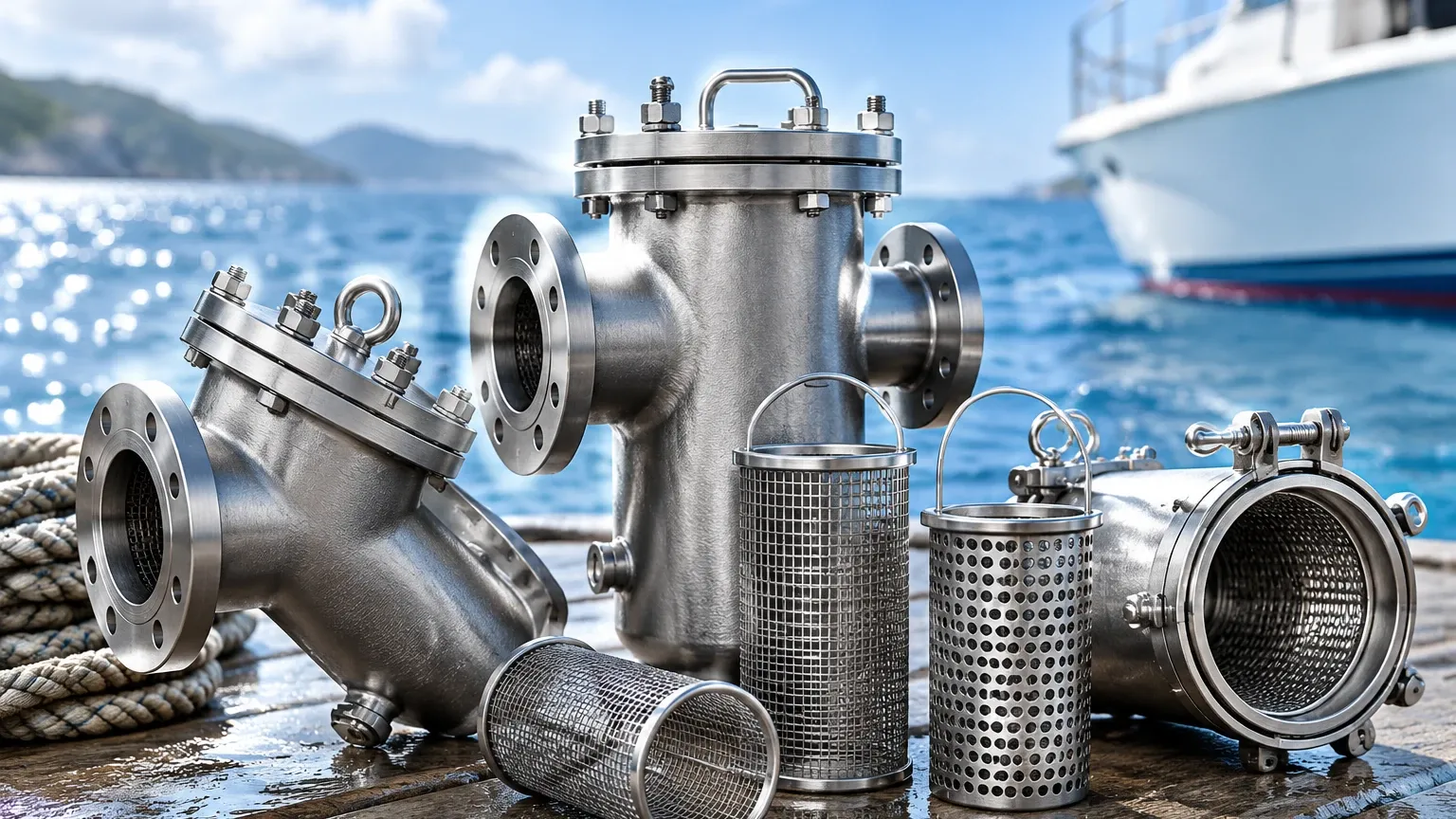
The internal basket is the functional heart of the sea strainer. Depending on the application, these baskets can be constructed in several ways to balance filtration accuracy with structural strength.
1. Perforated Baskets: These are the most robust options, constructed from heavy-gauge metal sheets with punched holes. They are ideal for removing large debris and can withstand high differential pressures without collapsing.
2. Mesh-Lined Baskets: For applications requiring finer filtration, a wire mesh liner is typically spot-welded or mechanically fastened to the inside of a perforated metal basket. The perforated outer layer provides the necessary structural support, while the mesh determines the filtration fineness.
3. Pleated Baskets: In scenarios where space is limited but a high surface area is required, pleated designs increase the available filtration area within the same footprint, effectively extending the time between cleaning cycles.
Customization of these Strainers & Baskets allows for the optimization of hole patterns, mesh counts, and reinforcement structures to meet the specific demands of the intake environment.
Maintenance and Operational Reliability
A sea strainer is only effective if it is maintained. In many industrial settings, the failure to monitor strainer performance leads to emergency shutdowns.
Monitoring Differential Pressure
The most effective way to monitor a sea strainer's condition is through differential pressure gauges. By measuring the pressure before and after the strainer, operators can determine exactly when the basket is reaching its holding capacity. A sudden spike in differential pressure indicates a rapid intake of debris, while a gradual increase suggests standard accumulation.
Cleaning Cycles and Access
Designers must ensure that sea strainers are located in accessible areas. Quick-release covers, such as swing-bolt or yoke-style closures, are essential for minimizing downtime during cleaning. In critical systems where flow cannot be interrupted, duplex strainers—which feature two separate chambers and a diverter valve—allow one side to be cleaned while the other remains in operation.
Selection Criteria for Purchasing Teams
When specifying sea strainers for a project, purchasing teams and engineers should confirm several technical parameters to ensure the component is fit for purpose:
* Connection Type and Size: Ensure the flange or NPT connection matches the existing piping and can handle the design pressure of the system.
* Filtration Requirement: Define the maximum particle size allowed downstream. Selecting a mesh that is too fine will lead to frequent clogging, while one that is too coarse will fail to protect equipment.
* Maximum Operating Pressure and Temperature: Verify that the housing and seals (O-rings/gaskets) are compatible with the fluid temperature and the system’s peak pressure.
* Seal Compatibility: Sea strainers often use Buna-N, EPDM, or Viton seals. The choice depends on the presence of oils, chemicals, or extreme temperatures in the raw water.
* Customization Needs: In many OEM applications, standard off-the-shelf strainers do not fit the physical envelope or the specific flow characteristics required. Working with a manufacturer that offers custom fabrication of stainless steel components is often necessary to achieve the desired performance.
Conclusion
Sea strainers are a fundamental requirement for the protection of industrial and marine water systems. By focusing on high-quality materials like 316 stainless steel, optimizing the Open Area Ratio, and ensuring robust basket construction, facilities can significantly reduce the risk of equipment failure and unscheduled maintenance.
For organizations requiring precision-engineered solutions, Kaifil provides a range of custom stainless steel filtration components designed to meet the rigorous demands of industrial environments. Whether the application involves chemical processing, power generation, or marine cooling, the correct selection of Strainers & Baskets ensures long-term operational efficiency and system protection.
