


Suction Strainers
In industrial fluid handling and hydraulic systems, the suction line represents the most critical point for protecting downstream equipment. Suction strainers serve as the primary defense mechanism, positioned at the pump inlet to capture coarse contaminants before they can enter the pump chamber. Unlike fine pressure-line filters, suction strainers are designed to handle high flow rates with minimal resistance, ensuring that the pump receives a steady supply of fluid while remaining shielded from large debris, scale, and particulate matter.
For engineers and procurement teams, selecting the right suction strainer is not merely a matter of matching pipe sizes. It requires a deep understanding of fluid dynamics, material compatibility, and the specific mechanical requirements of the pump. A poorly specified strainer can lead to cavitation, excessive pressure drops, and premature pump failure, while a high-quality, precision-engineered solution ensures long-term operational stability.
Fundamental Principles of Suction Filtration
The primary objective of a suction strainer is to protect the pump from catastrophic damage caused by large solids. In many industrial environments, reservoirs and tanks can accumulate weld slag, metal chips, or environmental debris. If these particles enter a centrifugal or positive displacement pump, they can score cylinders, damage impellers, or cause immediate mechanical seizure.
Suction strainers are typically classified as "coarse" filters. While secondary filters in a system might target particles in the 1-10 micron range, suction strainers generally operate in the 74 to 500-micron range (approx. 30 to 200 mesh). The engineering challenge lies in balancing filtration efficiency with the Net Positive Suction Head (NPSH) requirements of the pump. If the strainer is too fine, it creates a vacuum at the pump inlet, leading to cavitation—a phenomenon where vapor bubbles form and collapse violently, eroding metal surfaces and destroying the pump's efficiency.
Material Engineering: Why Stainless Steel Dominates
In demanding B2B environments, material selection is the foundation of reliability. While plastic or carbon steel strainers may suffice for temporary or low-stakes applications, stainless steel is the industry standard for high-performance industrial filtration.
Corrosion Resistance and Chemical Compatibility
Most industrial processes involve fluids that are either chemically aggressive or require high levels of purity. Stainless steel 304 and 316 are the preferred materials for Strainers & Baskets due to their inherent resistance to oxidation and a wide range of industrial chemicals. For pharmaceutical and food and beverage applications, 316L stainless steel is often mandated to prevent metallic leaching and to withstand rigorous Clean-in-Place (CIP) protocols.
Structural Integrity and Durability
Suction lines can experience significant pressure fluctuations and mechanical vibrations. Stainless steel wire mesh and perforated metal provide the structural rigidity necessary to resist collapsing under high vacuum conditions. Unlike synthetic materials, stainless steel maintains its mechanical properties across a broad temperature spectrum, making it suitable for both cryogenic applications and high-temperature chemical processing.
Design Variations in Suction Strainers
Industrial suction strainers come in several configurations, each optimized for specific installation environments and maintenance requirements. Understanding these variations is essential for engineers designing new systems or retrofitting existing ones.
Internal Tank-Mounted Strainers
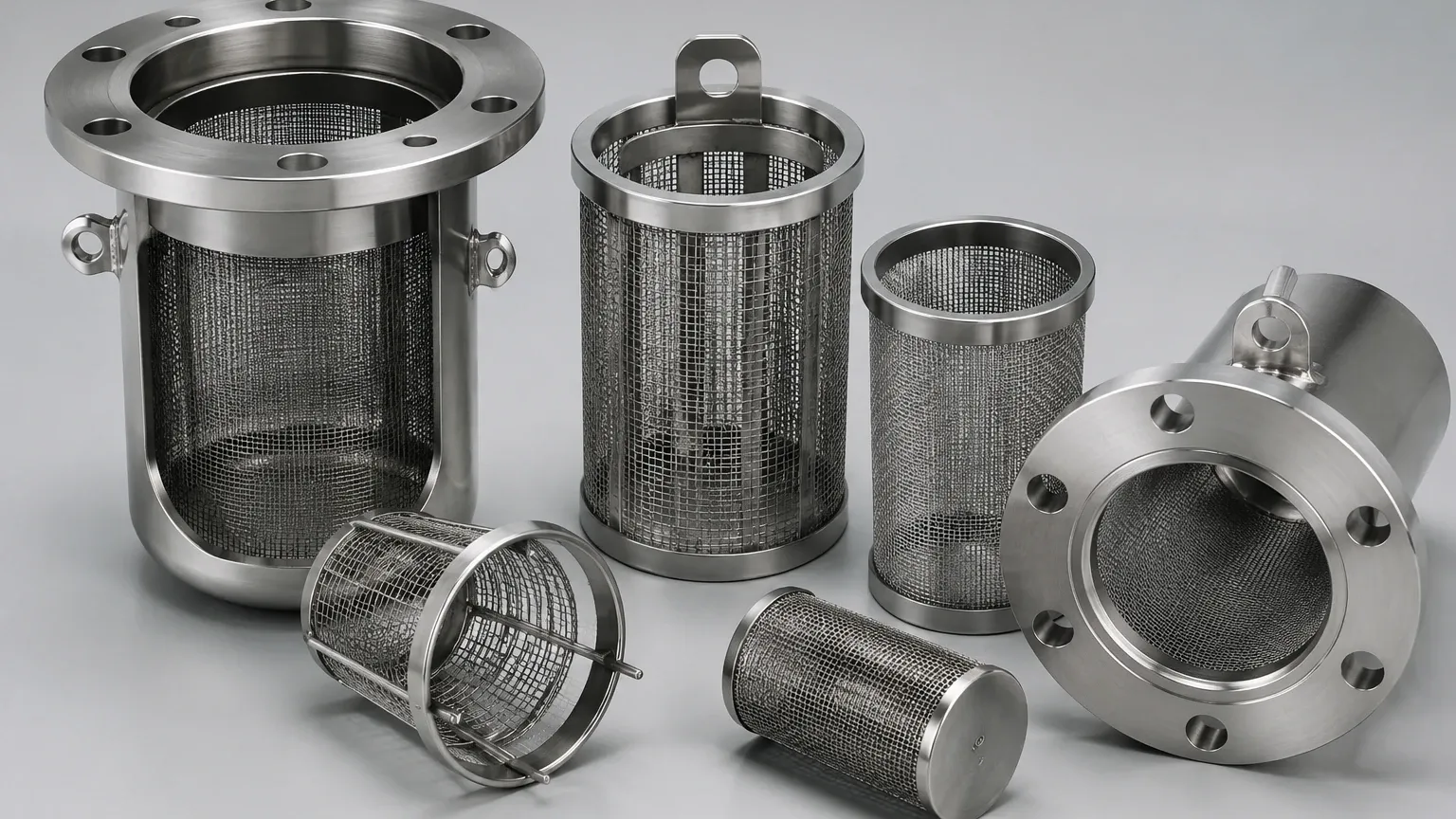
These are often referred to as "sump strainers." They are submerged directly into the fluid reservoir and attached to the suction pipe. They are cost-effective and save space, but maintenance requires draining the tank or accessing the interior of the reservoir. These are common in hydraulic power units where space is at a premium.
External In-Line Strainers
Mounted outside the reservoir on the suction piping, in-line strainers offer significantly easier access for maintenance. They often feature a housing with a removable lid, allowing the internal basket to be cleaned without dismantling the entire pipe run. This design is preferred in continuous process industries where downtime must be minimized.
Basket-Style Strainers
For applications with high solids loading, basket-style strainers provide a larger surface area than simple cylindrical designs. The increased area reduces the frequency of cleaning cycles and lowers the initial pressure drop across the element. These are frequently used in water treatment and heavy industrial cooling systems.
Calculating Pressure Drop and NPSH Requirements
One of the most common mistakes in suction strainer selection is failing to account for the "dirty" pressure drop. A clean strainer might meet the pump's NPSH requirements, but as it accumulates debris, the resistance increases. Engineers must calculate the allowable pressure drop across the strainer at maximum flow and maximum fluid viscosity.
Key factors influencing pressure drop include:
* Open Area Ratio: The ratio of the total area of the holes in the mesh to the total area of the strainer. A higher open area ratio leads to a lower pressure drop.
* Fluid Viscosity: High-viscosity fluids (such as heavy oils or syrups) require much larger strainers to maintain acceptable flow rates.
* Mesh Weave Type: Plain square weaves offer the highest open area, while Dutch weaves provide greater strength and finer filtration at the cost of higher resistance.
As a rule of thumb, suction strainers should be sized so that the total open area is at least two to four times the cross-sectional area of the suction pipe. This safety margin accounts for gradual clogging and helps maintain a stable inlet pressure for the pump.
Application-Specific Selection Criteria
Different industries impose unique demands on suction filtration technology. A one-size-fits-all approach often leads to operational inefficiencies.
Chemical Processing
In chemical plants, the primary concern is material compatibility. Suction strainers must be resistant to the specific acids, bases, or solvents being handled. Furthermore, specialized gasket materials (such as PTFE or Viton) must be used to ensure leak-proof seals in external housings.
Food and Beverage
Hygiene is the priority here. Strainers must be designed without "dead zones" where bacteria can proliferate. Precision-welded stainless steel mesh ensures that no wire fragments can break off and contaminate the product stream. These strainers often require polished surfaces and sanitary fittings (e.g., Tri-Clamp).
Hydraulic Systems
Hydraulic suction strainers must handle varying viscosities as the oil heats up during operation. They are often equipped with internal bypass valves. If the strainer becomes completely clogged, the bypass valve opens to prevent the pump from cavitating, though this allows unfiltered oil to enter the system—a necessary compromise to prevent immediate pump destruction.
Maintenance and Operational Longevity
The total cost of ownership (TCO) for a suction strainer is heavily influenced by its maintenance requirements. While disposable elements exist, most industrial suction strainers are designed to be cleaned and reused.
Cleaning Protocols
Stainless steel elements can be cleaned using several methods:
1. Backwashing: Reversing the flow of fluid to dislodge particles from the mesh.
2. Ultrasonic Cleaning: Using high-frequency sound waves in a solvent bath to remove fine particles trapped deep within the weave.
3. Chemical Cleaning: Soaking the element in a compatible solvent to dissolve organic or mineral deposits.
Monitoring Performance
To move from reactive to predictive maintenance, many industrial systems now incorporate differential pressure gauges across the suction strainer. By monitoring the pressure rise, maintenance teams can schedule cleaning before the pump's performance is compromised.
Customization and OEM Solutions
Standard off-the-shelf strainers often fail to meet the exact spatial or performance constraints of complex industrial machinery. This is where custom manufacturing becomes vital. Customization options typically include:
* Non-Standard Dimensions: Tailoring the length and diameter of the strainer to fit specific reservoir depths or pipe configurations.
* Reinforced Structures: Adding internal support cores or external shrouds for high-vacuum or high-flow applications.
* Integrated Sensors: Incorporating ports for temperature or pressure sensors directly into the strainer housing.
As a professional manufacturer, Kaifil specializes in these types of tailored solutions. By working closely with engineering teams, we develop suction strainers that match the specific flow characteristics and environmental challenges of their applications. Whether it is a unique wire mesh configuration or a specific mounting flange, custom engineering ensures that the filtration component integrates seamlessly into the broader system architecture.
Conclusion: The Strategic Importance of Suction Filtration
Suction strainers are a small but critical component of industrial infrastructure. By preventing large debris from reaching the pump, they safeguard the most expensive parts of the fluid system. When selecting suction strainers, engineers must prioritize material quality, structural integrity, and precise flow calculations.
Investing in high-quality stainless steel suction strainers reduces the risk of unplanned downtime, extends the service life of pumps, and ensures the overall reliability of the industrial process. In the long run, the durability and cleanability of precision-engineered metal filters provide a significantly better return on investment than lower-quality alternatives. For technical professionals, the goal is clear: ensure the pump is protected without starving it of the fluid it needs to perform.
