


Strainer 70um
In the landscape of industrial filtration, precision is the primary determinant of system longevity and process efficiency. A strainer 70um (70-micron) specification represents a critical threshold in fine-particle removal, bridging the gap between coarse primary straining and ultra-fine secondary filtration. For engineers and procurement teams, selecting a 70-micron strainer involves more than just identifying a mesh size; it requires an understanding of fluid dynamics, material compatibility, and the mechanical stresses inherent in high-pressure industrial environments.
At this level of filtration, often corresponding to approximately 200 mesh in standard wire cloth scales, the strainer is tasked with capturing particles that are invisible to the naked eye but large enough to cause catastrophic wear in precision components like hydraulic valves, fuel injectors, and spray nozzles. Kaifil, as a specialist in stainless steel filtration, provides the technical framework necessary to integrate these components into complex industrial systems.
Technical Foundations of 70-Micron Filtration
The term "70um" refers to the nominal or absolute pore size of the filtration media. In the context of Strainers & Baskets, achieving a 70-micron rating typically involves the use of high-grade stainless steel wire mesh. The engineering behind this mesh must account for the trade-off between filtration fineness and the structural integrity of the basket.
Mesh Weave and Geometry
For a strainer 70um application, the weave type is a primary consideration. Plain weave is common, where each warp wire crosses alternately over and under each weft wire. However, at 70 microns, the wire diameter becomes quite thin. To maintain durability under high flow rates, manufacturers may utilize a Dutch weave or a Twilled weave. These configurations allow for a higher density of wires, providing a more robust structure while maintaining the precise 70-micron openings required for the application.
Nominal vs. Absolute Ratings
When specifying a 70um strainer, it is vital to distinguish between nominal and absolute ratings. A nominal 70um rating implies that the strainer will retain a majority of particles of that size, but some may pass through due to the irregular shapes of the particles or the flexibility of the mesh. An absolute rating, often achieved through multi-layered sintered mesh or high-precision weaving, ensures that no particle larger than 70 microns can pass through the media. For critical applications in the pharmaceutical or chemical sectors, absolute ratings are often the standard to ensure process consistency.
Material Selection: The Role of Stainless Steel
Industrial environments often subject filtration components to corrosive fluids, extreme temperatures, and high mechanical loads. Therefore, the material of the strainer 70um is as important as the micron rating itself. Stainless steel is the industry standard due to its versatility and resistance to degradation.
Grade 304 Stainless Steel
SS304 is the most common material for general industrial use. It provides excellent resistance to oxidation and is suitable for most water treatment and food-grade applications. When used in a 70um strainer, SS304 offers a cost-effective solution that maintains its shape and filtration accuracy under standard operating conditions.
Grade 316 and 316L Stainless Steel
For more demanding environments, such as chemical processing or marine applications, SS316 is preferred. The addition of molybdenum enhances resistance to pitting and crevice corrosion, particularly in chloride-rich environments. SS316L (low carbon) is often specified for components that require welding, as it prevents carbide precipitation that could lead to localized corrosion at the weld points. In a strainer 70um configuration, using 316L ensures that the fine mesh remains intact even after being integrated into a heavy-duty basket frame.
Structural Design: Baskets and Support Frames
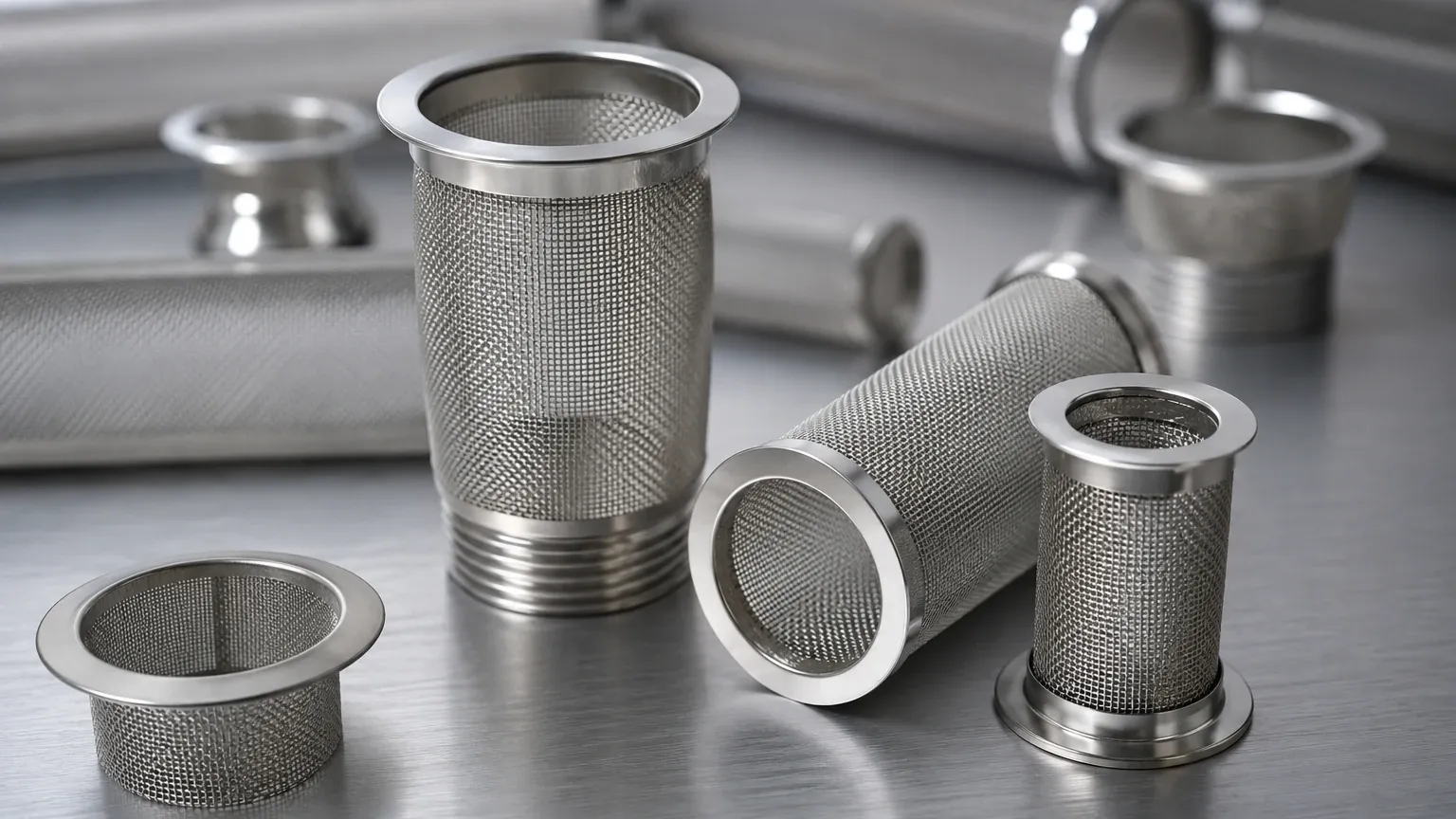
A 70-micron mesh is relatively delicate. If placed directly into a high-pressure flow without support, the mesh would likely deform or rupture (a phenomenon known as "media migration"). Consequently, the design of Strainers & Baskets for 70um filtration usually involves a multi-stage construction.
Perforated Metal Support
The 70um wire mesh is typically lined or wrapped around a perforated metal basket. This perforated core provides the necessary mechanical strength to withstand the differential pressure (ΔP) that builds up as the strainer captures debris. The hole pattern and open area of the perforated support must be engineered to minimize flow restriction while providing maximum support to the fine mesh.
Pleated vs. Cylindrical Designs
To increase the effective filtration area without increasing the overall footprint of the strainer housing, engineers may opt for a pleated 70um element. Pleating increases the surface area significantly, which lowers the flux (flow per unit area) and extends the time between cleaning cycles. For high-viscosity fluids, a cylindrical design might be simpler to clean, but for high-flow water systems, pleated 70um strainers offer superior performance.
Key Performance Metrics for 70um Strainers
Before implementing a strainer 70um into a system, several performance metrics must be evaluated to ensure the component does not become a bottleneck or a point of failure.
Pressure Drop (ΔP)
Every filter media introduces a resistance to flow. For a 70-micron strainer, the initial pressure drop should be calculated based on the fluid's viscosity, density, and flow rate. As the strainer captures particles, the ΔP will increase. Systems must be designed with a maximum allowable pressure drop, at which point the strainer basket must be cleaned or replaced. If the ΔP exceeds the structural limits of the mesh or the support basket, the strainer could collapse, sending a surge of contaminants downstream.
Dirt Holding Capacity
The dirt holding capacity refers to the amount of contaminant the strainer 70um can retain before reaching its terminal pressure drop. This is influenced by the total surface area of the mesh. In B2B procurement, choosing a strainer with a higher dirt holding capacity often results in a lower total cost of ownership (TCO) because it reduces the frequency of manual intervention and system downtime.
Flow Velocity
High fluid velocities can cause "particle bypass" or erosion of the wire mesh. For 70-micron filtration, it is generally recommended to keep fluid velocities within a range that prevents turbulent impingement on the fine wires of the mesh. Proper sizing of the strainer housing and the basket diameter is essential to maintaining laminar flow through the 70um media.
Industrial Applications of the Strainer 70um
The 70-micron threshold is a "sweet spot" for many industrial processes where protection of downstream equipment is paramount.
Chemical and Petrochemical Processing
In chemical plants, a strainer 70um is often used to protect catalysts and high-pressure pumps. Contaminants such as pipe scale, rust, and process byproducts can damage expensive seals and impellers. By utilizing a 70-micron stainless steel basket, plants can ensure that only clean fluid reaches sensitive reaction chambers.
Food and Beverage Production
Filtration in the food industry requires adherence to strict sanitary standards. A 70um strainer is frequently used to remove fine sediments from juices, oils, or syrups. Because Kaifil utilizes high-quality stainless steel, these strainers can withstand the aggressive Clean-in-Place (CIP) chemicals and high-temperature steam sterilization required in food-grade environments.
Hydraulic and Lube Oil Systems
Hydraulic systems rely on tight tolerances between moving parts. Particles as small as 70 microns can cause abrasive wear, leading to internal leakage and loss of system pressure. A 70um strainer serves as a reliable guard filter in the return line or the suction side of the pump to maintain oil cleanliness and extend the life of the hydraulic fluid.
Water Treatment and Irrigation
In water treatment, 70-micron strainers are used as pre-filters for membrane systems (like Reverse Osmosis) or to protect fine-mist irrigation nozzles. By removing the bulk of suspended solids at the 70um level, the load on more expensive downstream filters is reduced, optimizing the entire filtration train.
Customization and OEM Considerations
Standard off-the-shelf strainers often fail to meet the specific spatial or performance requirements of specialized machinery. This is where custom manufacturing becomes essential. When sourcing a strainer 70um, engineering teams should consider the following customization options:
1. End Fittings and Flanges: Whether the system requires ANSI flanges, NPT threads, or custom sanitary couplings, the strainer basket must be designed to fit the housing perfectly to prevent bypass.
2. Handle and Lifting Options: For large Strainers & Baskets, adding heavy-duty handles or lifting lugs ensures that maintenance personnel can safely remove the basket for cleaning.
3. Reinforcement Rings: In high-vibration environments, adding reinforcement rings to the top and bottom of the 70um basket prevents mechanical fatigue of the mesh.
4. Multi-Layer Sintering: For extreme pressure applications, multiple layers of 70um mesh can be sintered together with coarser support meshes to create a single, rigid filtration plate that is virtually indestructible under normal operating conditions.
Maintenance and Cleaning of 70-Micron Mesh
The longevity of a strainer 70um is heavily dependent on the cleaning protocol. Unlike disposable cartridge filters, stainless steel baskets are designed for reuse, making them a more sustainable and cost-effective choice for long-term operations.
Cleaning Methods
* Manual Wash: For non-hazardous fluids, the basket can be removed and sprayed with a high-pressure water hose. It is important to spray from the "clean side" to the "dirty side" (backwashing) to dislodge particles trapped in the mesh.
* Ultrasonic Cleaning: For 70um mesh that has become blinded by sticky or carbonized deposits, ultrasonic cleaning is highly effective. The high-frequency sound waves create cavitation bubbles that lift contaminants out of the fine wire openings without damaging the mesh.
* Chemical Soaking: In applications involving resins or polymers, soaking the 70um strainer in a compatible solvent can dissolve the buildup, restoring the original flow characteristics.
Inspection for Wear
During every cleaning cycle, the 70um mesh should be inspected for signs of "blinding" (permanent clogging), fraying, or holes. Even a small tear in a 70-micron mesh can allow significant amounts of debris to pass through, compromising the entire system. Kaifil recommends maintaining a regular inspection log to track the condition of the baskets and predict when a replacement may be necessary.
Conclusion: Selecting the Right Partner
Specifying a strainer 70um is a technical decision that impacts the reliability of an entire production line. By focusing on high-quality materials like SS316, engineered support structures, and precise mesh weaving, industrial operators can achieve a balance between fine filtration and mechanical durability.
Whether you are designing a new hydraulic system, upgrading a chemical processing plant, or seeking a reliable OEM partner for custom filtration components, understanding the nuances of 70-micron performance is essential. For those requiring specialized designs or technical consultation on Strainers & Baskets, focusing on manufacturers with deep expertise in stainless steel fabrication ensures that the final product will meet the rigorous demands of modern industry.
