


Types of Kitchen Strainers
In the context of industrial food processing and high-volume commercial kitchens, the term "strainer" transcends simple household utensils. For engineers and facility managers, selecting the correct types of kitchen strainers—or more accurately, industrial-grade Strainers & Baskets—is a critical decision that impacts production efficiency, product purity, and equipment longevity.
Industrial filtration requires a deep understanding of material science, fluid dynamics, and mechanical durability. While a consumer might look for aesthetic appeal, a B2B purchaser evaluates a strainer based on its micron rating, flow rate capacity, and resistance to corrosive cleaning agents. This guide examines the various configurations of strainers used in professional and industrial food environments, focusing on the technical specifications that define their performance.
Categorizing Industrial and Commercial Kitchen Strainers
When discussing the various types of kitchen strainers within a B2B or industrial framework, we must categorize them by their structural design and intended application. In large-scale food and beverage production, these components are often integrated into piping systems or used as standalone filtration units for bulk processing.
1. Fine Mesh Strainers and Chinois
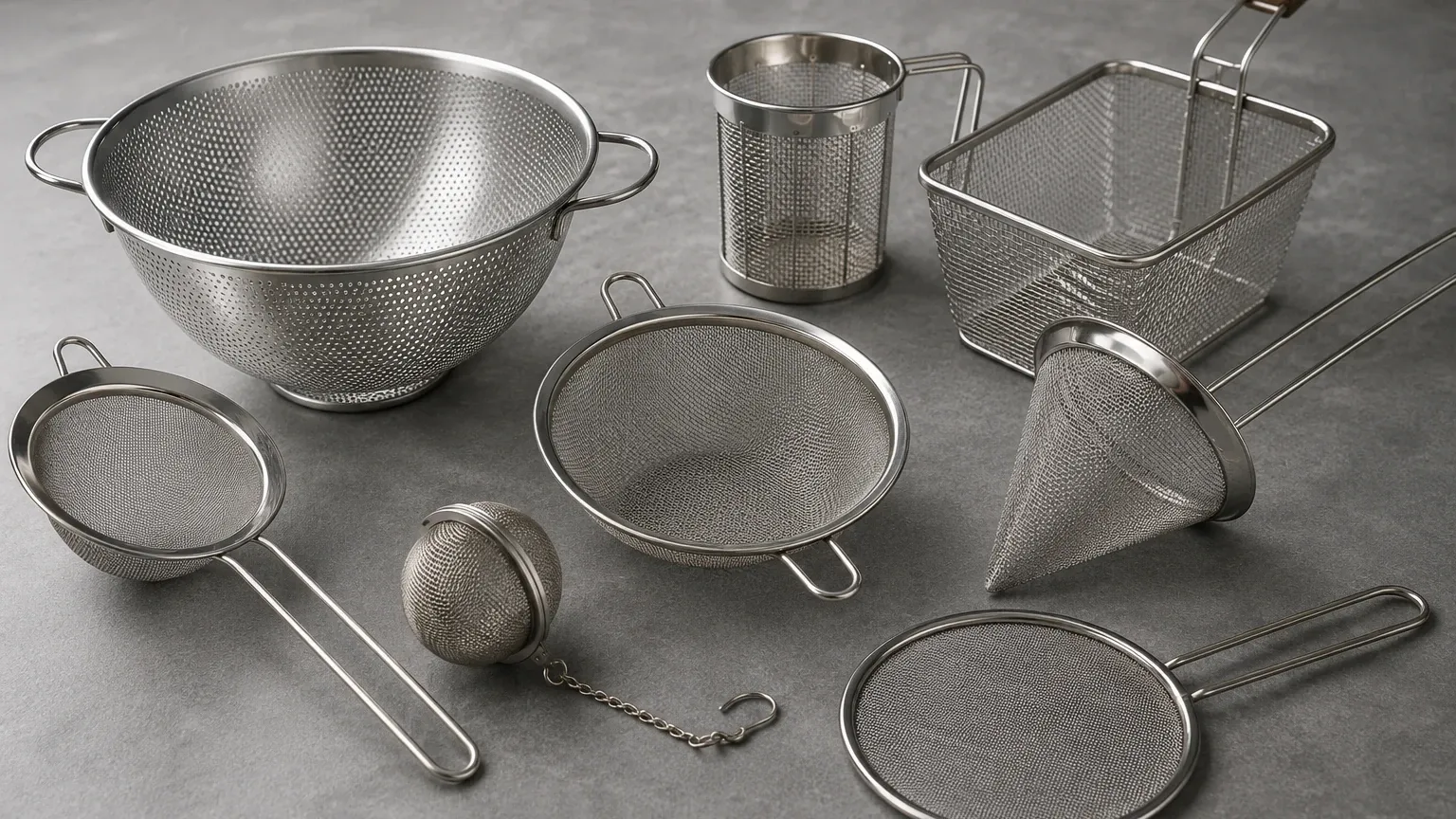
In commercial culinary environments, the chinois (a conical fine-mesh strainer) is the standard for achieving high levels of clarity in liquids. From an engineering perspective, these are essentially high-precision wire mesh filters. They are designed to remove minute particles while maintaining a consistent flow. In industrial applications, these are often replaced by conical inline strainers that can be bolted directly into a fluid handling system.
2. Perforated Basket Strainers
Unlike wire mesh, perforated baskets are constructed from a solid sheet of stainless steel with punched holes. These are typically used for "coarse" filtration, where the goal is to remove large debris or solid ingredients from a liquid stream. They offer superior structural integrity compared to mesh, making them ideal for high-pressure environments where a mesh screen might deform.
3. Industrial Simplex and Duplex Strainers
For continuous production lines, simple manual strainers are often insufficient. Simplex strainers are used when the flow can be periodically shut down for cleaning. Duplex strainers, however, feature two separate baskets with a diverter valve. This allows the operator to clean one basket while the other remains in service, ensuring zero downtime in a 24/7 manufacturing environment.
Fine Mesh vs. Coarse Mesh: Selecting the Right Filtration Accuracy
The most significant technical differentiator among the types of kitchen strainers is the mesh count or perforation size. This determines the "filtration accuracy," which is the size of the smallest particle the strainer can reliably capture.
Wire Mesh Specifications
Industrial wire mesh is defined by the number of openings per linear inch. A "20 mesh" screen has 20 openings per inch. As the mesh count increases, the openings become smaller, and the filtration becomes finer. For precision food processing—such as filtering oils or clarifying juices—engineers often specify "micron ratings." A micron is one-millionth of a meter; for reference, a human hair is approximately 70 microns thick.
When selecting mesh for Strainers & Baskets, it is vital to balance filtration fineness with flow resistance. A very fine mesh will provide excellent clarity but will also cause a significant pressure drop across the filter, potentially straining pumps and slowing down production.
Perforation Patterns
For coarser applications, perforated metal is preferred. The choice between round holes, square holes, or staggered patterns affects the "open area percentage." A higher open area allows for higher flow rates but may reduce the overall strength of the basket. In industrial kitchen settings, perforated baskets are often used as pre-filters to protect more sensitive downstream equipment, such as heat exchangers or fine-mesh cartridges.
Structural Design: Conical, Flat, and Basket Configurations
The geometry of the strainer is not merely a matter of fit; it dictates how the fluid interacts with the filter media and how easy the unit is to maintain.
Conical (Witch’s Hat) Strainers
Conical strainers are frequently used during the commissioning of a new plant or after repairs to catch construction debris. Their shape provides a large surface area relative to the pipe diameter, which helps minimize pressure drop. However, they are generally considered temporary or "start-up" strainers because they can be difficult to clean compared to basket designs.
Basket Strainers
Basket-style strainers are the workhorses of the food and beverage industry. The vertical walls of the basket allow for a significant accumulation of solids before the flow is significantly restricted. In B2B applications, these baskets are often custom-engineered with reinforced handles and heavy-duty flanges to withstand the rigors of industrial cleaning cycles.
Flat Disc Strainers
Flat discs are typically used in applications where space is extremely limited or where only minimal filtration is required. While they are the simplest of the types of kitchen strainers to manufacture, they have the lowest dirt-holding capacity and require the most frequent cleaning.
Material Selection for Food-Grade Environments
In any professional or industrial kitchen application, material selection is non-negotiable. The industry standard is stainless steel, but the specific grade of steel depends on the chemical composition of the food product and the cleaning protocols used.
Stainless Steel 304
SS304 is the most common grade used for kitchen strainers. It offers excellent corrosion resistance to most food products and is easy to sanitize. It is the cost-effective choice for general-purpose filtration of water, dairy, and non-acidic vegetables.
Stainless Steel 316 and 316L
For environments involving high salt concentrations, acidic sauces (like tomato-based products), or harsh CIP (Clean-in-Place) chemicals, SS316 is required. The addition of molybdenum in SS316 provides superior resistance to pitting and crevice corrosion. SS316L (the low-carbon version) is often specified for welded components to prevent "weld decay," ensuring the strainer remains structurally sound over years of use.
Surface Finishes and Electropolishing
In the pharmaceutical and high-end food sectors, the surface finish of the strainer is just as important as the material. A rough surface can harbor bacteria and biofilms. Industrial strainers often undergo electropolishing, a process that removes a microscopic layer of metal to create a mirror-like, ultra-smooth surface. This not only improves hygiene but also makes the strainer easier to clean, reducing the total cost of ownership.
Maintenance and Durability in High-Volume Operations
One of the primary concerns for B2B buyers is the maintenance cycle. A strainer that is difficult to clean or prone to damage leads to increased labor costs and potential production halts.
Cleaning Protocols
In industrial settings, strainers are cleaned using one of three methods:
1. Manual Cleaning: The basket is removed and scrubbed. This is common for smaller batch operations.
2. Backwashing: Fluid is pumped in the reverse direction to dislodge particles. This is common in automated systems.
3. Ultrasonic Cleaning: For very fine mesh that has become "blinded" (clogged) by fats or proteins, ultrasonic baths are used to vibrate the particles loose without damaging the delicate wire mesh.
Identifying Wear and Tear
Engineers must regularly inspect Strainers & Baskets for signs of mechanical fatigue. Common issues include "wire migration" in mesh strainers, where the wires shift and create larger-than-specified openings, and stress cracking at the weld points of basket handles. Choosing a manufacturer that utilizes advanced welding techniques, such as TIG or laser welding, significantly extends the service life of these components.
Custom OEM Solutions for Specialized Filtration Needs
While standard types of kitchen strainers are available, many industrial applications require custom-engineered solutions. Standard off-the-shelf products often fail to meet the specific flow rates, pressure requirements, or space constraints of a specialized production line.
Engineering for Specific Viscosities
Filtering water is vastly different from filtering honey or heavy syrups. A custom-designed strainer takes the viscosity of the fluid into account, adjusting the open area and structural reinforcement to ensure the basket does not collapse under the weight of the thick fluid.
Integration with Existing Systems
For OEM (Original Equipment Manufacturer) applications, strainers must be designed to fit perfectly within a larger machine. This might involve custom flange sizes, unique basket shapes, or specific mounting brackets. Working with a dedicated manufacturer like Kaifil allows companies to develop filtration components that are tailored to their specific mechanical and chemical requirements.
Conclusion: Making an Informed Selection
Selecting the right types of kitchen strainers for industrial use requires more than a cursory glance at a catalog. It involves a technical evaluation of the fluid properties, the required filtration fineness, and the operational environment. Whether the need is for a simple perforated basket to protect a pump or a high-precision duplex mesh system for continuous juice clarification, the quality of the Strainers & Baskets directly correlates to the efficiency of the entire production process.
By focusing on high-grade materials like SS316L, precise mesh counts, and robust structural designs, industrial buyers can ensure their filtration systems provide reliable performance, meet food safety standards, and deliver a low total cost of ownership over the long term.
