


Strainer Basket O Ring
In industrial filtration systems, the integrity of the seal is as critical as the filtration media itself. While the mesh or perforated metal of the filter handles the particulate removal, the strainer basket o ring ensures that the fluid bypass is eliminated, maintaining the efficiency of the entire process. For engineers and maintenance professionals in the chemical, pharmaceutical, and food processing industries, understanding the technical nuances of o-ring selection, material compatibility, and installation is essential for preventing leaks and ensuring system reliability.
Industrial strainers are designed to remove large particles from liquid streams to protect downstream equipment like pumps, valves, and heat exchangers. These systems often operate under significant pressure and temperature fluctuations. The o-ring serves as the primary static seal between the strainer basket, the housing cover, or the internal seating surface. A failure in this small component can lead to process contamination, environmental hazards, or costly downtime.
The Critical Role of the O-Ring in Industrial Filtration
The primary function of a strainer basket o ring is to create a mechanical seal that prevents fluid from bypassing the filtration element. In many basket strainer designs, the basket rests on a machined seat within the housing. Without a proper seal, the fluid will naturally take the path of least resistance, flowing around the basket rather than through the mesh. This bypass allows contaminants to reach sensitive downstream components.
In high-pressure applications, the o-ring must also withstand the force of the fluid trying to push it out of its groove—a phenomenon known as extrusion. Furthermore, in suction-side applications, the seal must prevent air from entering the system, which could cause pump cavitation. Therefore, the o-ring is not merely a consumable part but a precision-engineered component that must be matched to the specific requirements of the Strainers & Baskets in use.
Material Selection Criteria for Strainer Basket O-Rings
Selecting the correct elastomer for a strainer basket o ring is perhaps the most critical decision an engineer faces. The material must be compatible with the process fluid, the operating temperature, and the cleaning protocols (such as SIP or CIP).
Common Elastomers and Their Applications
1. Buna-N (Nitrile/NBR): This is the standard material for general-purpose industrial applications. It offers excellent resistance to petroleum-based oils, water, and some hydraulic fluids. However, it has a limited temperature range (typically up to 100°C to 120°C) and poor resistance to ozone and weathering.
2. EPDM (Ethylene Propylene Diene Monomer): Widely used in water treatment and steam applications, EPDM offers excellent resistance to heat, ozone, and weather. It is also compatible with many polar solvents and dilute acids. It is not suitable for use with petroleum oils or mineral-based lubricants.
3. Viton™ (FKM): Known for its high-temperature stability and broad chemical resistance, Viton is the preferred choice for chemical processing and high-heat environments. It can withstand temperatures up to 200°C and is resistant to most oils, fuels, and mineral acids.
4. PTFE (Teflon) and Encapsulated O-Rings: For the most aggressive chemical environments where standard elastomers fail, PTFE-encapsulated o-rings provide a silicone or FKM core for elasticity with a PTFE outer jacket for near-universal chemical resistance. These are common in pharmaceutical and high-purity chemical sectors.
5. Silicone: Often used in food and beverage applications due to its cleanliness and wide temperature range. While it has poor mechanical strength and tear resistance, its biocompatibility makes it ideal for sanitary strainers.
Engineering Specifications: Dimensions and Tolerances
When replacing a strainer basket o ring, relying on visual inspection or "close enough" measurements is a common cause of premature failure. Engineers must confirm three primary dimensions: the Inside Diameter (ID), the Outside Diameter (OD), and the Cross-Section (CS).
Compression and Gland Design
In most industrial strainers, the o-ring is housed in a "gland" or groove. To create an effective seal, the o-ring must be slightly compressed. For static seals, a compression of 15% to 30% of the cross-section is typical. If the o-ring is too thin, it will not provide enough contact pressure; if it is too thick, it may be pinched during assembly or prevent the housing cover from seating correctly.
Stretch and Volume Swell
When installed on a basket or a plug, the o-ring usually undergoes a slight stretch. An internal diameter stretch of 1% to 5% is standard. Furthermore, engineers must account for volume swell. Many elastomers will expand when they absorb process fluids. If the groove is too small to accommodate this expansion (typically 75% to 85% groove fill is the limit), the o-ring may extrude or cause the metal housing to deform.
Identifying and Preventing O-Ring Failure
Understanding the modes of failure for a strainer basket o ring allows maintenance teams to move from reactive to predictive maintenance.
Compression Set
Over time, an elastomer may lose its ability to "spring back" to its original shape after being compressed. This is known as a compression set. High temperatures accelerate this process. If an o-ring appears flat or squared-off when removed, it has reached the end of its functional life and should be replaced regardless of whether a leak has started.
Chemical Degradation
Signs of chemical incompatibility include softening, blistering, cracking, or extreme swelling. For example, using a Nitrile o-ring in a system carrying concentrated nitric acid will result in rapid hardening and cracking. Engineers should always consult chemical resistance charts before finalizing a material choice.
Installation Damage
A common cause of failure is "nicking" the o-ring during installation. If the o-ring is forced over sharp threads or un-deburred metal edges on the strainer basket, small cuts can occur. These cuts can propagate under pressure, leading to a sudden seal failure. Using compatible lubricants and ensuring all mating surfaces are smooth can mitigate this risk.
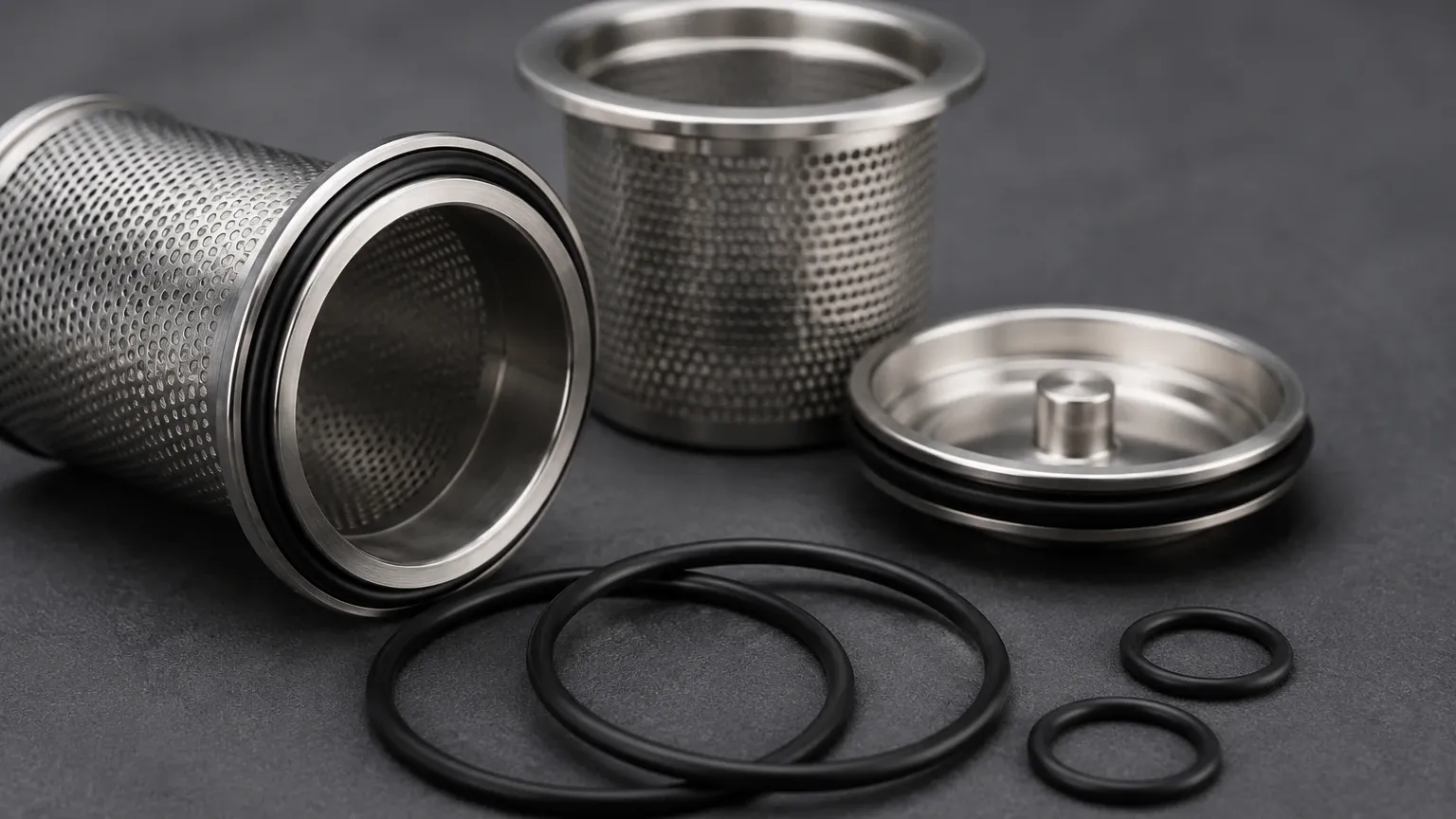
Integration with Custom Strainers & Baskets
At the manufacturing level, the design of the strainer housing and the basket must account for the sealing interface. High-performance Strainers & Baskets often feature precision-machined seats to ensure that the o-ring is held securely in place even during high-flow conditions.
For custom filtration solutions, manufacturers like Kaifil work with engineers to determine if a standard o-ring profile is sufficient or if a custom-molded seal is required. In applications involving high-viscosity fluids or extreme pressures, the basket design may include a "dovetail" groove to prevent the o-ring from being pulled out of its seat during basket removal and cleaning. This level of engineering ensures that the filtration system remains easy to maintain while providing a reliable seal every time the unit is reassembled.
Maintenance and Replacement Best Practices
To maximize the lifespan of a strainer basket o ring and ensure continuous process uptime, the following best practices should be implemented:
* Regular Inspection: Every time the strainer basket is removed for cleaning, the o-ring should be inspected for signs of wear, flattening, or chemical attack.
* Lubrication: Use a lubricant that is compatible with both the elastomer and the process fluid. For example, silicone-based lubricants are common for EPDM and Nitrile but should be avoided if the process involves silicone-sensitive paints or coatings.
* Proper Storage: Spare o-rings should be stored in a cool, dark place away from ozone-generating equipment (like electric motors) and UV light, which can cause elastomers to become brittle.
* Standardization: Where possible, standardize o-ring sizes and materials across the facility to reduce inventory complexity and the risk of installing the wrong material in a critical application.
Procurement Considerations for Industrial Applications
When sourcing o-rings for industrial strainers, purchasing teams should look beyond the unit price. The total cost of ownership includes the risk of process contamination and the labor costs associated with frequent replacements.
Confirming the following information with the supplier is vital:
* Certifications: Does the application require FDA, USP Class VI, or 3-A Sanitary standards? This is common in the food and pharmaceutical sectors.
* Traceability: For critical applications, batch traceability ensures that the material properties are consistent and meet the specified standards.
* Compatibility Testing: If the process fluid is a proprietary blend or a complex chemical mixture, performing a soak test with a sample o-ring can prevent catastrophic failures in the field.
In conclusion, the strainer basket o ring is a small but vital component of any industrial filtration system. By selecting the right material, ensuring proper engineering tolerances, and following rigorous maintenance protocols, industrial operators can ensure that their Strainers & Baskets perform at peak efficiency, protecting downstream equipment and maintaining product quality. Whether dealing with standard water filtration or complex chemical processing, the technical details of the seal should never be overlooked.
