


Strainer Basket Over Sink
In industrial and commercial environments, the management of solid waste and the protection of drainage systems begin at the point of discharge. A strainer basket over sink application is more than a simple convenience; it is a critical component of primary filtration designed to capture debris, prevent downstream clogs, and ensure compliance with environmental regulations regarding effluent quality. For engineers and facility managers, selecting the correct filtration hardware requires an understanding of material compatibility, flow dynamics, and the specific mechanical requirements of the process at hand.
Industrial sinks used in food processing, pharmaceutical laboratories, and chemical manufacturing facilities often handle a diverse range of solids. Without effective Strainers & Baskets, these solids can enter the plumbing system, leading to costly downtime, pump damage, and potential regulatory fines. This guide explores the technical considerations for selecting and implementing over-sink strainer baskets in professional settings.
Technical Role of Over-Sink Strainers in Industrial Processes
The primary function of a strainer basket over sink is to act as a coarse filter. Unlike fine process filters that operate within pressurized lines, these baskets operate under gravity flow. Their position—suspended over or seated within the sink opening—allows for the immediate separation of solids from liquid waste.
From an engineering perspective, the efficiency of these components is measured by their ability to maintain a high flow rate while capturing particles of a specific size. In high-volume environments, such as commercial kitchens or industrial wash stations, the "open area" of the mesh or perforated metal is a vital metric. If the open area is insufficient, the basket will clog rapidly, causing the sink to overflow and creating a safety hazard. Conversely, if the mesh is too coarse, it fails to protect the downstream infrastructure.
Engineering Considerations for Material Selection
Material selection is the most significant factor in determining the service life and performance of a strainer basket. Because these components are frequently exposed to water, cleaning chemicals, and varying temperatures, stainless steel is the industry standard.
Stainless Steel 304 vs. 316
Most industrial strainer baskets are manufactured from either Grade 304 or Grade 316 stainless steel.
* Grade 304: This is suitable for general-purpose applications where moisture is present but chemical exposure is limited. It provides excellent structural integrity and oxidation resistance.
* Grade 316: For environments involving high salinity (food processing) or aggressive chemicals (laboratories and chemical plants), Grade 316 is preferred. The addition of molybdenum enhances its resistance to pitting and crevice corrosion, ensuring the strainer remains hygienic and structurally sound over long-term use.
Surface Finishes and Hygiene
In the pharmaceutical and food industries, the surface finish of the strainer basket is critical. Electropolishing or high-grit mechanical polishing reduces surface roughness, which prevents the adhesion of bacteria and organic matter. This makes the strainer easier to clean and sterilize, meeting stringent health and safety standards.
Design Variations: Over-Sink vs. In-Sink Configurations
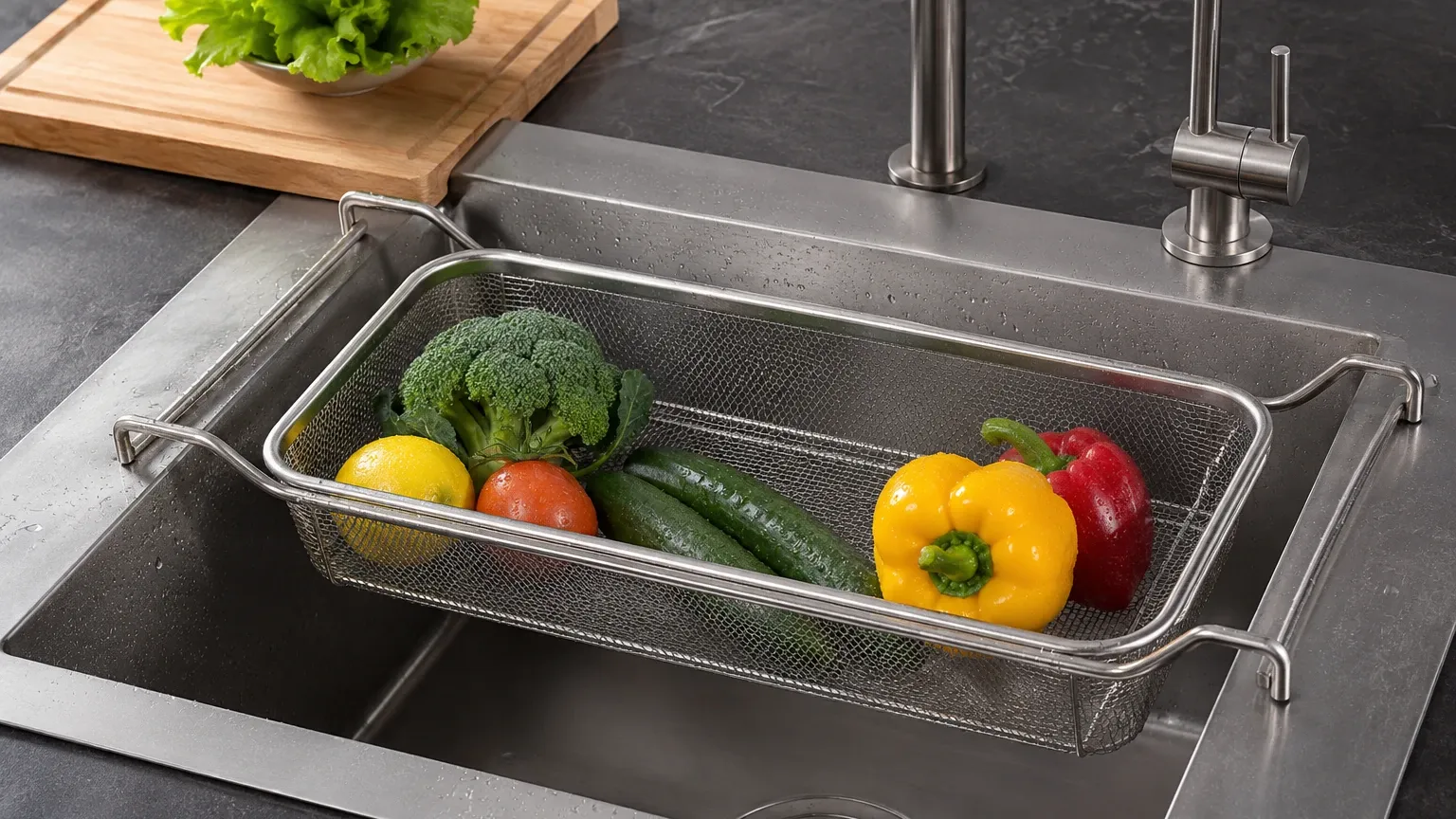
While the term "strainer basket over sink" often refers to a unit that rests on the rim of the sink, the design can vary based on the specific workflow.
Rim-Mounted Baskets
These are designed with extended handles or flanges that allow the basket to sit securely across the top of the sink. This configuration is ideal for rinsing large quantities of material where the operator needs to keep the solids elevated from the sink floor to allow for complete drainage. It is commonly used in food preparation and component cleaning.
Drop-In Basket Strainers
These units fit directly into the sink drain opening. They are often deeper than standard domestic strainers and include a handle for easy removal. In industrial settings, these are frequently paired with a secondary fine mesh liner to capture smaller particulates that might bypass a standard perforated basket.
Custom Geometry
Industrial sinks are rarely one-size-fits-all. Custom manufacturing allows for the creation of baskets that match the exact dimensions of a specific wash station. This ensures a tight fit, preventing "bypass" where liquids and solids flow around the edges of the strainer rather than through it.
Filtration Accuracy and Mesh Specifications
The performance of a strainer basket is defined by its filtration media. Depending on the application, a manufacturer may use perforated metal, woven wire mesh, or a combination of both.
1. Perforated Metal: This provides the highest structural strength. It is ideal for capturing large, heavy debris. The hole size and pattern (staggered vs. straight) determine the flow characteristics.
2. Woven Wire Mesh: For finer filtration, wire mesh is layered over a perforated support. This allows for the capture of particles down to the micron level. Engineers must balance the mesh count (wires per inch) with the wire diameter to ensure the basket does not become a bottleneck in the drainage system.
3. Reinforced Edges: Because these baskets are frequently removed, emptied, and cleaned, the top rim and bottom corners are often reinforced with solid stainless steel bands to prevent deformation.
Evaluating Flow Rates and Clogging Risks
A common failure point in industrial sink management is underestimating the volume of solids produced during a shift. When selecting a strainer basket over sink, the total volume of the basket must be sufficient to hold the accumulated waste between cleaning cycles without obstructing the flow.
Engineers use the "Ratio of Open Area" to evaluate this. A high-performance strainer typically offers an open area that is several times the cross-sectional area of the drain pipe. This ensures that even as the basket begins to fill with solids, there is enough remaining open surface area to allow the liquid to exit at the required flow rate.
Maintenance and Total Cost of Ownership
While a strainer basket is a relatively low-cost component compared to a process pump or a centrifuge, its failure can cause significant operational expenses. A poorly made basket may corrode, lose its shape, or suffer from mesh detachment.
Cleaning Cycles
In B2B environments, the ease of cleaning is a primary productivity factor. Baskets designed with smooth welds and no sharp internal corners allow for rapid emptying and sanitization. For heavy-duty applications, some baskets are designed to be compatible with ultrasonic cleaning tanks.
Replacement and Durability
Investing in high-quality stainless steel construction reduces the replacement frequency. A durable basket maintains its filtration accuracy over time, whereas a cheap, thin-walled alternative may allow larger particles to pass as the mesh stretches or tears, eventually leading to plumbing blockages that cost far more than the initial savings on hardware.
Custom OEM Solutions for Industrial Filtration
Many facilities require specialized filtration components that cannot be found in a standard catalog. Custom OEM manufacturing, such as that provided by Kaifil, allows for the development of strainer baskets tailored to unique environmental challenges. Whether it is a specific handle configuration for ergonomic safety, a unique alloy for chemical resistance, or a non-standard shape to fit a proprietary machine, custom solutions ensure optimal performance.
When consulting with a manufacturer, engineers should provide the following data points to ensure the best fit:
* Chemical Profile: What liquids will pass through the strainer?
* Particle Size: What is the smallest solid that must be captured?
* Flow Rate: What is the maximum volume of liquid expected per minute?
* Physical Dimensions: What are the precise measurements of the sink or drain opening?
Conclusion
The implementation of a professional-grade strainer basket over sink is a fundamental step in maintaining industrial efficiency and protecting facility infrastructure. By prioritizing material quality, precise filtration specs, and robust mechanical design, purchasing teams can ensure they are providing their operations with a reliable tool that minimizes maintenance and maximizes uptime. For those seeking high-performance filtration components, exploring specialized Strainers & Baskets is the best way to secure a solution that meets the rigorous demands of modern industrial processing.
