


Strainer Basket Square
In the landscape of industrial filtration, the geometry of a filter component is often as critical as the material from which it is constructed. While cylindrical filters are ubiquitous in pressurized piping systems, the strainer basket square configuration serves a specialized and vital role in various industrial processes. These square or rectangular baskets are engineered to fit specific housing geometries, such as trench drains, rectangular sumps, or custom-designed machinery where space constraints or flow patterns necessitate a non-cylindrical approach. For engineers and procurement teams, understanding the technical nuances of these components is essential for ensuring system longevity and filtration efficiency.
Industrial filtration relies on the ability to remove solid contaminants from liquid or gas streams. The Strainers & Baskets provided by professional manufacturers like Kaifil are designed to handle high-volume flow while maintaining structural integrity under significant differential pressure. This article explores the engineering considerations, material selections, and customization options associated with square strainer baskets, providing a technical foundation for informed decision-making.
Engineering Geometry and Flow Dynamics
The primary reason for selecting a strainer basket square design over a traditional round basket is usually dictated by the physical environment of the installation. In many gravity-fed systems or open-channel flows, the containment vessel is rectangular. A square basket maximizes the available surface area within that footprint, which is critical for reducing the frequency of cleaning cycles and minimizing pressure drop.
From a fluid dynamics perspective, square baskets present unique challenges. In a cylindrical strainer, flow is generally uniform across the circumference. In a square configuration, the corners can potentially become "dead zones" where flow velocity decreases, leading to uneven sediment accumulation. To mitigate this, engineers often specify radiused corners or reinforced mesh structures that encourage more uniform distribution. When calculating the required surface area, it is important to consider the "open area ratio." This ratio compares the total area of the holes or mesh openings to the total surface area of the basket. A higher open area ratio reduces the initial pressure drop across the filter, which is vital for maintaining pump efficiency and preventing cavitation in suction-side applications.
Material Selection for Industrial Environments
Material compatibility is the cornerstone of industrial filtration reliability. Because square strainer baskets are often used in harsh environments—ranging from chemical processing to food production—the choice of stainless steel grade is paramount.
1. Stainless Steel 304: This is the standard grade for general-purpose applications. It offers excellent corrosion resistance to most oxidizing acids and is widely used in food and beverage processing due to its ease of cleaning and durability. However, it is susceptible to pitting in high-chloride environments.
2. Stainless Steel 316/316L: For applications involving marine environments, brine, or aggressive chemicals, SS316 is the preferred choice. The addition of molybdenum enhances its resistance to chloride-induced pitting and crevice corrosion. The "L" (low carbon) variant is often specified for components requiring extensive welding, as it prevents carbide precipitation that can lead to intergranular corrosion.
3. Specialty Alloys: In extreme cases involving high temperatures or highly acidic media, manufacturers may utilize Duplex stainless steel or Monel. These materials provide superior mechanical strength and chemical stability where standard grades might fail.
Beyond the alloy, the surface finish also plays a role. For pharmaceutical and food-grade applications, electrolytic polishing may be required to remove microscopic surface irregularities, thereby preventing bacterial growth and making the basket easier to sanitize.
Construction and Structural Reinforcement
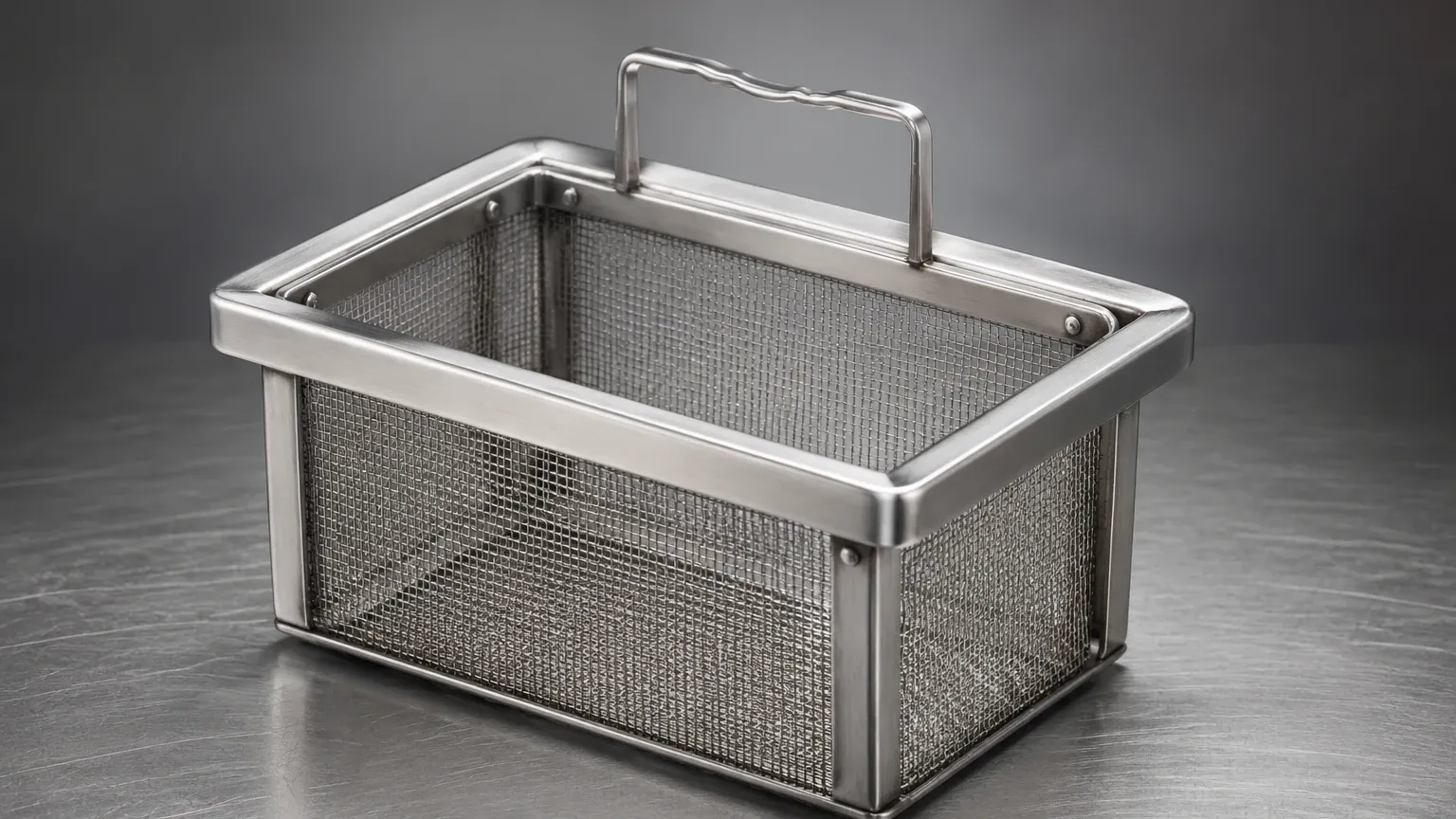
A strainer basket square must be robust enough to withstand the weight of collected debris and the force of the fluid flow. The construction typically involves a multi-layered approach:
The Support Structure
The foundation of the basket is usually a perforated metal plate. This plate provides the mechanical strength needed to prevent the basket from collapsing under pressure. The thickness of the plate and the size of the perforations are engineered based on the expected flow rate and the weight of the solids to be captured.
The Filtration Media
Inside or outside the perforated support, a layer of fine wire mesh is often added to achieve the desired filtration accuracy. This mesh is measured in microns or mesh count (the number of wires per linear inch). In high-precision applications, multiple layers of mesh may be sintered together to create a rigid, high-strength filter medium that can be cleaned repeatedly without losing its shape.
Reinforcement and Handles
Because square baskets can be heavy when full, they are often equipped with heavy-duty handles, such as swing bails or fixed bars, to facilitate safe removal. Structural reinforcement, such as angle iron frames or flat bar ribs, may be welded to the exterior of the basket to ensure it remains seated correctly within the housing and does not warp over time.
Customization Parameters for Specialized Applications
One of the primary advantages of working with a manufacturer like Kaifil is the ability to customize the strainer basket square to exact specifications. Off-the-shelf solutions rarely meet the precise needs of complex industrial systems. Key customization parameters include:
* Dimensional Accuracy: Precise length, width, and depth measurements are required to ensure a bypass-free fit. Even a few millimeters of gap can allow contaminants to pass the filter, potentially damaging downstream equipment like pumps or spray nozzles.
* Flange and Seating Designs: The top of the basket may feature a flat flange, an O-ring groove, or a specialized gasket seat to ensure a tight seal against the housing.
* Filtration Gradient: In some cases, a basket may be designed with different mesh sizes at different levels to manage varying types of debris or to facilitate staged filtration.
* Drainage and Sludge Management: For baskets used in heavy-duty sludge removal, the bottom may be designed with a sloped profile or a quick-release valve to assist in emptying the collected waste.
Operational Maintenance and Service Life
The total cost of ownership for a strainer basket square is heavily influenced by its maintenance requirements and durability. Unlike disposable cartridge filters, stainless steel baskets are designed for long-term reuse. However, their service life depends on proper handling and cleaning protocols.
Cleaning Cycles
Determining the optimal cleaning cycle is usually done by monitoring the differential pressure (ΔP) across the strainer. When the ΔP reaches a predetermined limit (typically 10-15 psi above the clean pressure drop), the basket should be removed and cleaned. Allowing the pressure drop to increase beyond this point risks damaging the mesh or forcing contaminants through the filter media.
Cleaning Methods
Mechanical cleaning involves brushing or high-pressure water jets. For stubborn contaminants, such as resins or fats, chemical cleaning or ultrasonic baths may be necessary. It is crucial to ensure that the cleaning method does not damage the wire mesh. For example, using a wire brush made of carbon steel on a stainless steel basket can embed iron particles into the surface, leading to "tea staining" or localized rusting.
Inspection for Wear
During each cleaning cycle, the basket should be inspected for signs of fatigue. Common issues include broken wires in the mesh, cracked welds at the corners, or deformation of the support structure. Early detection of these issues allows for repair or planned replacement, preventing catastrophic system failure.
Procurement Strategy: Evaluating Quality and Performance
When sourcing a strainer basket square, purchasing teams should look beyond the initial price tag. A low-cost basket made with inferior welding techniques or thinner-than-specified materials will likely fail prematurely, leading to expensive downtime and potential damage to other system components.
Engineers should request documentation regarding material certifications (MTRs) to verify the grade of stainless steel. Furthermore, understanding the manufacturer's welding standards—such as TIG welding for clean, strong joints—is essential for ensuring the basket can handle the rigors of industrial use.
Kaifil’s expertise in providing custom Strainers & Baskets ensures that each component is engineered for the specific demands of the application. By focusing on precision manufacturing and high-quality materials, they help industrial operators achieve reliable filtration performance while minimizing the total cost of ownership.
In conclusion, the strainer basket square is a critical component in many industrial systems where standard cylindrical filters are impractical. By carefully considering geometry, material science, and structural design, engineers can select a filtration solution that provides the necessary protection for their equipment and maintains the purity of their process fluids. Whether in a chemical plant, a food processing facility, or a water treatment station, a well-engineered square strainer basket is an investment in operational stability and efficiency.
