


Strainer Baskets for Pumps
In industrial fluid handling systems, the pump is often the most critical and expensive component. Protecting this asset from debris, scale, and foreign particulates is essential for maintaining operational uptime and preventing catastrophic mechanical failure. Strainer baskets for pumps serve as the primary line of defense, capturing solids before they can enter the pump casing where they might damage impellers, wear rings, or mechanical seals.
As a specialized manufacturer of stainless steel filtration solutions, Kaifil provides precision-engineered Strainers & Baskets designed to meet the rigorous demands of chemical processing, food production, and water treatment. Selecting the correct strainer basket requires a deep understanding of fluid dynamics, material compatibility, and the specific mechanical requirements of the pumping system.
Understanding the Role of Strainer Baskets in Pump Systems
Strainer baskets are typically installed in the suction side of a pump. Their primary function is to remove large solids that could cause blockages or abrasive wear. Unlike fine filters that target microscopic particles, strainer baskets are designed for high-flow environments where the goal is to protect downstream equipment rather than achieve high-purity fluid polishing.
When debris enters a pump, several issues can occur:
1. Impeller Damage: Hard particles can pit or erode the impeller blades, leading to imbalance and reduced hydraulic efficiency.
2. Mechanical Seal Failure: Fine grit can find its way into the narrow tolerances of mechanical seals, causing overheating and leakage.
3. Clogging: Large debris can physically block the eye of the impeller, significantly reducing flow and potentially leading to pump cavitation.
By utilizing high-quality strainer baskets for pumps, engineers can ensure that the fluid entering the pump meets the necessary cleanliness standards to maintain the design life of the equipment.
Engineering Considerations: Open Area Ratio and Pressure Drop
One of the most critical technical specifications when selecting or designing a strainer basket is the Open Area Ratio (OAR). This is the ratio of the total area of the holes in the basket to the cross-sectional area of the inlet pipe.
For pump suction applications, a high OAR is vital. A common engineering standard is to maintain an OAR of at least 6:1. If the open area is too small, the strainer will create a significant pressure drop (Delta P). In suction applications, an excessive pressure drop can lower the Net Positive Suction Head Available (NPSHa) below the Net Positive Suction Head Required (NPSHr) by the pump, leading to cavitation. Cavitation causes the formation and subsequent collapse of vapor bubbles, which can destroy internal pump surfaces in a matter of hours.
Kaifil’s engineering team focuses on optimizing the hole pattern and mesh selection to maximize the open area while maintaining the structural integrity required to withstand the differential pressure that occurs as the basket collects debris.
Material Selection for Industrial Environments
Material durability is a non-negotiable factor in industrial filtration. Because strainer baskets are often exposed to corrosive chemicals, high temperatures, and high-velocity fluids, the choice of alloy is paramount.
Stainless Steel 304
This is the standard grade for general industrial use. It offers excellent strength and good corrosion resistance in most water and mild chemical applications. It is frequently used in HVAC systems and general manufacturing water loops.
Stainless Steel 316 and 316L
For more demanding environments, such as pharmaceutical manufacturing or chemical processing, SS316 is the preferred choice. The addition of molybdenum provides superior resistance to chlorides and pitting. SS316L (low carbon) is used when welding is required during the fabrication of the basket to prevent carbide precipitation and ensure long-term weld integrity.
Specialty Alloys
In highly aggressive environments involving seawater or concentrated acids, specialty alloys like Duplex stainless steel or Monel may be required. Kaifil works closely with clients to match the material selection to the specific chemical profile of the process fluid, ensuring the strainer does not become a point of failure due to corrosion.
Customization Options for OEM and Specialized Applications
Standard off-the-shelf strainer baskets often fail to meet the specific geometric or performance requirements of custom industrial machinery. As an OEM-focused manufacturer, Kaifil provides extensive customization options for Strainers & Baskets to ensure a perfect fit and optimal performance.
Construction Styles
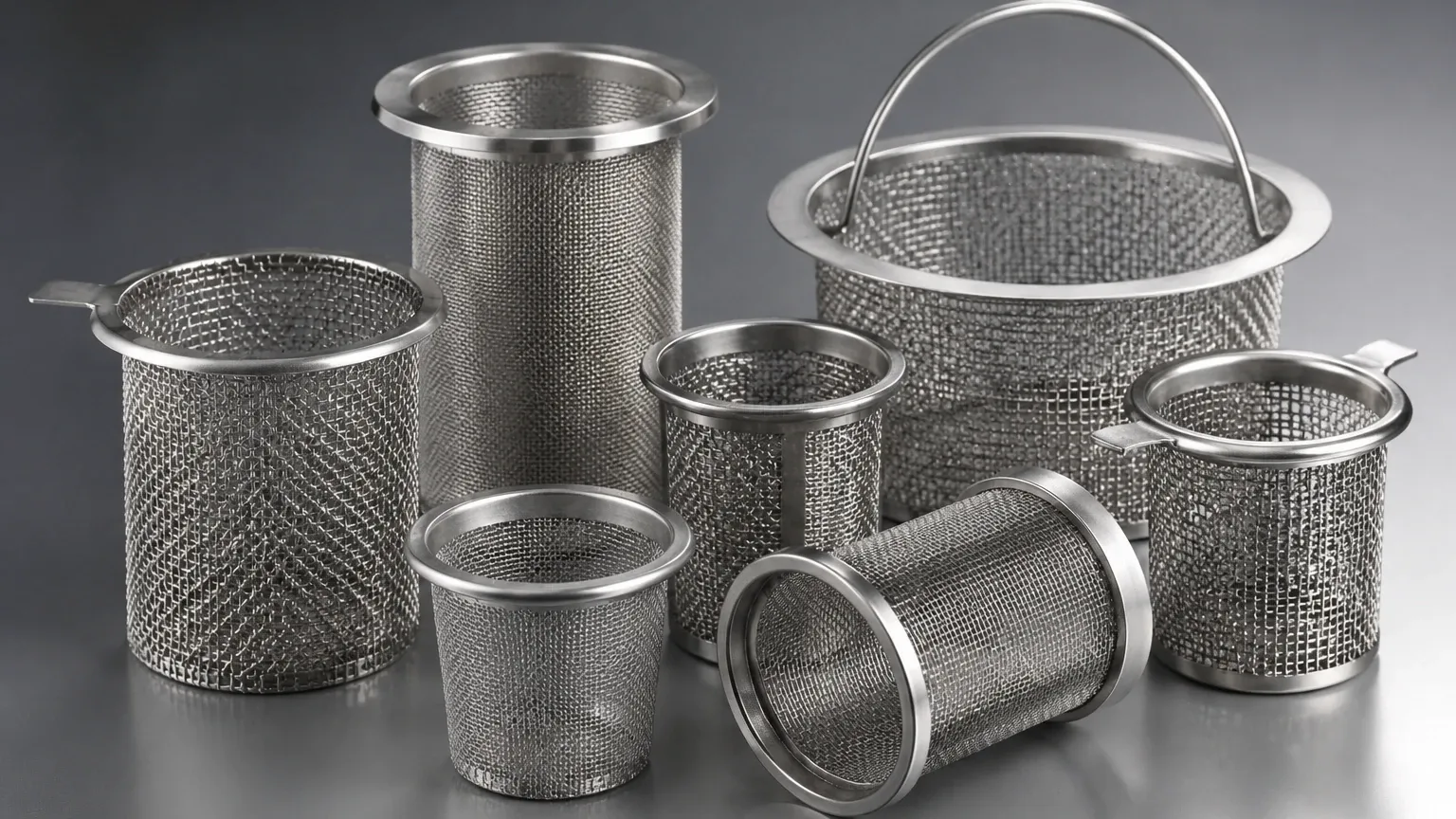
* Perforated Metal Baskets: These provide the highest structural strength and are ideal for removing large, heavy debris. Hole sizes can range from 1/2" down to 1/32".
* Mesh-Lined Baskets: For finer filtration, a stainless steel wire mesh is lined inside or outside a perforated metal support basket. This "dual-layer" approach combines the fine filtration of wire cloth with the mechanical strength of perforated plate.
* Pleated Designs: In applications where space is limited but a high open area is required, pleated mesh baskets increase the available surface area within the same footprint, extending the time between cleaning cycles.
Handle and Sealing Configurations
Ease of maintenance is a key design consideration. Custom baskets can be equipped with various handle types—such as swing handles, fixed bars, or slanted handles—to facilitate quick removal from the strainer housing. Furthermore, the sealing surface (the flange or top ring) must be machined to precise tolerances to prevent fluid bypass, ensuring that all fluid passes through the filtration media.
Maintenance and Operational Lifespan
The total cost of ownership for a pump system is heavily influenced by maintenance efficiency. Strainer baskets for pumps are consumable items in the sense that they require regular cleaning, but high-quality stainless steel construction ensures they can be reused for years if handled correctly.
Monitoring Differential Pressure
Engineers should always install pressure gauges upstream and downstream of the strainer. A rising differential pressure is the most reliable indicator that the basket is filling with debris. Most systems are designed with a "clean" pressure drop of less than 2 PSI. When the pressure drop reaches a predetermined limit (often 10-15 PSI depending on the basket's structural rating), the basket must be cleaned.
Cleaning Procedures
To maintain the integrity of the wire mesh, cleaning should be performed using soft brushes or ultrasonic baths rather than high-pressure water jets, which can displace the wire weave and alter the filtration rating. For baskets used in the food and beverage industry, the design must be free of "dead zones" where bacteria could proliferate, allowing for effective Clean-in-Place (CIP) or Steam-in-Place (SIP) sterilization.
Selecting the Right Strainer Basket: A Technical Checklist
When specifying strainer baskets for pumps, purchasing teams and engineers should confirm the following parameters to ensure the solution is fit for purpose:
1. Fluid Characteristics: Confirm the viscosity, density, and temperature of the fluid. High-viscosity fluids require larger hole sizes or increased surface area to maintain flow.
2. Contaminant Profile: What is the nature of the debris? Is it hard and angular (like weld slag) or soft and fibrous? This determines whether a simple perforated basket or a reinforced mesh lining is needed.
3. Flow Rate: Ensure the basket design can handle the maximum system flow without exceeding the allowable pressure drop.
4. Filtration Rating: Define the maximum particle size that can safely pass through the pump. Selecting a mesh that is too fine will lead to frequent clogging and unnecessary maintenance costs.
5. Housing Compatibility: Confirm the exact dimensions, including the flange diameter, basket depth, and seat type, to ensure a bypass-free fit within the existing strainer body.
The Kaifil Advantage in Industrial Filtration
Kaifil’s expertise in custom stainless steel fabrication allows us to bridge the gap between standard filtration components and specialized engineering requirements. By controlling the entire manufacturing process—from material selection and precision perforation to final assembly and quality inspection—we deliver strainer baskets that provide reliable protection for critical pump infrastructure.
Whether you are designing a new hydraulic system, upgrading a chemical processing line, or seeking a more durable replacement for OEM baskets, understanding the technical nuances of Strainers & Baskets is the first step toward optimized system performance. Our commitment to quality and technical support ensures that every filtration component we produce meets the high standards required by today’s industrial professionals.
