


Strainer Big Size
In industrial fluid handling, the scale of operation often dictates the complexity of the filtration system. When engineers specify a strainer big size, they are typically addressing high-flow applications where protecting downstream equipment—such as pumps, heat exchangers, and sensitive instrumentation—is critical to operational uptime. Large-scale strainers are not merely oversized versions of standard components; they require specific engineering considerations regarding structural integrity, fluid dynamics, and maintenance ergonomics.
As a specialized manufacturer of custom stainless steel filtration solutions, Kaifil provides high-performance Strainers & Baskets designed to meet the rigorous demands of chemical processing, water treatment, and large-scale industrial manufacturing. Understanding the technical nuances of large-diameter strainers is essential for procurement teams and engineers to ensure long-term reliability and cost-efficiency.
Engineering Considerations for Large-Scale Strainers
When dealing with a strainer big size, the primary engineering challenge is managing the relationship between flow rate and pressure drop ($ \Delta P $). In large-diameter piping systems, even a minor increase in resistance can lead to significant energy losses and potential cavitation in centrifugal pumps.
Flow Velocity and Turbulence
In large systems, fluid velocity must be carefully managed. High-velocity flow through a strainer can cause turbulence, which increases the likelihood of vibration and mechanical fatigue. Engineers must calculate the "open area ratio"—the ratio of the total area of the holes in the strainer basket to the internal cross-sectional area of the inlet pipe. For large-scale applications, an open area ratio of at least 6:1 is often recommended to ensure that the pressure drop remains within acceptable limits even as the basket begins to collect debris.
Structural Reinforcement
The physical force exerted on a large strainer basket can be immense, especially under high-pressure conditions or when the basket is heavily loaded with solids. Unlike small strainers, a strainer big size often requires internal or external reinforcement. This may include heavy-duty perforated metal backings for fine wire mesh linings or longitudinal ribs welded to the basket frame to prevent collapsing or bypassing under differential pressure spikes.
Material Selection and Durability in Heavy-Duty Filtration
The longevity of a large-scale strainer is heavily dependent on material compatibility and the quality of the manufacturing process. For most industrial applications, stainless steel is the preferred material due to its mechanical strength and resistance to various forms of corrosion.
Grade 304 vs. 316L Stainless Steel
* Grade 304: Suitable for general industrial use, water treatment, and food processing where moderate corrosion resistance is required. It offers excellent structural properties for large housings and baskets.
* Grade 316L: Specified for more aggressive environments, such as chemical processing or marine applications. The addition of molybdenum provides superior resistance to pitting and crevice corrosion, particularly in chloride-rich environments. The "L" (low carbon) designation is crucial for large welded structures to prevent sensitization and intergranular corrosion at the weld zones.
Surface Treatments and Coatings
In some large-scale applications, additional surface treatments such as electropolishing or passivating are applied to the stainless steel. Electropolishing is particularly valuable in the pharmaceutical and food industries, as it removes surface irregularities where bacteria could potentially lodge, ensuring a higher standard of hygiene and easier cleaning cycles for large components.
Key Design Features of Industrial Strainers & Baskets
The efficiency of a strainer big size is largely determined by the design of its internal components. The basket is the heart of the strainer, and its configuration must be tailored to the specific debris profile of the process fluid.
Basket Geometry and Capacity
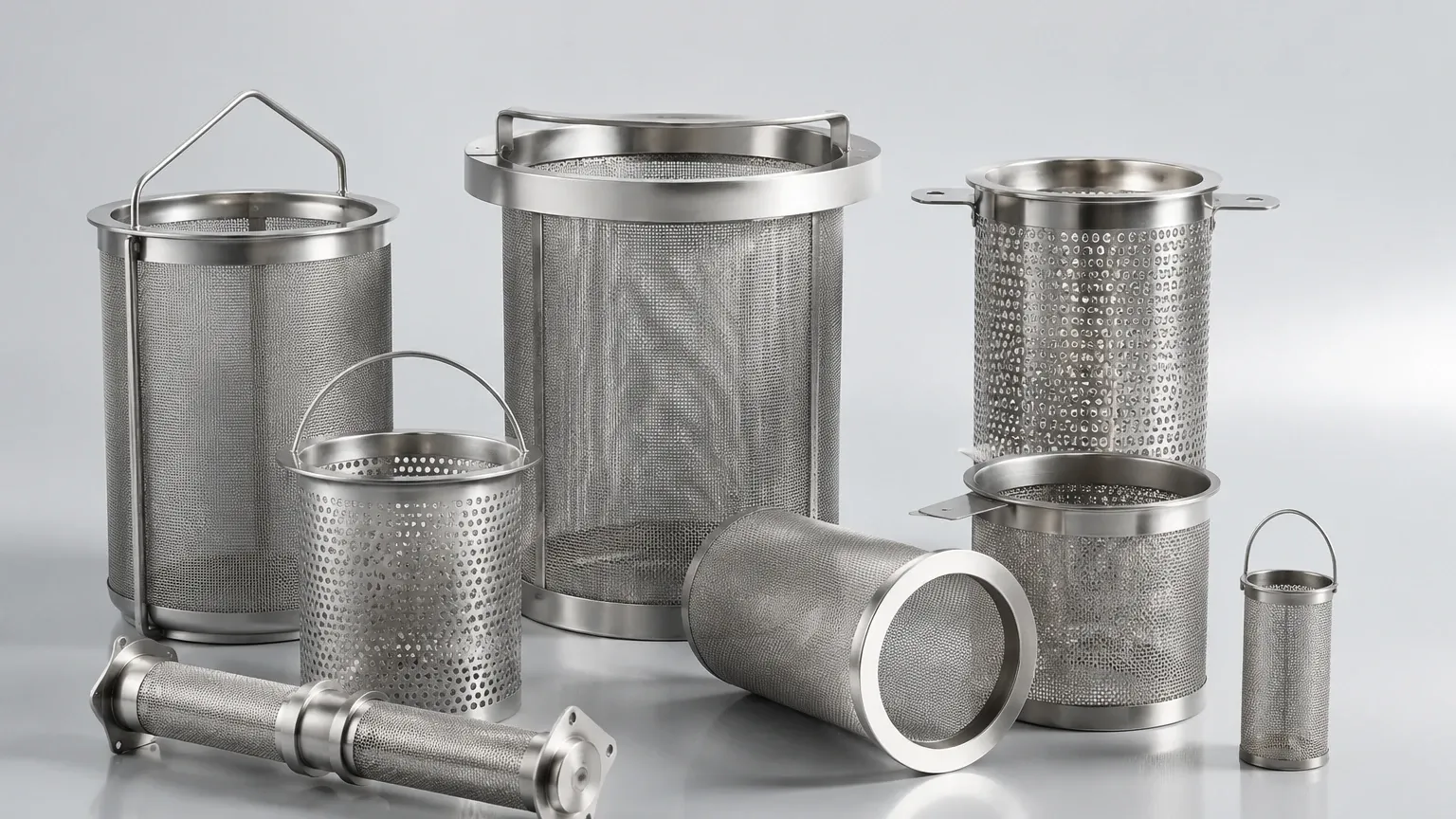
Large strainers often utilize deep-draw or multi-basket configurations to maximize surface area within a compact footprint. For very large pipe diameters (e.g., 12 inches and above), a single basket might become too heavy for manual removal. In these cases, manufacturers like Kaifil may design multi-basket systems or incorporate lifting eyes and davit arms into the housing design to facilitate safe maintenance.
Perforation and Mesh Selection
The choice between perforated plate and wire mesh depends on the required filtration accuracy.
1. Perforated Plate: Acts as a robust primary strainer for removing large solids (e.g., stones, scale, or bolts).
2. Wire Mesh Liners: When finer filtration is required, a stainless steel wire mesh is lined inside the perforated basket. The perforated plate provides the structural strength, while the mesh determines the filtration micron rating.
For a strainer big size, the mesh must be securely bonded or welded to the support structure to prevent "fluttering," which can lead to wire fatigue and eventual failure of the filtration media.
Application-Specific Requirements for Large Strainers
Different industries have unique demands that influence the specification of large-scale filtration equipment.
Chemical and Petrochemical Processing
In these sectors, large strainers must often comply with specific pressure vessel codes (such as ASME Section VIII). The focus is on chemical compatibility and the ability to withstand high temperatures. Sealing mechanisms, such as heavy-duty gaskets or O-rings, must be selected based on their resistance to the specific chemicals being processed.
Water Treatment and Desalination
Large-scale water intake systems require strainers capable of handling high volumes of raw water. In these applications, the strainer big size is often equipped with automatic self-cleaning mechanisms or duplex configurations. A duplex strainer allows for continuous operation by diverting flow from one basket to another during cleaning, which is essential for municipal water supplies or cooling water loops in power plants.
Food and Beverage Production
For large-scale food production, such as juice processing or dairy manufacturing, the strainer must meet sanitary standards. This includes smooth internal welds, the absence of dead legs where product can stagnate, and the use of food-grade materials. The ability to quickly disassemble and clean a large strainer is a primary concern for maintaining production schedules.
Maintenance and Operational Longevity
One of the most overlooked aspects of purchasing a strainer big size is the total cost of ownership, which is heavily influenced by maintenance requirements.
Monitoring Pressure Differential
To optimize the cleaning cycle, large industrial strainers should be equipped with differential pressure gauges. By monitoring the pressure drop across the Strainers & Baskets, operators can identify the exact moment a basket requires cleaning. This prevents unnecessary downtime and protects the basket from damage caused by excessive debris buildup.
Cleaning Procedures for Large Baskets
Cleaning a large strainer basket requires a systematic approach. Because of their size, these baskets may require specialized cleaning stations involving high-pressure water jets or ultrasonic baths. For baskets used in adhesive or resin applications, chemical cleaning may be necessary. It is vital to inspect the mesh for signs of wear or "blinding" (permanent clogging of the pores) during every maintenance cycle.
Replacement Cycles
While high-quality stainless steel strainers are designed for years of service, the internal baskets are considered wear parts. Factors such as abrasive particles in the fluid, frequent pressure surges, and corrosive attack will eventually necessitate replacement. Keeping spare baskets on-site is a standard best practice for large-scale operations to minimize emergency downtime.
Customization Options for Industrial Projects
Off-the-shelf solutions rarely meet the exact needs of a complex industrial system, especially when a strainer big size is required. Customization allows for the optimization of the filtration system to the specific environment.
Dimensional and Connection Flexibility
Custom manufacturers can adjust the face-to-face dimensions of the strainer housing to fit into existing piping layouts. This is particularly useful in retrofit projects where space is limited. Connection types can also be customized, ranging from standard ANSI flanges to specialized victaulic or DIN connections.
Specialized Filtration Media
Depending on the application, the filtration media can be customized beyond standard mesh. This includes wedge wire for high-strength applications or multi-layered sintered mesh for precise filtration in high-pressure environments. Kaifil works closely with engineering teams to determine the optimal material and structure based on the particle size distribution and fluid characteristics.
Conclusion: Selecting the Right Large-Scale Strainer
Specifying a strainer big size is a critical decision that impacts the efficiency and safety of an entire industrial process. By focusing on engineering fundamentals—such as flow velocity, structural reinforcement, and material science—purchasing teams can select a solution that provides reliable protection for their downstream assets.
When evaluating Strainers & Baskets, it is essential to partner with a manufacturer that understands the technical demands of large-scale filtration. Kaifil’s expertise in custom stainless steel fabrication ensures that every strainer is built to handle the specific pressures, temperatures, and flow rates of your application. Whether you are managing a chemical plant, a water treatment facility, or a food production line, the right large-scale strainer is a foundational component of a robust and profitable operation.
