


Strainer Equipment
In industrial fluid handling and process engineering, the protection of downstream equipment is a critical operational priority. Strainer equipment serves as the primary line of defense, utilizing mechanical separation to remove coarse particles, debris, and contaminants from liquid or gas streams. Unlike fine filtration systems designed for sub-micron particle removal, industrial strainers are engineered to handle higher solids loading and provide high-flow capacity while maintaining low pressure drops.
For engineers and procurement professionals, selecting the right Strainers & Baskets involves a complex evaluation of fluid dynamics, material compatibility, and maintenance requirements. This guide examines the technical nuances of strainer equipment, providing the factual foundation necessary for optimizing system performance and longevity.
The Role of Strainer Equipment in Process Systems
Strainer equipment is fundamentally a closed-loop pressure vessel containing a removable screen or basket. Its primary function is to intercept solid particles that could otherwise cause catastrophic failure or excessive wear in sensitive components such as pumps, control valves, flow meters, and heat exchangers.
In many industrial applications, strainers are installed upstream of more expensive filtration units. By capturing larger particulates, they extend the life of fine filter cartridges and reduce the frequency of costly media replacements. The effectiveness of a strainer is measured not just by what it removes, but by its ability to do so without significantly impeding the flow of the process fluid. This balance between filtration efficiency and hydraulic performance is the cornerstone of industrial strainer design.
Engineering Criteria for Selection
When specifying strainer equipment, several engineering parameters must be analyzed to ensure the component meets the specific needs of the application. Failure to account for these variables can lead to premature clogging, structural failure of the basket, or system-wide pressure issues.
1. Flow Rate and Pressure Drop (Delta P)
Every strainer introduces a degree of resistance to the flow. This resistance, known as pressure drop or Delta P, is influenced by the fluid's velocity, viscosity, and the "open area ratio" of the strainer basket. The open area ratio is the relationship between the total area of the holes in the screen and the cross-sectional area of the inlet pipe. A common engineering standard for industrial strainers is an open area ratio of at least 4:1. If the ratio is too low, the pressure drop increases rapidly as the basket begins to collect debris, leading to cavitation in pumps or reduced throughput.
2. Filtration Accuracy: Mesh vs. Micron
Selecting the correct perforation or mesh size is a critical decision. If the opening is too large, harmful particles pass through; if it is too small, the strainer will clog too frequently.
* Perforated Metal: Generally used for coarser straining (0.5 mm to several millimeters).
* Wire Mesh: Used for finer applications. Stainless steel wire mesh can be woven to precise specifications to capture particles down to approximately 40 microns.
Engineers must determine the maximum allowable particle size for downstream equipment and select a strainer opening slightly smaller than that value.
3. Fluid Viscosity
Viscosity plays a significant role in how fluid passes through the strainer equipment. High-viscosity fluids, such as heavy oils or resins, require larger surface areas and coarser screens to prevent excessive pressure buildup. In these cases, oversized strainer bodies are often specified to compensate for the increased resistance.
Material Science in Strainer Construction
The durability of strainer equipment is largely dependent on the materials used for the body and the internal basket. In demanding industrial environments, stainless steel is the industry standard due to its mechanical strength and resistance to corrosion.
* Type 304 Stainless Steel: Suitable for general-purpose applications, including water treatment and some food processing, where mild corrosion resistance is required.
* Type 316/316L Stainless Steel: Contains molybdenum, which provides superior resistance to chlorides and acidic environments. This is the preferred material for chemical processing, pharmaceutical manufacturing, and marine applications.
* Specialty Alloys: For highly corrosive or high-temperature environments, materials like Monel, Hastelloy, or Duplex stainless steel may be required to prevent pitting and stress corrosion cracking.
Kaifil specializes in the precision manufacturing of these components, ensuring that the structural integrity of the basket can withstand the differential pressure that occurs when the screen becomes partially blinded.
Common Design Configurations
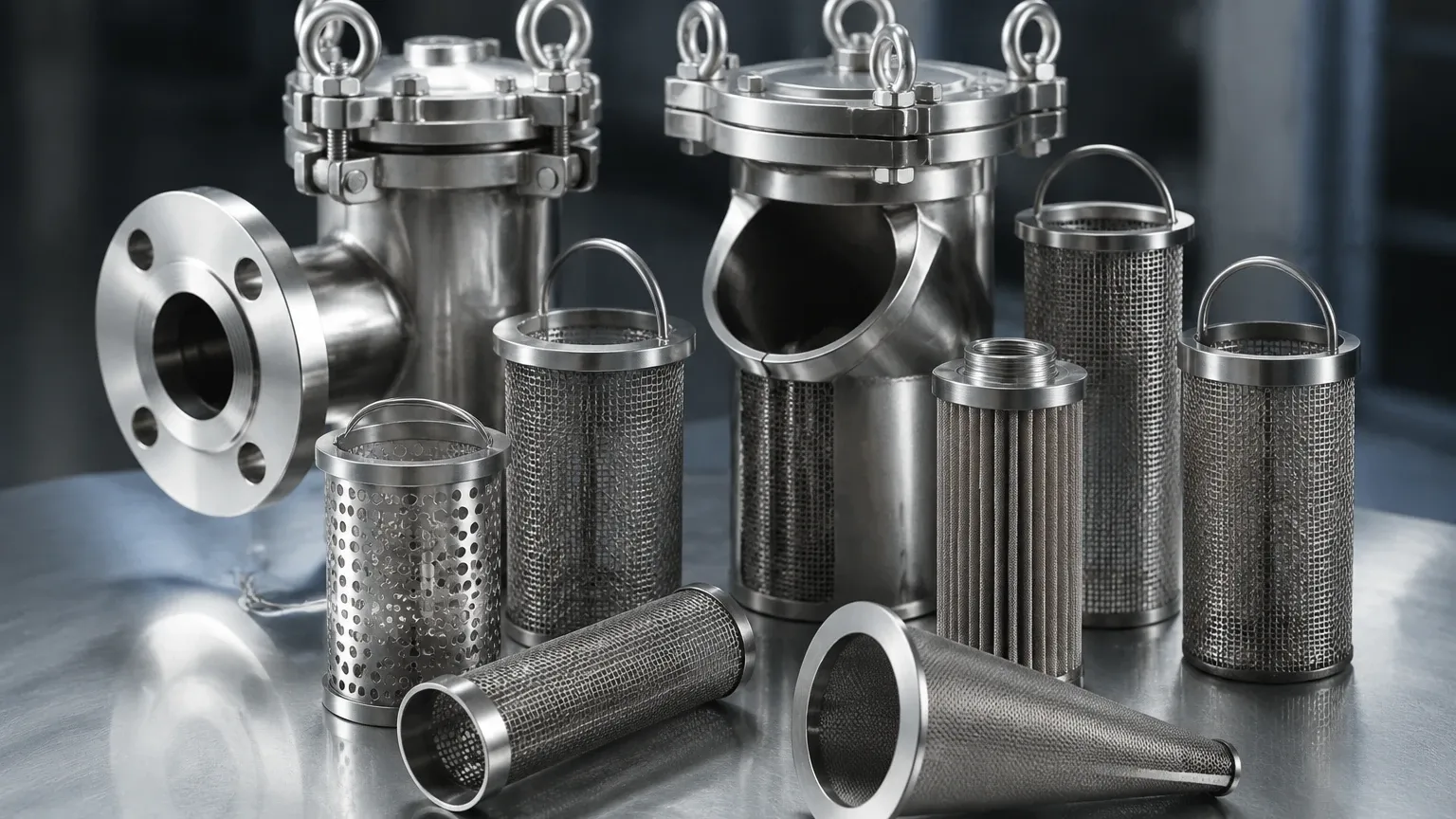
Strainer equipment is available in several standard configurations, each suited to different operational needs. Understanding the pros and cons of each is essential for system design.
Y-Strainers
Named for their shape, Y-strainers are typically used in applications where the amount of solids to be removed is small. They are compact and can be installed in either horizontal or vertical pipelines. However, they have a limited dirt-holding capacity and generally require the system to be shut down for cleaning.
Simplex Basket Strainers
Simplex strainers feature a top-loading basket that offers a much larger surface area than a Y-strainer. This design is ideal for high-flow applications with higher solids loading. Like the Y-strainer, the process must be stopped to remove and clean the basket.
Duplex Basket Strainers
For processes that cannot tolerate downtime, duplex strainers are the solution. These consist of two separate strainer chambers connected by a diverting valve. When one basket becomes full, the flow is diverted to the clean chamber, allowing the operator to service the dirty basket without interrupting the flow. This is common in fuel oil systems, cooling water loops, and continuous chemical reactors.
Customization and OEM Capabilities
Off-the-shelf strainer equipment often fails to meet the unique constraints of specialized industrial machinery. Customization is frequently required in terms of flange connections, housing dimensions, and internal basket reinforcements.
Professional manufacturers like Kaifil provide OEM solutions where the strainer is designed as an integral part of a larger system. This includes custom-engineered wire mesh configurations, reinforced baskets for high-pressure differentials, and specialized coatings. When sourcing custom components, engineers should provide detailed data on fluid chemistry, operating temperature, and maximum surge pressures to ensure the manufacturer can deliver a component that meets the safety and performance standards of the specific industry.
Maintenance and Operational Risks
The most common risk associated with strainer equipment is "blinded" or clogged baskets. As debris accumulates, the effective open area decreases, causing the differential pressure to rise. If the pressure exceeds the structural limit of the basket (the collapse pressure), the basket can rupture, sending both the debris and shards of the basket downstream—potentially causing the very damage the strainer was intended to prevent.
Best Practices for Maintenance:
1. Differential Pressure Monitoring: Installing gauges upstream and downstream of the strainer allows operators to monitor the pressure drop in real-time. A common rule of thumb is to clean the basket when the pressure drop reaches 5-10 psi over the clean-start pressure.
2. Regular Inspection: Baskets should be inspected for signs of wire fatigue, corrosion, or bypass. Even small gaps in the seating of the basket can allow large particles to bypass the filter media.
3. Spare Parts Inventory: Maintaining a stock of replacement baskets and gaskets is essential for minimizing downtime during scheduled maintenance or unexpected surges in debris.
Total Cost of Ownership (TCO)
When evaluating strainer equipment, the initial purchase price is only one component of the total cost. Engineers must also consider:
* Labor Costs: The time required to clean or replace baskets.
* Disposal Costs: The cost of disposing of the captured waste material.
* Energy Costs: The cost of the energy required to pump fluid against the pressure drop created by the strainer. A more expensive strainer with a larger open area may save thousands of dollars in energy costs over its operational life.
* Downtime: For non-duplex systems, the cost of lost production during cleaning cycles.
By selecting high-quality stainless steel components and optimizing the design for the specific flow characteristics of the system, facilities can significantly reduce their long-term TCO.
Technical Confirmation Checklist
Before finalizing a purchase or design specification for industrial strainers, engineers should confirm the following data points with their manufacturer:
* Fluid Properties: What is the specific gravity and viscosity at operating temperature?
* Flow Dynamics: What is the minimum, normal, and maximum flow rate?
* Contaminant Profile: What is the nature of the solids? Are they hard, fibrous, or gelatinous? What is the expected loading rate?
* Pressure Ratings: What is the maximum operating pressure and the design pressure of the vessel?
* Compliance Standards: Does the equipment need to meet specific industry certifications (e.g., ASME, FDA for food contact, or 3-A Sanitary Standards)?
Selecting the right industrial filtration solution requires a deep understanding of both the process requirements and the mechanical capabilities of the hardware. For those seeking reliable, high-performance components, it is essential to partner with a manufacturer that understands the rigors of industrial environments. To explore specific configurations and technical data, engineers can Review product options and application support to ensure their systems remain protected and efficient.
