


Strainer Jar
In industrial fluid handling and processing, the protection of sensitive downstream equipment is a primary engineering concern. The strainer jar, a specialized configuration within the broader category of Strainers & Baskets, serves as a critical line of defense against particulate contamination. Unlike standard inline filters that may require complex disassembly, a strainer jar is designed for high-capacity debris collection and ease of access, making it an essential component in sectors ranging from chemical processing to food and beverage production.
For engineers and procurement professionals, selecting the right strainer jar involves more than just matching pipe sizes. It requires a deep understanding of fluid dynamics, material compatibility, and the specific mechanical stresses of the application environment. This guide examines the technical nuances of strainer jar design, performance evaluation, and the critical factors that influence long-term operational efficiency.
Engineering Principles of Strainer Jar Design
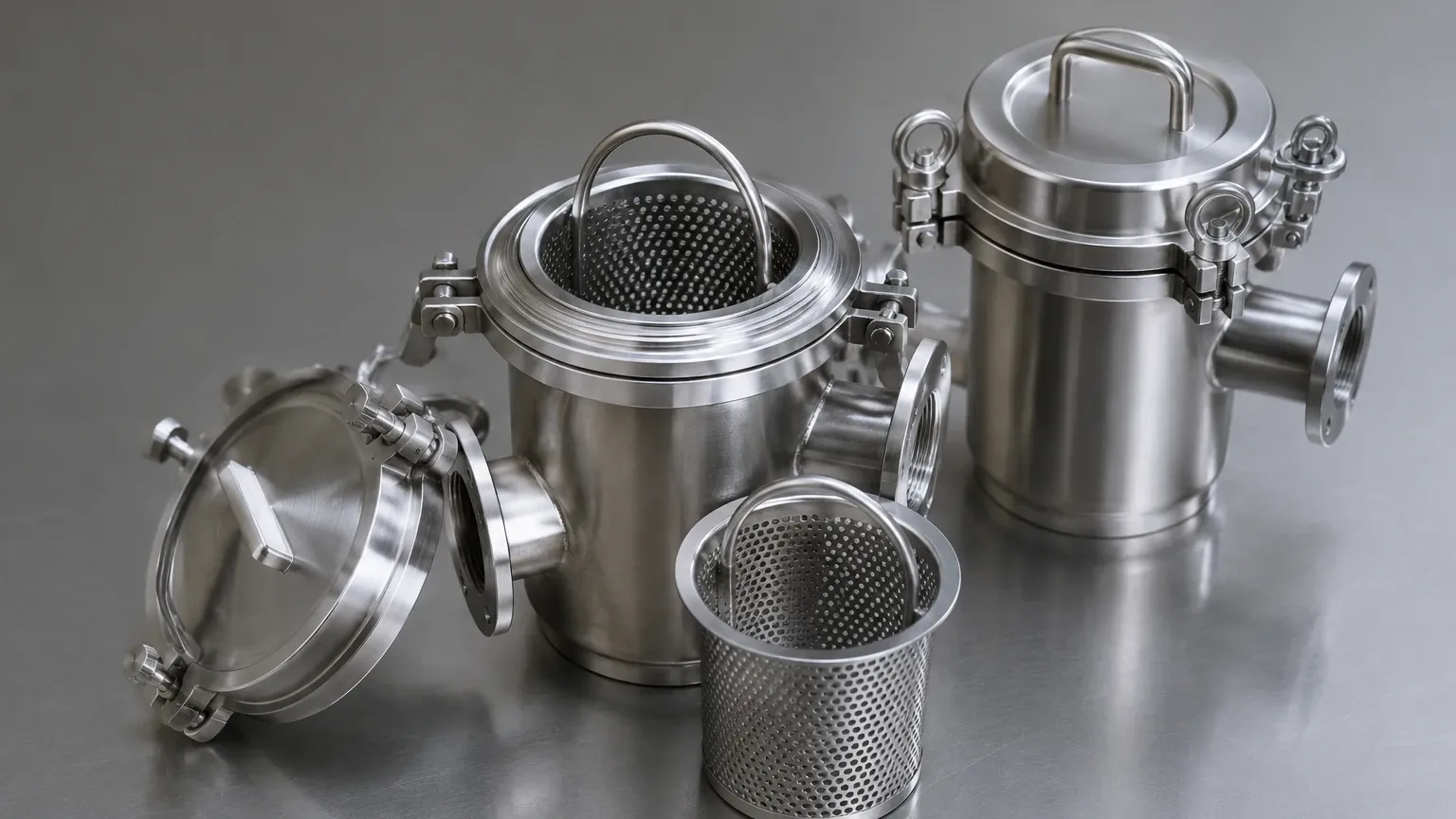
The fundamental architecture of a strainer jar consists of an outer pressure vessel—the "jar"—and an internal, removable filtration element, typically a basket or a screen. The design objective is to facilitate the transition of fluid from an inlet port, through the filtration medium, and out through an outlet port while capturing all solids larger than the specified mesh opening.
Flow Dynamics and Internal Volume
One of the defining characteristics of a strainer jar is its internal volume. Unlike Y-strainers, which have a compact, angled profile, the jar configuration typically offers a larger sump area. This increased volume allows for a greater collection capacity, which is vital in applications with high solids loading. By providing a larger surface area for the internal basket, the design minimizes the velocity of the fluid as it passes through the mesh, reducing the rate of pressure drop and extending the time between cleaning cycles.
Housing Geometry
Industrial strainer jars are usually cylindrical to optimize pressure distribution. The "jar" aspect often refers to the vertical orientation of the vessel, which allows gravity to assist in settling heavier particulates at the bottom of the basket. High-quality units feature precision-machined seats for the internal basket to ensure a positive seal, preventing "bypass"—the phenomenon where unfiltered fluid leaks around the edges of the filter element.
Material Selection and Chemical Compatibility
The durability of a strainer jar is directly tied to its material composition. In industrial environments, stainless steel is the standard due to its mechanical strength and resistance to a wide array of corrosive agents.
Stainless Steel Grades
* Type 304 Stainless Steel: This is the most common material for general industrial use. It provides excellent corrosion resistance for water treatment, hydraulic oils, and many food-grade applications. It is cost-effective and maintains structural integrity under moderate thermal stress.
* Type 316/316L Stainless Steel: For more demanding environments, such as chemical processing or marine applications, Type 316 is preferred. The addition of molybdenum enhances resistance to pitting and crevice corrosion, particularly in chloride-rich environments. The "L" (low carbon) variant is often specified for components requiring extensive welding to prevent carbide precipitation.
Gasket and Seal Considerations
The "jar" lid or cover must be sealed effectively to maintain system pressure. Common sealing materials include:
* Buna-N (Nitrile): Suitable for petroleum-based fluids and general water service.
* Viton (FKM): Preferred for high-temperature applications and aggressive chemicals.
* PTFE (Teflon): Used when near-universal chemical inertness is required, though it lacks the elasticity of elastomers and requires specific groove designs.
* EPDM: Ideal for steam, water, and certain polar solvents, commonly used in the food and beverage industry.
Performance Metrics: Filtration Accuracy and Pressure Drop
When evaluating a strainer jar, engineers must balance the need for fine filtration with the requirement for high flow rates. This balance is measured through filtration accuracy (micron rating) and differential pressure ($ΔP$).
Understanding Mesh and Micron Ratings
The internal element of the strainer jar can be constructed from perforated metal, woven wire mesh, or a combination of both.
* Perforated Metal: Used for coarse straining (e.g., 1/16" to 1/4" holes). It provides high structural strength.
* Woven Wire Mesh: Used for finer filtration. The mesh count refers to the number of openings per linear inch. A higher mesh count results in a lower micron rating (finer filtration).
It is important to distinguish between "nominal" and "absolute" ratings. A nominal rating indicates the ability of the strainer to retain the majority of particles of a certain size, while an absolute rating (more common in high-precision cartridges than coarse strainers) indicates the size of the largest particle that can pass through the mesh.
Calculating and Monitoring Pressure Drop
Pressure drop is the loss of fluid pressure as it moves through the strainer jar. It is influenced by the fluid's viscosity, velocity, and the percentage of open area in the strainer basket.
$$ΔP_{total} = ΔP_{housing} + ΔP_{element}$$
As the strainer jar collects debris, the open area decreases, and the differential pressure increases. Industrial systems should always be equipped with pressure gauges on both the inlet and outlet sides of the jar. A common rule of thumb is to clean or replace the internal basket when the differential pressure reaches 10-15 psi, or as specified by the equipment manufacturer to prevent basket collapse or flow restriction.
Customization Options for Industrial Applications
Standard off-the-shelf solutions often fall short in specialized industrial processes. Customization of the strainer jar allows for optimization based on specific spatial constraints or fluid properties.
Connection Types
Depending on the piping system, strainer jars can be configured with various connection styles:
* NPT/BSP Threaded: Common for smaller jars (under 2 inches) and lower pressure applications.
* Flanged (ANSI/DIN): The standard for larger industrial lines, providing a robust, leak-proof connection that is easy to install and remove.
* Sanitary/Tri-Clamp: Essential for the pharmaceutical and food industries, where crevice-free connections are required to prevent bacterial growth.
Specialized Features
* Jacketed Jars: For fluids that must be maintained at a specific temperature (like resins, chocolate, or heavy oils), the strainer jar can be equipped with a heating or cooling jacket.
* Magnetic Inserts: In hydraulic or machining applications, magnetic rods can be placed inside the strainer basket to capture fine ferrous particles that might otherwise pass through a standard mesh.
* Quick-Opening Covers: For processes requiring frequent cleaning, swing-bolt or V-band clamp covers allow operators to access the internal basket without specialized tools, significantly reducing downtime.
Maintenance and Operational Best Practices
The longevity of a strainer jar depends on a rigorous maintenance schedule. Because these components are designed to capture contaminants, they are inherently "sacrificial" in terms of labor; they must be cleaned to function.
Cleaning Procedures
When the differential pressure indicates a clog, the system (or that specific line) must be depressurized. The strainer jar lid is removed, and the basket is extracted. For stainless steel wire mesh, cleaning can often be achieved through back-flushing with water, ultrasonic cleaning, or chemical soaking, depending on the nature of the contaminant. It is crucial to inspect the mesh for signs of fraying or mechanical deformation during each cleaning cycle.
Spare Parts Management
To minimize downtime, facilities should maintain an inventory of critical spares for their strainer jars, including:
1. Replacement Baskets: Having a clean basket ready to swap in allows the process to resume immediately while the dirty basket is cleaned.
2. Gaskets and O-rings: These should be replaced whenever the cover is opened if they show signs of compression set or wear.
3. Cover Bolts: In high-pressure environments, the hardware can experience fatigue and should be inspected regularly.
Selection Criteria for Engineers and Procurement
When sourcing a strainer jar for a new project or as a replacement in an existing line, the following technical data must be confirmed:
1. Fluid Properties: What is the viscosity? Is the fluid Newtonian or non-Newtonian? High-viscosity fluids require larger strainer jars and coarser mesh to maintain flow.
2. Flow Rate: What is the maximum and minimum GPM (gallons per minute)? Sizing the jar for the maximum flow rate ensures the system is not throttled.
3. Operating Pressure and Temperature: Ensure the vessel's pressure rating (e.g., ASME Class 150 or 300) exceeds the maximum potential system pressure, including surges.
4. Contaminant Characteristics: Are the particles hard, soft, fibrous, or gelatinous? Fibrous particles may require specialized wedge-wire elements rather than standard woven mesh.
5. Total Cost of Ownership (TCO): Beyond the initial purchase price, consider the cost of replacement gaskets, the ease of cleaning, and the projected lifespan of the stainless steel components.
The Role of the Strainer Jar in System Integrity
In many industrial layouts, the strainer jar is the unsung hero of the process line. By capturing scale, weld slag, and external contaminants, it protects expensive pumps, flow meters, and spray nozzles from catastrophic failure. In the chemical and pharmaceutical sectors, the use of precision-engineered Strainers & Baskets ensures that final products meet strict purity standards.
By focusing on high-quality materials like 304 and 316 stainless steel and utilizing advanced manufacturing techniques, companies like Kaifil provide the reliability required for 24/7 industrial operations. Whether it is a standard strainer jar for a water cooling loop or a highly customized, jacketed vessel for a chemical reactor, the engineering remains the same: provide the most efficient filtration with the lowest possible impact on system hydraulics.
When selecting a partner for filtration components, engineers should look for manufacturers who offer comprehensive technical support, from material selection advice to custom design capabilities. This ensures that the strainer jar is not just a commodity, but a precision-engineered solution tailored to the specific demands of the application.
