


Strainer Valve Symbol
In the field of industrial piping and instrumentation, clear communication through standardized documentation is essential for safety, maintenance, and system efficiency. Piping and Instrumentation Diagrams (P&IDs) and Process Flow Diagrams (PFDs) serve as the blueprints for complex industrial systems. Among the various components represented in these diagrams, the strainer valve symbol is a critical indicator that informs engineers and technicians about the location, type, and orientation of filtration equipment designed to protect downstream components from particulate contamination.
Understanding these symbols is not merely an academic exercise for designers; it is a practical necessity for procurement teams and maintenance engineers who must ensure that the physical hardware, such as industrial Strainers & Baskets, matches the design specifications. This article provides a technical overview of strainer symbols, their variations across different standards, and the engineering considerations that influence their selection in industrial applications.
The Role of Symbols in Industrial Piping Systems
Graphical symbols in engineering are governed by international standards such as ISO 14617, ANSI/ISA-5.1, and DIN standards. These symbols provide a universal language that transcends linguistic barriers, ensuring that a system designed in one region can be accurately constructed and maintained in another.
In a P&ID, a strainer is technically classified as a piping specialty or a mechanical component rather than a functional valve, although it often shares space with valves in a piping assembly. The primary function of the strainer is the mechanical removal of solids from a flowing fluid (liquid or gas) through a perforated or wire mesh straining medium. Because they are often installed immediately upstream of sensitive equipment like pumps, control valves, and flow meters, the correct identification of the strainer valve symbol is the first step in verifying that the system's protection strategy is correctly implemented.
Standard Strainer Valve Symbol Variations
While there is a general consensus on how to represent a strainer, subtle variations exist depending on the specific type of strainer and the standard being followed. Most symbols utilize a basic geometric shape—often a square or a rectangle—bisected by a line representing the filter element.
Y-Strainer Symbols
The Y-strainer is perhaps the most common type used in industrial liquid and steam applications. Its symbol typically consists of a main flow line with a diagonal leg extending downward. Inside this diagonal leg, a dashed or dotted line represents the mesh screen. In more detailed P&IDs, a small valve symbol (usually a ball or gate valve) may be shown at the end of the diagonal leg, indicating a blow-off or drain connection for cleaning the screen without dismantling the piping.
Basket and Simplex Strainer Symbols
Basket strainers, used where higher flow capacities or lower pressure drops are required, are often represented by a square or rectangular box situated on the main flow line. A diagonal line or a series of dots within the box indicates the presence of the basket element. If the strainer is a "Simplex" type, it features a single chamber. In P&IDs, the symbol may include an arrow or a specific notation to indicate the direction of flow, which is critical for basket strainers as they are typically designed for one-way flow from the inside of the basket to the outside.
Duplex Strainer Symbols
For systems that cannot be shut down for maintenance, duplex strainers are employed. The symbol for a duplex strainer is more complex, usually consisting of two basket strainer symbols connected by a common inlet and outlet. A central valve symbol, representing the diverter valve (often a plug or ball valve), is placed between the two chambers. This indicates to the operator that flow can be switched from one chamber to the other, allowing for the cleaning of one basket while the process continues through the other.
Temporary and Conical Strainer Symbols
Temporary strainers, often used during system start-up to catch construction debris, have a distinct symbol. They are frequently represented by a simple triangle or a cone shape inserted between two pipe flanges. Because these are intended to be removed after the initial commissioning phase, the symbol is often accompanied by a note or a specific line style to indicate its temporary nature.
Engineering Specifications for Strainers & Baskets
When transitioning from a schematic symbol to a physical component, engineers must define several technical parameters. The effectiveness of Strainers & Baskets depends heavily on matching the hardware to the specific process conditions.
Filtration Accuracy and Mesh Selection
The most critical specification is the filtration rating, often expressed in microns or mesh size. For example, a 40-mesh screen has 40 openings per linear inch. Engineers must balance the need for fine filtration with the risk of rapid clogging. In high-precision industries like pharmaceutical or chemical processing, custom-manufactured wire mesh from specialists like Kaifil is often required to meet exact particle retention requirements while maintaining structural integrity under pressure.
Pressure Drop (Delta P)
Every strainer introduces a restriction to the flow, resulting in a pressure drop. This is a function of the fluid's velocity, viscosity, and the ratio of the open area of the screen to the cross-sectional area of the pipe. A standard rule of thumb for industrial strainers is a 6:1 or 8:1 open area ratio to minimize pressure loss. On a P&ID, the presence of the strainer valve symbol often triggers the requirement for differential pressure (DP) instrumentation to monitor the health of the filter element.
Flow Velocity and Orientation
The orientation of the strainer is often dictated by the symbol's placement on the diagram. For instance, a Y-strainer in a horizontal line must have its "leg" pointing downward to allow gravity to assist in collecting debris. In vertical lines with upward flow, Y-strainers are generally ineffective because the debris will fall back into the pipe when the flow stops. These nuances are why the graphical representation must be precise.
Interpreting P&ID Notations for Differential Pressure
A common addition to the strainer symbol in technical drawings is the inclusion of differential pressure gauges or transmitters (labeled as PDI or PDT). These instruments measure the pressure difference between the inlet and the outlet of the strainer.
As the mesh or basket collects debris, the effective open area decreases, and the differential pressure increases. Engineers typically specify a "clean" pressure drop and a "dirty" pressure drop. Once the dirty pressure drop limit is reached (e.g., 5-10 psi depending on the system), the strainer must be cleaned or replaced. In automated systems, the PDT may send a signal to a control room, triggering an alarm or automatically switching the diverter valve in a duplex strainer setup.
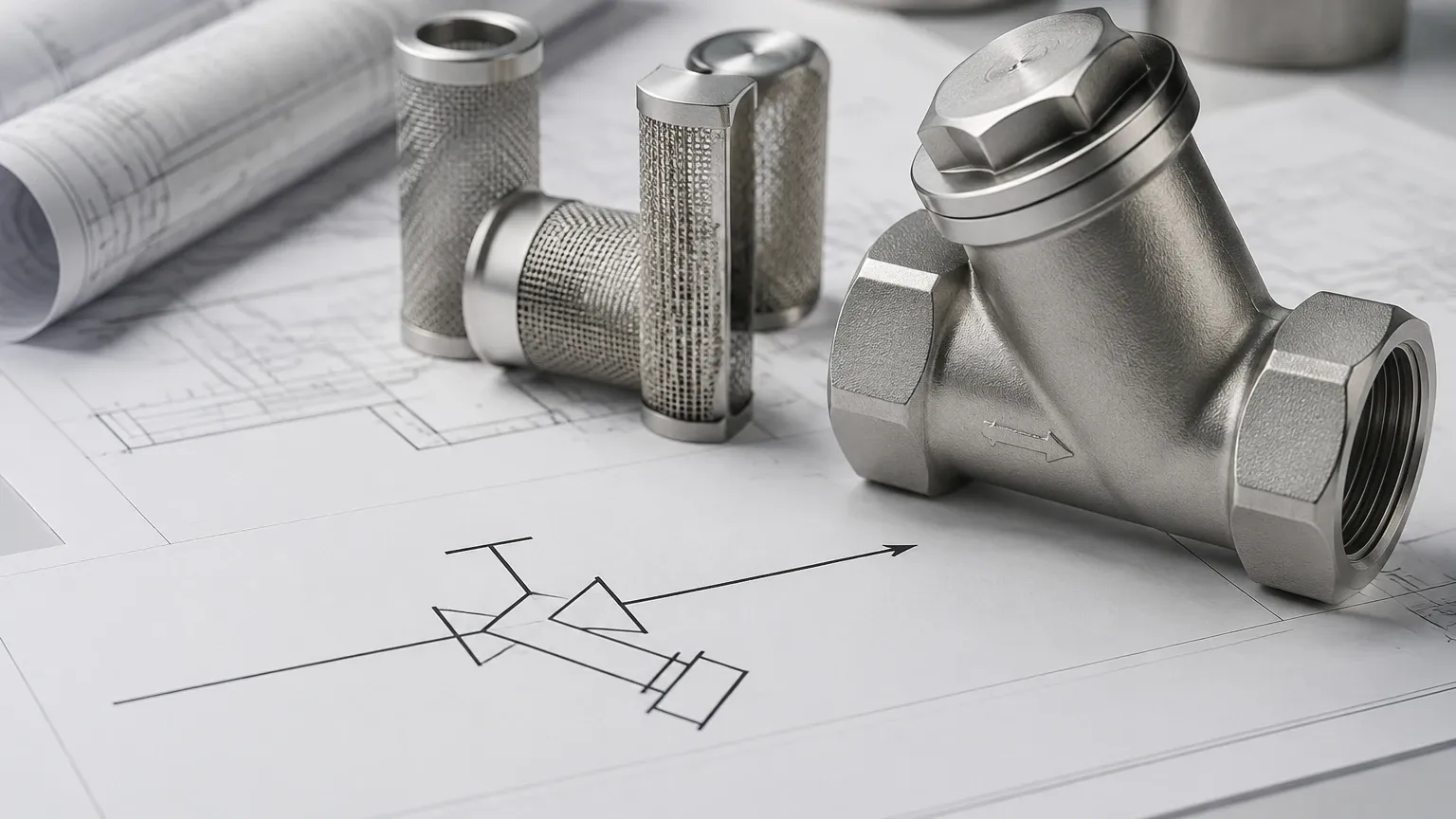
Material Selection and Customization in Industrial Filtration
The symbol on a drawing does not specify the material of construction, which is a vital detail found in the piping specification or the equipment data sheet. For most industrial applications, stainless steel (Grade 304, 316, or 316L) is the preferred material due to its corrosion resistance and durability.
1. Chemical Compatibility: In chemical processing, the strainer material must be compatible with the fluid to prevent galvanic corrosion or chemical degradation. Stainless steel provides a broad range of compatibility for both acidic and alkaline environments.
2. Temperature and Pressure Ratings: The housing of the strainer must be rated for the maximum operating pressure and temperature of the system. This often involves selecting the appropriate flange rating (e.g., ANSI 150#, 300#).
3. Customization: Standard off-the-shelf strainers may not suffice for specialized applications. Manufacturers like Kaifil provide customized filtration solutions, allowing for specific dimensions, specialized mesh weaves, or reinforced basket designs that can withstand high-pressure surges or heavy particulate loads.
Maintenance and Operational Considerations
From an operational perspective, the strainer valve symbol serves as a marker for routine maintenance tasks. The design of the system must allow for sufficient clearance around the strainer to remove the basket or screen.
* Access: For basket strainers, there must be enough vertical clearance to lift the basket out of the housing.
* Drainage: The symbol often indicates a drain plug. In hazardous fluid applications, this drain should be piped to a safe location or a recovery tank to prevent operator exposure during cleaning.
* Replacement Cycles: While stainless steel mesh is often cleanable and reusable, it is subject to wear and mechanical fatigue over time. High-frequency cleaning cycles or abrasive particles can damage the wire mesh, leading to "bypass," where contaminants pass through the screen. Regular inspection of the internal elements is essential to maintain the integrity of the filtration system.
Conclusion
The strainer valve symbol is a fundamental component of industrial documentation that bridges the gap between engineering design and physical implementation. By correctly interpreting these symbols and understanding the technical specifications they represent—such as mesh size, pressure drop, and material compatibility—procurement and engineering teams can ensure the longevity and reliability of their piping systems.
When selecting Strainers & Baskets for demanding environments, it is essential to work with manufacturers who understand the nuances of industrial filtration. Precise engineering, high-quality stainless steel materials, and the ability to customize components to specific application needs are the hallmarks of an effective filtration strategy. Whether you are designing a new system or maintaining an existing one, the clarity provided by standardized symbols and high-performance hardware is the key to operational excellence.
