


Strainer vs Sifter
In industrial process engineering, the terminology used to describe separation equipment often overlaps, leading to potential confusion during the procurement and specification phases. Two of the most frequently conflated terms are the strainer and the sifter. While both utilize a porous medium—typically stainless steel wire mesh or perforated plate—to separate materials based on size, their mechanical designs, operational environments, and intended outcomes differ significantly. Understanding the nuances of a strainer vs sifter is essential for engineers and plant managers to ensure equipment longevity, process efficiency, and product purity.
For most industrial applications, the choice between these two components is dictated by the phase of the media being processed. Strainers are primarily designed for liquid-stream applications, whereas sifters are engineered for dry bulk solids. This article examines the technical distinctions, engineering considerations, and selection criteria for these critical components.
Defining Industrial Separation: Strainer vs Sifter
The fundamental distinction between a strainer and a sifter lies in the state of the matter they process and the force used to drive the separation.
The Industrial Strainer
A strainer is a closed-system component integrated into a piping network. Its primary function is to remove coarse solid contaminants from a liquid stream to protect downstream equipment such as pumps, valves, heat exchangers, and spray nozzles. In this context, the liquid is the carrier, and the strainer acts as a pressure-vessel-contained filter. The separation is driven by the system's hydraulic pressure. Because strainers operate within pressurized lines, they must be designed to withstand specific bar or PSI ratings and handle the fluid's viscosity.
The Industrial Sifter
Conversely, a sifter (often referred to as a screener or separator) is typically used for dry, granular, or powdered materials. The goal of a sifter is often more complex than simple debris removal; it is frequently used for "grading" or "scalping." Grading involves separating a dry bulk material into multiple size fractions, while scalping removes a small percentage of oversized material from a high-volume feed. Unlike the hydraulic pressure used in straining, sifting usually relies on gravity combined with mechanical agitation, such as vibration, centrifugal force, or gyration, to move particles through the mesh.
The Engineering of Industrial Strainers & Baskets
When specifying Strainers & Baskets, engineers must account for the fluid dynamics of the system. Unlike a sifter, which might operate in an open environment, a strainer is a critical point of potential pressure drop in a closed loop.
Construction and Geometry
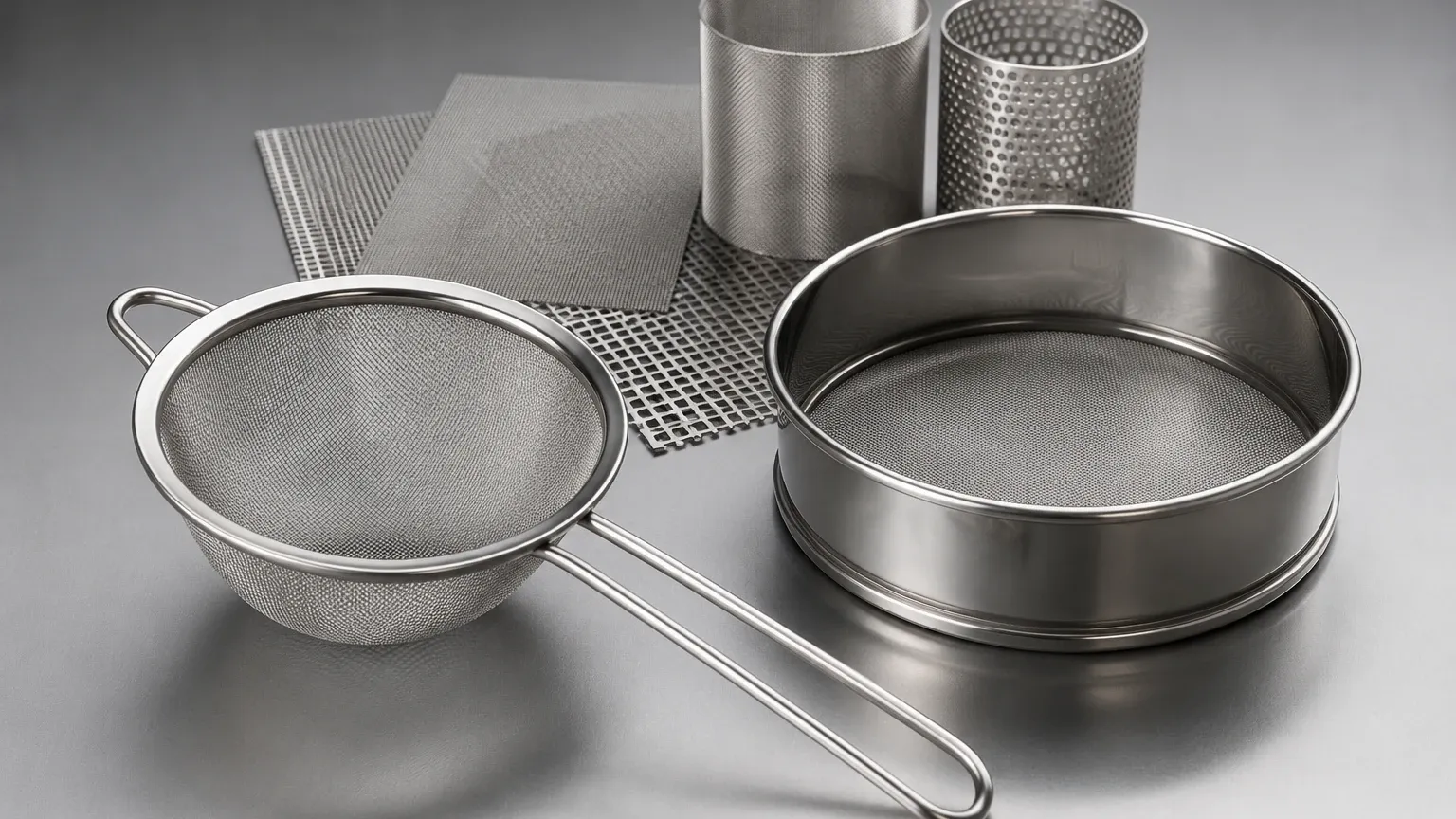
Industrial strainers are categorized by their housing geometry, most commonly Y-strainers, T-strainers, and basket strainers. Basket strainers are particularly prevalent in B2B industrial settings because they offer a larger surface area for debris collection compared to Y-strainers. This larger area results in a lower initial pressure drop and longer intervals between cleaning cycles. The internal "basket" is the heart of the unit, often constructed from a heavy-duty perforated metal support cylinder lined with a fine stainless steel wire mesh.
Material Selection
Since strainers are frequently exposed to corrosive chemicals, high temperatures, and high pressures, material integrity is paramount. Most high-performance industrial strainers are manufactured from 304 or 316L stainless steel. 316L is preferred in pharmaceutical and food processing due to its superior resistance to pitting and crevice corrosion, especially in the presence of chlorides. The choice of mesh weave—such as plain weave, twilled weave, or Dutch weave—depends on the required micron rating and the mechanical strength needed to resist the force of the flow.
Mechanics of Industrial Sifting and Grading
While the strainer vs sifter debate often focuses on the media, the mechanical action of a sifter is a distinct engineering field. In dry processing, particles do not flow as uniformly as liquids. They are prone to clumping, blinding (plugging of the mesh), and static buildup.
Vibratory and Centrifugal Action
To overcome these challenges, sifters utilize mechanical energy. Vibratory sifters use eccentric motors to create a three-dimensional motion that spreads the material across the screen surface. Centrifugal sifters, on the other hand, use high-speed paddles to throw the material against a stationary cylindrical screen. This is particularly effective for materials that are prone to agglomeration or have high moisture content.
Screen Tensioning and Blinding Prevention
In sifting, the tension of the wire mesh is critical. A loose screen will not transmit vibratory energy efficiently, leading to poor separation. Furthermore, sifters often require "anti-blinding" devices, such as bouncing balls or ultrasonic transducers, to keep the mesh openings clear. This is rarely a requirement for liquid strainers, where the fluid flow itself often helps move particles toward the collection area of the basket.
Comparative Analysis: Media, Mechanism, and Maintenance
To help procurement teams make informed decisions, it is useful to compare the two technologies across several operational parameters.
| Feature | Strainer | Sifter |
| :— | :— | :— |
| Primary Media | Liquids (Water, Oil, Chemicals) | Dry Solids (Powders, Granules) |
| Driving Force | Hydraulic System Pressure | Gravity + Mechanical Vibration/Centrifugal Force |
| Installation | Inline (Bolted/Welded into Piping) | Process Point (Inlet/Outlet of Hoppers or Silos) |
| Primary Goal | Equipment Protection / Fluid Purity | Particle Size Grading / Scalping |
| Pressure Rating | High (Vacuum to hundreds of PSI) | Low (Typically atmospheric or slight vacuum) |
| Common Mesh | 20 mesh to 5 microns | 4 mesh to 400 mesh |
Flow Rate vs. Throughput
In straining, the critical metric is the flow rate (GPM or m³/h) and the allowable clean pressure drop (ΔP). If the strainer is too small, the pump must work harder, increasing energy costs and risking cavitation. In sifting, the metric is throughput (kg/h or tons/h). Throughput is influenced by the "open area" of the mesh and the residence time of the material on the screen surface.
Material Selection and Durability in Corrosive Environments
Both strainers and sifters rely on the durability of stainless steel components, but the wear patterns differ. In Strainers & Baskets, the primary wear factors are erosion from high-velocity fluid and chemical degradation. If a liquid contains abrasive particles moving at high speed, the mesh can experience localized thinning.
In sifters, the wear is often more mechanical. The constant vibration and the friction of dry particles sliding across the metal wires can lead to fatigue failure. For this reason, the quality of the wire drawing and the precision of the weaving process are vital. High-quality manufacturers ensure that the wire mesh used in both components is burr-free and has consistent aperture sizes to prevent "off-spec" particles from passing through.
For specialized industries like chemical processing or marine applications, exotic alloys such as Monel or Hastelloy may be used for the internal baskets or screens to provide resistance to specific corrosive agents that standard stainless steel cannot handle.
Key Performance Indicators (KPIs) for Selection
When an engineering team is deciding on the specifications for a new filtration or separation stage, several KPIs must be confirmed before contacting a manufacturer:
1. Micron Rating vs. Mesh Count: Engineers must specify the exact particle size that needs to be retained. In straining, this is often the "absolute" rating. In sifting, it is usually the "nominal" rating or the specific mesh count per linear inch.
2. Viscosity and Density: For strainers, the viscosity of the liquid significantly impacts the pressure drop. High-viscosity fluids (like heavy oils or syrups) require much larger surface areas.
3. Percentage of Solids: If the liquid stream has a high concentration of solids, a standard strainer may clog too quickly. In such cases, a duplex strainer (which allows for cleaning without stopping the flow) or an automated self-cleaning strainer may be required.
4. Temperature and Pressure: The housing and the internal basket must be rated for the maximum operating temperature and pressure, including potential surges (water hammer).
Maintenance, Cleaning, and Replacement Cycles
Operational efficiency is heavily dependent on the ease of maintenance. For Strainers & Baskets, maintenance usually involves monitoring the differential pressure across the unit. When the pressure drop reaches a predetermined limit (often 5-10 PSI over the clean drop), the basket must be removed and cleaned.
In sifting applications, maintenance is often scheduled based on time or volume processed. Because sifters have moving parts (motors, bearings, and drive belts), they require more frequent mechanical inspections than static strainers. However, the mesh in a sifter is often more accessible than the basket inside a high-pressure strainer housing.
For both components, using high-quality stainless steel allows for various cleaning methods, including ultrasonic cleaning, backwashing, or chemical soaking, which extends the total lifecycle of the part and reduces the total cost of ownership (TCO).
Conclusion: Optimizing Your Process Flow
Choosing between a strainer and a sifter—and selecting the specific configuration of each—is a technical decision that impacts the entire production line. While the "strainer vs sifter" terminology can be confusing, focusing on the media phase (liquid vs. dry) and the driving force (pressure vs. vibration) provides a clear path forward.
For liquid applications requiring robust protection and high-precision filtration, industrial-grade Strainers & Baskets are the standard. By specifying the correct material, mesh size, and housing geometry, engineers can protect their infrastructure and ensure consistent product quality. When sourcing these components, it is essential to work with a manufacturer that understands the rigors of industrial environments and can provide customized solutions tailored to specific flow rates and chemical compatibilities.
