


Strainers 6 Letters
In the complex landscape of industrial fluid management, terminology often dictates the precision of procurement. Whether an engineer is searching for a specific component in a Bill of Materials (BOM) or a technician is verifying a part on a CAD drawing, the term "strainers" (6 letters) frequently appears as a fundamental requirement for system integrity. While the word itself is simple, the engineering principles governing industrial Strainers & Baskets are deeply technical, involving fluid dynamics, material science, and precision manufacturing.
Industrial strainers are essentially specialized filters designed to remove coarse particles from a liquid or gas stream. Unlike fine-micron membrane filters, strainers are typically used to protect downstream equipment—such as pumps, valves, and heat exchangers—from damage caused by scale, weld beads, or other debris. For B2B buyers and engineering teams, understanding the nuances of strainer design is critical to ensuring long-term operational efficiency and minimizing downtime.
Understanding Industrial Strainers and Baskets
At its core, a strainer is a closed vessel with a cleanable screen element designed to remove and retain foreign particles. The distinction between a strainer and a filter is often based on the size of the particles removed. Strainers are generally used for larger particles (measured in mesh sizes or millimeters), while filters handle smaller, sub-micron particulates.
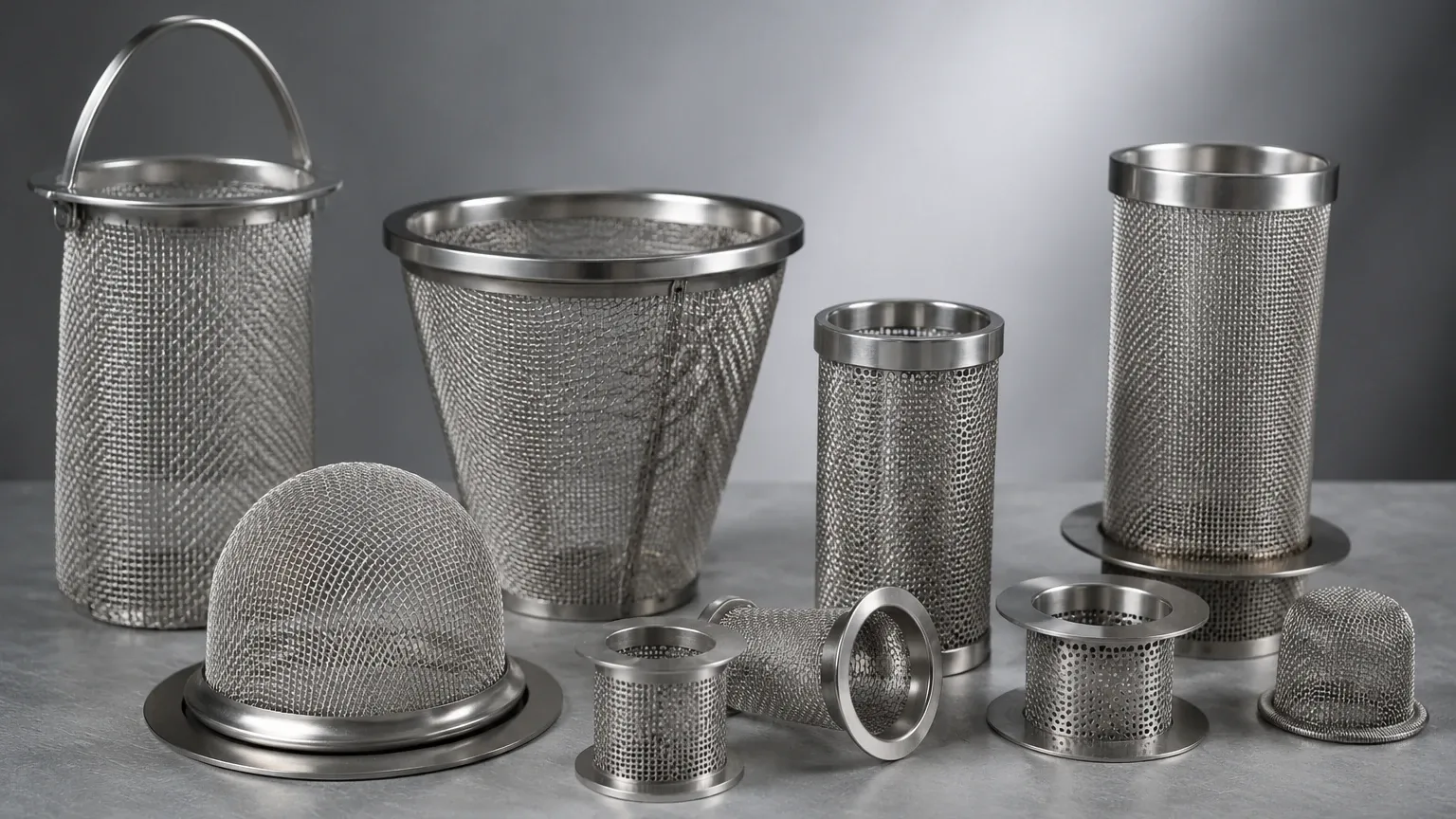
In industrial applications, the combination of Strainers & Baskets serves as the first line of defense. The basket is the internal, removable component that captures the debris. Because these components are often subjected to high pressures, corrosive chemicals, and extreme temperatures, the choice of material and construction method is paramount. Kaifil specializes in stainless steel solutions, utilizing the inherent durability of 304 and 316L grades to provide resistance against oxidation and chemical erosion.
Engineering Considerations for Strainer Selection
Selecting the correct strainer involves more than matching pipe sizes. Engineers must evaluate several technical variables to prevent system failure or excessive energy consumption due to pressure drops.
1. Filtration Accuracy and Mesh Size
The "open area ratio" is a critical metric. It refers to the ratio of the total area of the holes in the screen to the area of the inlet pipe. A common engineering standard is a 4:1 ratio, which ensures that the strainer does not become a bottleneck in the system. When specifying "strainers" (6 letters), procurement teams must define the micron rating or mesh count required for the specific debris expected in the process fluid.
2. Pressure Drop (Delta P)
Every strainer introduces some resistance to flow. As the basket fills with debris, this resistance—or pressure drop—increases. If the pressure drop becomes too high, it can starve downstream pumps or cause the strainer basket to collapse. High-quality Strainers & Baskets are designed with optimized internal geometries to minimize initial pressure drop and maximize the time between cleaning cycles.
3. Material Compatibility
In chemical processing or pharmaceutical applications, the material of the strainer must be inert to the fluid. Stainless steel is the industry standard for these demanding environments. Kaifil’s expertise in stainless steel fabrication ensures that every component meets the stringent requirements for corrosion resistance and structural integrity.
Types of Strainers and Their Applications
Different system layouts and operational requirements necessitate different strainer configurations. Understanding these types helps engineers select the most effective solution for their specific application.
Y-Strainers
Named for their shape, Y-strainers are typically used in pressurized lines, either for liquid or gas. They are compact and cost-effective, making them ideal for applications where the amount of material to be removed is relatively small. They are often installed in steam lines or air systems.
Basket Strainers (Simplex and Duplex)
Basket strainers feature a larger storage capacity for debris compared to Y-strainers.
- Simplex Strainers: These are used in systems where the flow can be interrupted for cleaning. The basket is manually removed, cleaned, and replaced.
- Duplex Strainers: These consist of two separate strainer chambers connected by a valve. This allows the flow to be diverted to one chamber while the other is being cleaned, enabling continuous operation. This is essential in industries like power generation or continuous chemical manufacturing where downtime is not an option.
Customization and OEM Solutions for Industrial Filtration
Standard off-the-shelf strainers often fall short in specialized industrial environments. This is where custom manufacturing becomes essential. For many engineers, finding a partner who can produce custom Strainers & Baskets to exact specifications is the key to system optimization.
Customization options include:
- Variable Mesh Liners: Adding a fine wire mesh liner inside a perforated metal basket to achieve higher filtration precision.
- Custom Dimensions: Designing strainers to fit into existing piping footprints where space is limited.
- Reinforced Baskets: For high-pressure applications, baskets can be reinforced with external frames to prevent deformation.
- Specialized Coatings: While stainless steel is highly resistant, some applications may require additional surface treatments or electropolishing to meet sanitary standards in food and beverage or pharmaceutical sectors.
Kaifil’s manufacturing capabilities allow for the production of these precision components, ensuring that even the most complex "strainers" (6 letters) requirements are met with technical accuracy.
Maintenance, Replacement Cycles, and Operational Efficiency
A common question among purchasing teams involves the total cost of ownership (TCO). While the initial purchase price is important, the long-term costs associated with maintenance and replacement are often more significant.
Monitoring Performance
The most effective way to maintain Strainers & Baskets is by installing differential pressure gauges. By monitoring the pressure difference between the inlet and outlet, operators can determine exactly when a basket is full. This prevents "blind cleaning," where a system is shut down unnecessarily, and also prevents "over-loading," where the basket might fail under pressure.
Cleaning and Durability
Stainless steel baskets are designed for longevity. Unlike disposable filter cartridges, these baskets are cleaned and reused. The durability of the wire mesh and the quality of the welds determine how many cleaning cycles a basket can withstand. In harsh environments, a poorly manufactured basket may see mesh separation or frame cracking, leading to bypass—where unfiltered fluid moves downstream.
Replacement Cycles
While the housings of strainers can last for decades, the internal baskets are considered wear parts. Factors influencing replacement cycles include the abrasiveness of the particles, the frequency of cleaning, and the chemical nature of the fluid. Providing a clear maintenance schedule and keeping spare baskets on hand is a best practice for any industrial facility.
The Role of Precision in Strainers & Baskets
In the B2B sector, the reliability of a component is a direct reflection of the manufacturer's technical expertise. When an engineer specifies "strainers" (6 letters), they are looking for a component that integrates seamlessly into a larger mechanical ecosystem. Precision in the manufacturing of the wire mesh, the accuracy of the perforation patterns, and the integrity of the structural welds are what separate a high-performance strainer from a generic alternative.
Kaifil’s focus on custom stainless steel filtration solutions addresses these needs directly. By combining advanced manufacturing with engineering knowledge, we ensure that our Strainers & Baskets provide the necessary protection for industrial equipment, whether in water treatment, hydraulic systems, or chemical processing.
Conclusion: Selecting the Right Filtration Partner
Navigating the technical requirements of industrial filtration requires a partner who understands the balance between flow rate, filtration accuracy, and structural durability. Whether you are looking for standard Y-strainers or highly customized duplex basket systems, the quality of the internal components is the determining factor in system performance.
By focusing on stainless steel construction and precision engineering, Kaifil provides the reliability that modern industrial applications demand. For engineers and purchasing teams, selecting the right "strainers" (6 letters) is not just about fulfilling a part number—it is about ensuring the continuous, efficient operation of the entire facility. When evaluating your next filtration project, consider the engineering details that contribute to a lower total cost of ownership and a more resilient process system.
