


Strainers All Clad
In the landscape of industrial fluid handling, the integrity of filtration components determines the longevity of downstream equipment. Industrial strainers and baskets serve as the primary line of defense, capturing macroscopic solids that could otherwise damage pumps, valves, and precision instrumentation. When engineers discuss "strainers all clad" in a B2B or manufacturing context, the focus shifts from consumer-grade terminology to the rigorous requirements of material cladding, multi-layer reinforcement, and high-performance stainless steel construction.
For technical professionals in chemical processing, food and beverage production, and pharmaceutical manufacturing, selecting the right Strainers & Baskets involves more than just choosing a mesh size. It requires a deep understanding of how material composition, structural design, and manufacturing precision converge to meet specific operational demands. This guide explores the engineering considerations behind high-durability industrial strainers, the role of material cladding in harsh environments, and the criteria for selecting components that ensure process continuity.
Engineering Principles of Industrial Strainers and Baskets
Industrial strainers are essentially pressure vessels containing a removable screen or basket. Unlike fine membrane filters, these components are designed to handle higher solids loads and higher flow rates. The engineering of these units must account for several mechanical factors to ensure they do not become a point of failure in the system.
Mechanical Strength and Structural Integrity
The primary challenge for any industrial basket is the differential pressure (ΔP) that builds up as debris accumulates. A poorly constructed strainer may collapse under high pressure, sending both the captured debris and fragments of the filter media into the downstream line. To prevent this, professional-grade baskets often utilize a multi-layered approach.
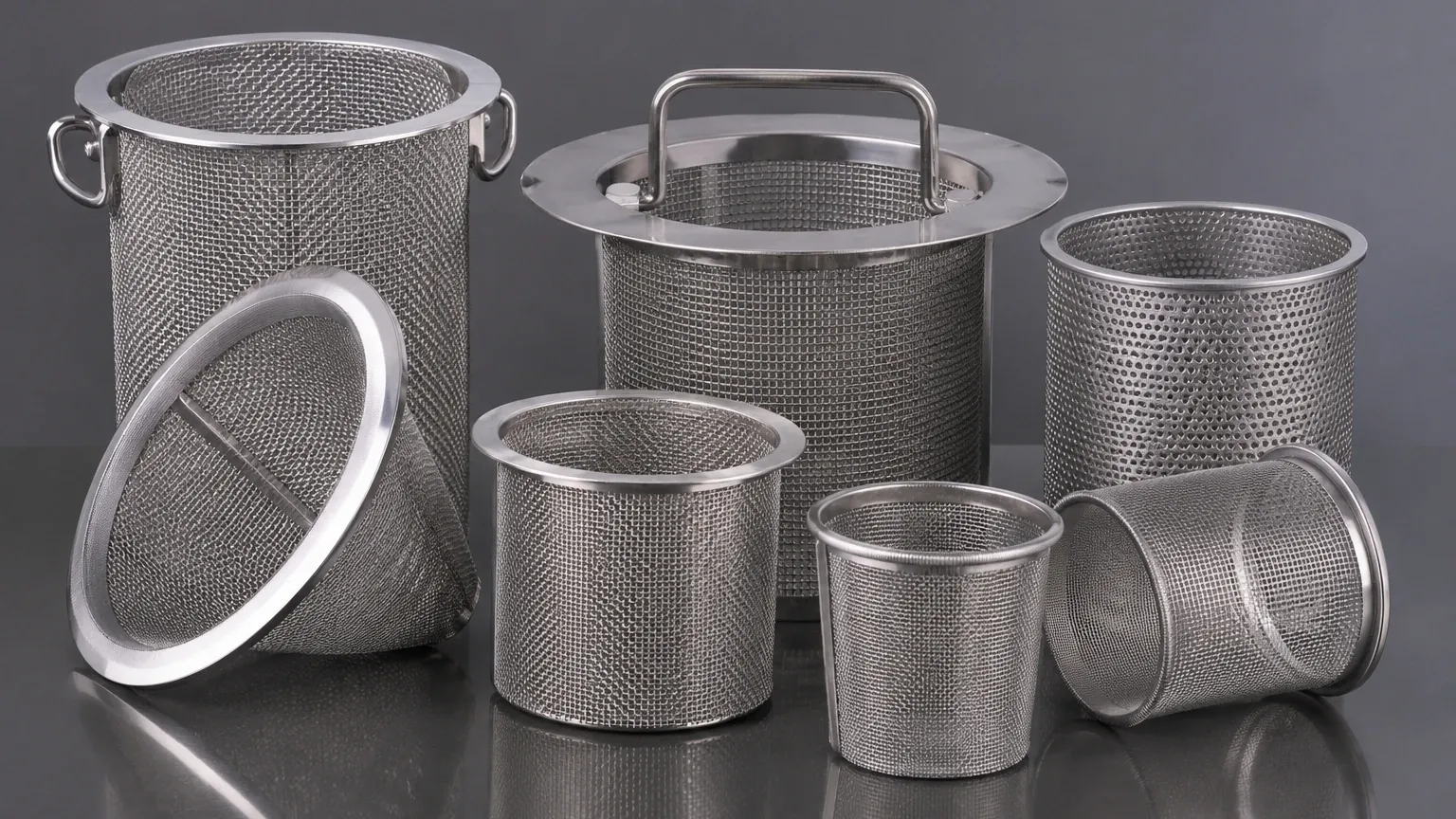
This construction typically involves a heavy-duty perforated metal support cage that provides the necessary mechanical strength, lined with a finer wire mesh that dictates the filtration accuracy. In demanding applications, the term "all clad" may refer to the complete encapsulation of the mesh edges within a solid metal frame or flange, ensuring that there are no bypass paths and that the mesh remains securely attached even under turbulent flow conditions.
Flow Dynamics and Pressure Drop
Engineers must balance filtration efficiency with the allowable pressure drop. The "open area ratio" is a critical metric here—it is the ratio of the total area of the holes in the strainer to the cross-sectional area of the inlet pipe. A higher ratio generally leads to a lower initial pressure drop and longer intervals between cleanings. For most industrial applications, a ratio of 6:1 or higher is preferred to ensure that the system does not experience significant flow restriction as the basket begins to fill.
Material Selection and Cladding in Filtration Systems
Material science is at the heart of industrial filtration. The choice of alloy determines the strainer’s resistance to corrosion, temperature fluctuations, and mechanical wear. While many applications utilize standard stainless steel, specialized environments require more advanced material strategies.
Stainless Steel Grades: 304 vs. 316L
Stainless steel 304 is the standard for many general-purpose industrial applications due to its excellent balance of cost and corrosion resistance. However, in the pharmaceutical and chemical sectors, 316L stainless steel is often mandatory. The addition of molybdenum in 316L provides superior resistance to chlorides and pitting, which is essential for systems handling saline solutions or aggressive chemicals.
The Concept of "All Clad" in Industrial Contexts
In industrial manufacturing, cladding refers to the process of bonding one metal to another to combine the desirable properties of both. For instance, a strainer body might be made of carbon steel for structural economy but cladded with a layer of high-grade stainless steel or a nickel alloy on the wetted surfaces to provide chemical resistance.
When searching for "strainers all clad," industrial buyers are typically looking for components where the entire filtration surface and the supporting structure are made from a unified, high-performance material—leaving no vulnerable carbon steel or inferior alloys exposed to the process fluid. This ensures that the entire assembly—from the handle to the mesh to the support ring—is capable of withstanding the same corrosive or thermal stresses.
Design Considerations for High-Performance Basket Strainers
The geometry of a strainer basket significantly impacts its performance and ease of maintenance. Custom-engineered solutions allow for the optimization of these components for specific fluid viscosities and particle types.
Mesh Selection and Weave Types
The filtration media within the basket can vary from simple square weaves to complex Dutch weaves.
* Plain Square Weave: Offers high flow rates and is easy to clean, making it ideal for general debris removal.
* Twilled Weave: Allows for a heavier wire diameter, increasing the strength of the mesh for higher pressure applications.
* Sintered Mesh: For the most demanding environments, multiple layers of wire mesh are sintered together (bonded with heat and pressure) to create a single, robust plate. Sintered mesh strainers offer the ultimate in durability, effectively functioning as an "all clad" single-piece filtration media that cannot migrate or delaminate.
Sealing and Bypass Prevention
A strainer is only as effective as its seal. If the basket does not seat perfectly within the housing, fluid will take the path of least resistance, bypassing the filter media entirely. High-quality industrial baskets feature precision-machined flanges or O-ring grooves to ensure a positive seal. In high-temperature applications where standard elastomers might fail, metal-to-metal seals or specialized gaskets are required to maintain system integrity.
Applications Across Demanding Industrial Sectors
Different industries impose unique stresses on filtration components. Understanding these application-specific needs is vital for selecting the correct Strainers & Baskets.
Food and Beverage Processing
In the food industry, hygiene is paramount. Strainers must be designed with "sanitary" features, meaning they have smooth surface finishes (often electropolished) and are free of crevices where bacteria could grow. The "all clad" approach here ensures that no base metals are exposed, preventing contamination. These baskets must also be capable of withstanding Clean-in-Place (CIP) procedures, which involve high-temperature caustic washes.
Chemical and Petrochemical Industry
Chemical processing often involves high-pressure lines and volatile fluids. Strainers in this sector must be engineered to withstand significant thermal expansion and contraction without losing their structural shape. Material cladding is frequently used here to protect the strainer housing from aggressive acids while maintaining the mechanical strength of the outer vessel.
Hydraulic and Lubrication Systems
In hydraulic systems, even microscopic particles can cause catastrophic pump failure. Strainers used in these systems often feature magnetic inserts to capture fine ferrous particles that might pass through the mesh. The baskets must be designed to handle high-viscosity fluids without causing excessive backpressure, which could lead to pump cavitation.
Maintenance and Replacement Cycles for Stainless Steel Strainers
Total cost of ownership (TCO) for industrial filtration is heavily influenced by the maintenance requirements and the durability of the components. A high-quality stainless steel strainer may have a higher upfront cost but significantly lower long-term expenses compared to disposable or lower-grade alternatives.
Monitoring Performance
The most effective way to manage strainer maintenance is through differential pressure monitoring. By installing pressure gauges upstream and downstream of the strainer, operators can identify exactly when a basket is reaching its capacity. Cleaning the basket before the ΔP reaches a critical limit prevents mechanical stress on the mesh and ensures consistent flow rates.
Cleaning vs. Replacement
One of the primary advantages of stainless steel strainers is that they are cleanable and reusable. Methods such as ultrasonic cleaning, backwashing, or manual scrubbing with compatible solvents can restore a basket to near-original performance. However, engineers should inspect baskets regularly for signs of "blinding" (permanent clogging of the mesh pores) or physical deformation. If the structural integrity of the basket is compromised, immediate replacement is necessary to protect downstream assets.
Customization Options for OEM Filtration Solutions
Off-the-shelf strainers rarely meet the exact needs of specialized industrial equipment. Customization is often necessary to fit specific housing dimensions, achieve non-standard micron ratings, or accommodate unique flow patterns.
Tailored Geometry and Fittings
Manufacturers like Kaifil specialize in producing baskets that match the specific requirements of an OEM's system. This includes custom handle designs for easy removal, specialized reinforcement bands for high-vibration environments, and unique flange configurations.
Advanced Surface Treatments
Beyond material selection, surface treatments can enhance the performance of a strainer. Electropolishing, for example, removes surface imperfections and creates a chrome-rich oxide layer that further improves corrosion resistance and reduces the adhesion of sticky substances. This is particularly beneficial in the pharmaceutical and food industries where product purity is non-negotiable.
Conclusion: Selecting the Right Filtration Partner
When evaluating "strainers all clad" and other high-performance filtration components, engineers must look beyond the surface level. The reliability of a filtration system depends on the precision of the manufacturing process, the quality of the raw materials, and the engineering expertise behind the design.
By focusing on robust construction, appropriate material grades like 316L, and optimized flow dynamics, purchasing teams can secure components that reduce downtime and extend the life of their industrial machinery. Whether you are looking for standard replacement baskets or a custom-engineered OEM solution, prioritizing technical specifications over generic marketing claims is the key to achieving efficient and cost-effective filtration performance. For those seeking specialized guidance on material compatibility and design optimization, exploring professional Strainers & Baskets options is the first step toward a more resilient fluid handling system.
