


Strainers for Food
In the food and beverage industry, filtration and separation processes are critical for maintaining product purity, protecting downstream equipment, and ensuring compliance with stringent safety standards. Industrial strainers for food are specialized components designed to remove oversized particles, debris, and contaminants from liquid process streams. Unlike standard industrial filters, food-grade strainers must adhere to specific hygienic design principles to prevent bacterial growth and cross-contamination.
Selecting the appropriate Strainers & Baskets involves more than choosing a mesh size; it requires a deep understanding of metallurgy, surface finishes, and the rheological properties of the food product being processed. From viscous syrups and chocolate to thin juices and dairy products, each application demands a specific engineering approach to balance filtration efficiency with flow requirements.
Material Selection and Metallurgy in Food-Grade Filtration
The primary material for strainers for food is stainless steel, specifically the 300-series alloys. The choice between Grade 304 and Grade 316L is determined by the chemical composition of the food product and the cleaning agents used in the facility.
Grade 304 Stainless Steel
Grade 304 is the standard choice for many food applications where corrosion risk is moderate. It offers excellent durability and is suitable for dairy, brewing, and general beverage processing. However, it may be susceptible to pitting in the presence of high chloride concentrations or acidic environments.
Grade 316L Stainless Steel
For applications involving high salt content, acidic juices, or aggressive Clean-in-Place (CIP) chemicals, Grade 316L is the industry standard. The addition of molybdenum provides superior resistance to chloride-induced pitting and crevice corrosion. The "L" designation denotes low carbon content, which minimizes carbide precipitation during welding, ensuring that the structural integrity and corrosion resistance of the strainer housing and basket remain intact at the weld joints.
Design Configurations for Strainers & Baskets
Industrial strainers are generally categorized by their housing configuration and the type of internal element they utilize. In food processing, the most common designs are simplex strainers, duplex strainers, and Y-strainers, often utilizing specialized baskets to maximize surface area.
Simplex Basket Strainers
Simplex strainers are used in batch processes where the flow can be intermittently stopped to clean or replace the basket. These are common in the final stages of packaging or in systems where solids loading is relatively low. The basket design allows for easy removal and manual cleaning, which is essential for maintaining hygiene in food production lines.
Duplex Strainers for Continuous Operation
In continuous production environments, such as large-scale juice pasteurization or milk processing, duplex strainers are required. These units consist of two separate strainer chambers connected by a diverting valve. When one basket becomes loaded with contaminants, the flow is diverted to the second chamber without interrupting the process. This allows for the cleaning of the first basket while the system remains fully operational, preventing costly downtime.
Specialized Basket Geometries
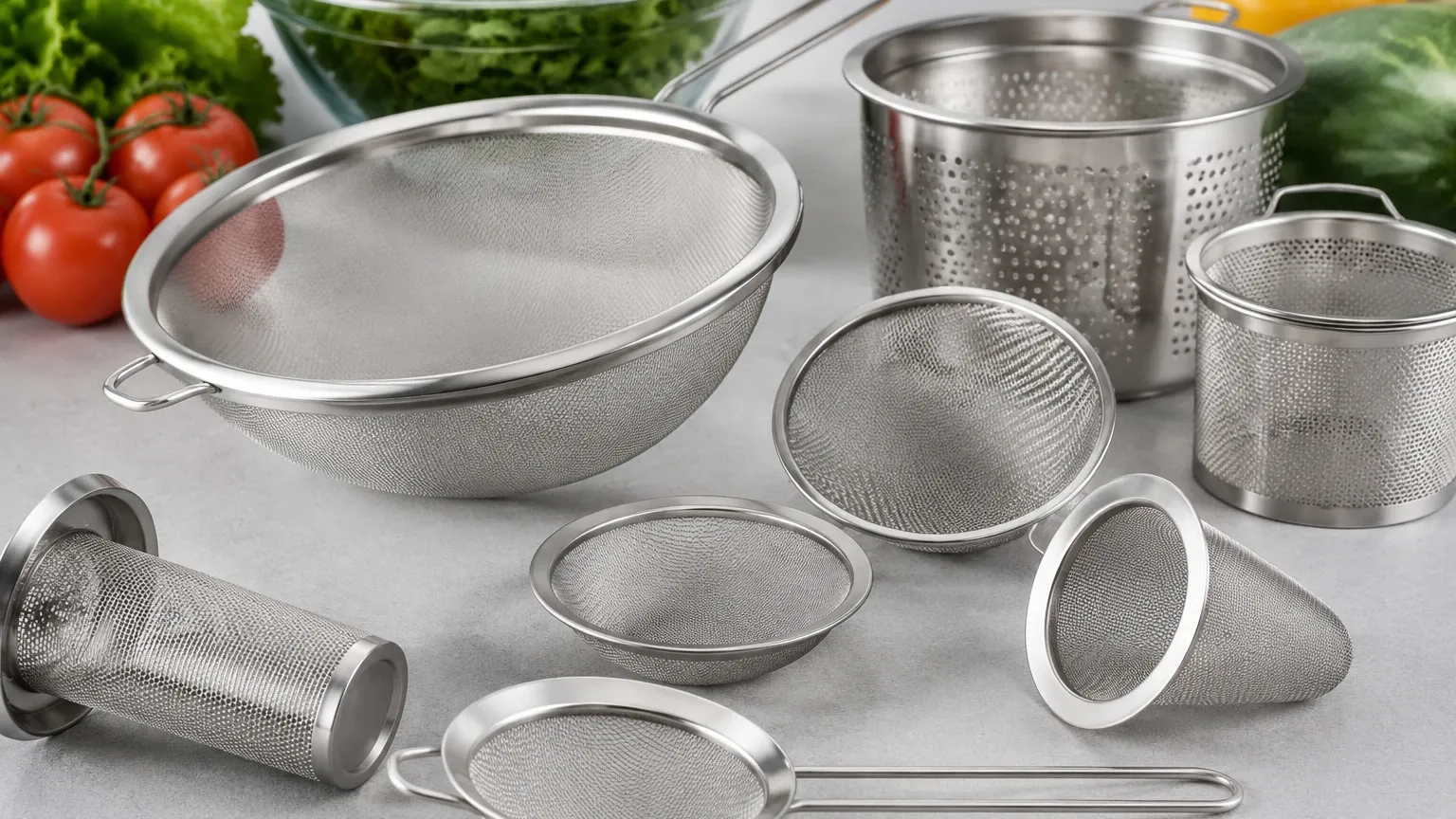
The internal basket is the core of the filtration process. Engineering considerations for these baskets include the use of perforated metal for coarse filtration or fine wire mesh for precision separation. In many food applications, a multi-layered basket design is used, where a heavy-duty perforated metal cylinder provides structural support for a fine stainless steel mesh lining. This configuration ensures the strainer can withstand high differential pressures without collapsing.
Filtration Accuracy and Performance Metrics
When specifying strainers for food, engineers must define the required filtration accuracy, typically measured in microns or mesh size. The goal is to remove targeted contaminants without stripping essential solids or causing excessive pressure drop.
1. Micron Rating: This indicates the size of the particles the strainer will capture. For example, a 100-micron mesh will stop particles larger than 0.1mm. In food processing, common ratings range from 50 microns for fine syrups to 2,000 microns for removing seeds or pulp from fruit juices.
2. Effective Filtration Area (EFA): The EFA is the total open area of the mesh or perforated plate. A higher EFA reduces the velocity of the fluid as it passes through the media, which lowers the initial pressure drop and extends the time between cleaning cycles.
3. Open Area Ratio: For efficient operation, the open area of the strainer basket should ideally be several times the cross-sectional area of the inlet pipe. This prevents the strainer from becoming a bottleneck in the system.
Sanitary Standards and Hygienic Design
Food-grade strainers must be designed to eliminate "dead zones" where product can stagnate and harbor bacteria. This is a fundamental difference between general industrial strainers and those specifically engineered for the food industry.
Surface Finish (Ra Value)
The internal surfaces of the strainer housing and the basket must be smooth. Surface roughness is measured by the Roughness Average (Ra). For food applications, a Ra of 0.8 μm (32 micro-inches) or better is typically required. Achieving this finish often involves mechanical polishing followed by electropolishing. Electropolishing not only smooths the surface at a microscopic level but also enhances the chromium-rich passive layer of the stainless steel, further improving corrosion resistance.
Welds and Connections
All internal welds in food-grade strainers must be ground smooth and flush with the base metal. Crevices, pits, and cracks are prohibited, as they are impossible to clean effectively. Connections are typically made using sanitary tri-clamp fittings or DIN 11851 couplings, which utilize food-safe gaskets (such as EPDM, PTFE, or Silicone) to ensure a leak-proof and hygienic seal.
Operational Considerations: Flow Rate and Pressure Drop
One of the most common challenges in implementing strainers for food is managing the differential pressure (ΔP). As the strainer basket collects solids, the available open area decreases, causing the pressure drop across the unit to rise.
Calculating Initial Pressure Drop
Engineers must calculate the clean pressure drop based on the fluid's viscosity, density, and flow rate. Highly viscous fluids, such as honey or heavy oils, require larger strainers or coarser mesh to maintain acceptable flow rates. If the initial ΔP is too high, it limits the "dirt-holding capacity" of the strainer, leading to frequent maintenance intervals.
Monitoring and Maintenance
Installing pressure gauges upstream and downstream of the strainer allows operators to monitor the differential pressure in real-time. Most food processing facilities establish a set point (e.g., 10-15 psi) at which the strainer must be cleaned. Exceeding this limit can result in mesh deformation, bypass of contaminants, or damage to upstream pumps.
Customization for Specialized Food Applications
Standard off-the-shelf strainers often fail to meet the unique demands of specialized food processes. Customization is frequently necessary to address specific engineering hurdles:
* Jacketed Strainers: For products that must be kept at a specific temperature to maintain flow (like chocolate, fats, or resins), steam or hot water jackets can be integrated into the strainer housing.
* Magnetic Inserts: In lines where fine metallic fragments (from upstream machinery wear) are a risk, magnetic bars can be placed inside the strainer basket to capture ferrous particles that might otherwise pass through a standard mesh.
* High-Solids Loading: For applications with a high volume of solids, such as vegetable washing or pulp removal, oversized baskets or self-cleaning mechanical strainers may be implemented to reduce the frequency of manual intervention.
Total Cost of Ownership and Selection Criteria
When evaluating Strainers & Baskets for a food production facility, the total cost of ownership (TCO) should be the primary metric. While a lower-cost strainer may seem attractive initially, it may lead to higher costs over time through increased labor for cleaning, shorter replacement cycles for damaged baskets, or, in the worst case, product recalls due to contamination.
Key questions for engineers and purchasing teams to confirm before selection include:
* What is the maximum operating pressure and temperature?
* Is the fluid Newtonian or non-Newtonian (does viscosity change with shear)?
* What are the specific cleaning protocols (CIP or manual)?
* Are there regulatory requirements for material traceability (MTRs)?
By addressing these technical parameters, manufacturers can ensure that their filtration systems provide reliable, long-term performance while maintaining the highest standards of food safety. High-quality stainless steel strainers for food are an investment in process integrity, protecting both the consumer and the brand's reputation for quality.
