


Strainers Meaning
In industrial fluid handling and process engineering, the term "strainers meaning" refers to the mechanical removal of unwanted solids from a liquid or gas stream through a perforated or wire mesh straining element. While often used interchangeably with filtration, straining specifically denotes the separation of larger particles—typically those visible to the naked eye—to protect downstream equipment such as pumps, valves, meters, and heat exchangers. For engineers and procurement specialists, understanding the technical definition and the operational nuances of strainers is critical for maintaining system integrity and minimizing downtime.
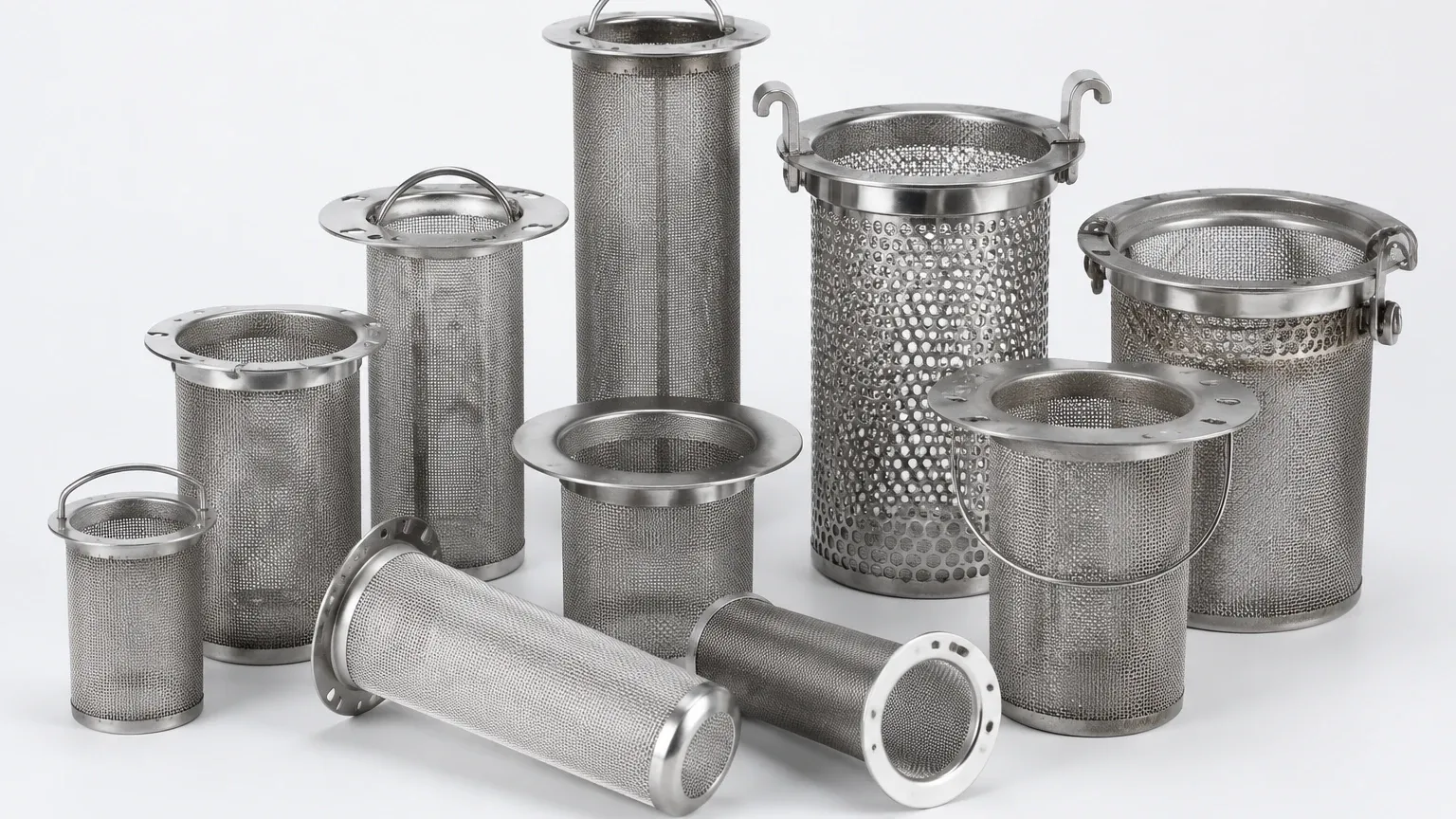
Industrial Strainers & Baskets serve as the primary line of defense in piping systems. Unlike fine filters that may target sub-micron contaminants, strainers are designed to handle larger debris loads with minimal pressure drop. This guide explores the engineering principles, material considerations, and selection criteria that define the role of strainers in modern industrial applications.
The Functional Definition of Industrial Strainers
To define strainers meaning in a B2B context, one must look at the device's role within a pressurized system. A strainer is a closed vessel with a cleanable screen element designed to remove and retain foreign particles. As the process fluid passes through the screen, the debris is trapped within the basket or on the surface of the mesh, while the cleaned fluid continues through the outlet.
The primary objective of a strainer is not necessarily to "purify" the fluid to a high degree of clarity, but rather to ensure that the particle size does not exceed the tolerances of the most sensitive component in the line. For example, in a cooling water loop, a strainer might be installed to catch scale, rust, or weld slag that could otherwise clog the narrow passages of a plate heat exchanger.
Key Components of a Strainer System
1. The Housing: The outer pressure vessel that contains the fluid and the straining element. It must be rated for the system's maximum operating pressure and temperature.
2. The Straining Element (Basket or Screen): The core component made of perforated metal, wire mesh, or a combination of both. This is where the actual separation occurs.
3. The Cover: A removable lid that allows access to the internal element for cleaning or replacement.
4. The Seal/Gasket: Ensures a leak-proof connection between the housing and the cover, selected based on chemical compatibility with the process fluid.
Strainers vs. Filters: Technical Distinctions
One of the most common points of confusion in fluid dynamics is the distinction between a strainer and a filter. While both perform mechanical separation, their applications and engineering specifications differ significantly.
Particle Size: Strainers are generally used for removing particles 40 microns and larger (approximately 325 mesh). Filters are typically employed for removing particles smaller than 40 microns, often reaching into the sub-micron range.
Pressure Drop: Because strainers utilize larger openings, they offer less resistance to flow. The initial pressure drop across a clean strainer is usually negligible. In contrast, filters often create a more significant pressure differential due to the density of the media required to trap fine particles.
Maintenance and Reuse: Most industrial strainers are designed to be cleaned and reused. The Strainers & Baskets can be removed, washed, and reinstalled. Filters, particularly cartridge or bag types, are frequently disposable or require complex backwashing cycles.
Placement: Strainers are almost always located on the suction side of pumps or at the inlet of a process to protect equipment. Filters are often located downstream to ensure the final product meets specific purity standards.
Common Types of Industrial Strainers
Understanding the "strainers meaning" also involves identifying the specific configuration required for a given piping layout and debris load. Each type offers distinct advantages in terms of capacity and ease of maintenance.
Y-Strainers
Named for their shape, Y-strainers are typically used in applications where the amount of material to be removed is small, or where frequent cleaning is not required. They are compact and can be installed in either horizontal or vertical pipelines. In steam or gas lines, the "leg" of the Y points downward to trap condensate or solids effectively.
Simplex Basket Strainers
Simplex strainers feature a basket-shaped element that provides a much larger surface area than a Y-strainer. This allows for a greater holding capacity for debris and a lower frequency of cleaning. They are ideal for liquid applications where the line can be temporarily shut down to remove the basket for cleaning.
Duplex Basket Strainers
For processes that cannot be interrupted, duplex strainers are the standard. These consist of two separate strainer chambers connected by a diverting valve. When one basket becomes full, the flow is switched to the second chamber, allowing the operator to clean the first basket without stopping the process. This is common in fuel oil systems, lubrication lines, and continuous chemical processing.
Engineering Considerations for Selection
When specifying a strainer, engineers must look beyond the basic definition and evaluate several technical parameters to ensure long-term performance.
Material Selection
The choice of material is dictated by the corrosivity of the fluid and the operating environment. Stainless steel (SS304 and SS316) is the industry standard for its excellent corrosion resistance and durability. In pharmaceutical or food and beverage applications, SS316L is often preferred due to its lower carbon content and resistance to pitting. For highly corrosive chemical environments, specialized alloys like Monel or Hastelloy may be required for the internal mesh.
Mesh Count vs. Micron Rating
Selecting the correct hole size is the most critical step in defining the efficiency of the strainer.
* Mesh Count: Refers to the number of openings per linear inch. A higher mesh count means smaller openings.
* Micron Rating: Refers to the actual size of the opening (1 micron = 0.001 mm).
It is important to note that as the mesh becomes finer, the open area ratio decreases, which can lead to higher pressure drops. Engineers must balance the need for fine straining with the available system pressure.
The Open Area Ratio
The open area ratio (OAR) is the relationship between the internal cross-sectional area of the pipe and the total open area of the holes in the strainer element. A common industry benchmark is an OAR of 4:1. This means the total area of the holes in the basket is four times the area of the inlet pipe. A higher OAR allows for longer run times between cleanings and reduces the velocity of the fluid through the mesh, which prevents particle "breakthrough."
Maintenance and Operational Lifespan
To maximize the value of industrial Strainers & Baskets, a proactive maintenance schedule is essential. The "meaning" of a strainer in a system is lost if it becomes a bottleneck due to neglect.
Differential Pressure Monitoring
The most effective way to determine when a strainer needs cleaning is by monitoring the differential pressure (DP) across the inlet and outlet. Most systems are designed with a maximum allowable DP. Once this threshold is reached, the basket must be cleaned. Operating a strainer with an excessive DP can lead to several risks:
* Basket Collapse: The pressure force can physically deform or rupture the mesh.
* Pump Cavitation: If the strainer is on the suction side, a clog can starve the pump of fluid, leading to catastrophic failure.
* Particle Bypass: High pressure can force flexible contaminants through the mesh openings.
Cleaning Procedures
Cleaning typically involves removing the basket and using a high-pressure water jet or an ultrasonic cleaner to remove lodged particles. In the case of stainless steel wire mesh, care must be taken not to damage the delicate wires, as even a small tear can compromise the entire straining process.
Customization in Strainer Design
In many B2B scenarios, off-the-shelf strainers do not meet the specific requirements of a unique process. Customization is often necessary to address specific challenges such as high viscosity, extreme temperatures, or restricted installation space.
Manufacturers like Kaifil specialize in engineering custom filtration solutions. This includes:
* Reinforced Baskets: For high-pressure applications where standard mesh might fail, a perforated metal backup cylinder is added to provide structural support to the fine wire mesh.
* Magnetic Inserts: For systems where fine iron or steel particles are present (such as in hydraulic systems), magnets can be added to the basket to capture metallic fines that might otherwise pass through the mesh.
* Specialized Coatings: Applying PTFE or other coatings to the basket can help in applications where the process fluid is particularly sticky or prone to buildup.
The Role of Strainers in Total Cost of Ownership
While the initial purchase price of a strainer is a consideration, the total cost of ownership (TCO) is heavily influenced by the quality of the component. A well-engineered stainless steel strainer reduces TCO by:
1. Extending Equipment Life: By preventing abrasive wear on pump impellers and valve seats.
2. Reducing Energy Costs: Maintaining a low pressure drop ensures the pump does not have to work harder to move fluid.
3. Minimizing Downtime: High-capacity baskets and duplex configurations allow for continuous operation and faster maintenance cycles.
Conclusion
Understanding the comprehensive "strainers meaning" allows engineering and procurement teams to select the right protection for their critical infrastructure. A strainer is more than just a piece of mesh; it is a precision-engineered component that balances flow dynamics, material science, and mechanical durability. By focusing on high-quality Strainers & Baskets and adhering to proper selection and maintenance protocols, industrial facilities can ensure efficient, reliable, and cost-effective fluid processing.
When evaluating a provider for these components, it is essential to partner with a manufacturer that understands the technical demands of your specific industry—whether it be the sanitary requirements of food production or the rugged durability needed for chemical processing. Proper straining is an investment in the longevity of the entire production line.
