


Strainers on Pumps
In industrial fluid handling, the pump is often the most critical and expensive component of a process loop. Whether it is a centrifugal pump moving process water or a positive displacement pump handling viscous chemicals, the internal components—impellers, seals, and valves—are susceptible to damage from entrained solids. The implementation of strainers on pumps serves as the primary line of defense, ensuring that debris, scale, and foreign particles are removed before they can cause mechanical failure or process downtime.
Selecting the correct configuration of Strainers & Baskets requires a deep understanding of fluid dynamics, pressure requirements, and material compatibility. This guide examines the technical considerations for integrating strainers into pumping systems, focusing on how to balance filtration efficiency with pump performance.
The Role of Strainers in Pump Protection
The primary function of strainers on pumps is to protect the pump’s internal moving parts. In many industrial environments, piping systems can contain welding slag, pipe scale, or even tools left behind during construction. During operation, raw materials or recycled fluids may also carry particulates that are abrasive or large enough to clog narrow passages.
Suction Side vs. Discharge Side
While strainers can be placed anywhere in a system, their role changes based on location.
* Suction Side Strainers: These are installed upstream of the pump. Their main job is to prevent large solids from entering the pump casing. Because the suction side of a pump is sensitive to pressure changes, these strainers must be carefully sized to avoid restricting flow.
* Discharge Side Strainers: These are installed downstream. They are typically used to protect sensitive equipment further down the line, such as spray nozzles, heat exchangers, or instrumentation, from any debris that might have passed through the pump or originated from the pump’s own wear components.
For most engineering applications, the term "strainers on pumps" refers to suction-side protection, as this is where the risk of catastrophic pump damage is highest.
Engineering Considerations: NPSH and Pressure Drop
One of the most critical factors when installing strainers on pumps is the impact on the Net Positive Suction Head (NPSH). Every pump requires a certain amount of pressure at the suction inlet (NPSHr) to prevent the fluid from vaporizing, a phenomenon known as cavitation. Cavitation causes the formation of vapor bubbles that implode against the impeller, leading to pitting, vibration, and eventual failure.
Calculating Pressure Drop
A strainer inherently creates a restriction in the flow path, resulting in a pressure drop ($ΔP$). This drop must be accounted for in the system's NPSH Available (NPSHa) calculation. If the $ΔP$ across the strainer is too high, the NPSHa may fall below the NPSHr, triggering cavitation.
To minimize this risk, engineers should look for Strainers & Baskets with a high Open Area Ratio (OAR). The OAR is the relationship between the total area of the holes in the mesh or screen and the cross-sectional area of the inlet pipe. A common industry standard is an OAR of at least 4:1, which ensures that even as the strainer begins to collect debris, there is still enough free area to maintain low velocity and minimal pressure drop.
Mesh and Perforation Selection
The choice of filtration media is a trade-off between protection and flow. If the mesh is too fine, the strainer will clog rapidly, increasing maintenance frequency and the risk of pump starvation. If the mesh is too coarse, particles small enough to pass through may still damage tight-tolerance components like mechanical seals. Engineers must consult the pump manufacturer’s specifications for the maximum allowable particle size and select a strainer mesh that is slightly finer than that limit.
Types of Strainers for Pumping Systems
Different pump applications and fluid types necessitate different strainer architectures. The three most common types used in industrial pumping are Y-strainers, Simplex basket strainers, and Duplex basket strainers.
Y-Strainers
Y-strainers are characterized by their compact, cylindrical shape. They are often used in high-pressure applications where the amount of debris is expected to be minimal. Because they have a smaller holding capacity compared to basket designs, they are ideal for "permanent" installations where they act as a safety net rather than a primary filter. They can be installed horizontally or vertically, provided the "leg" of the Y points downward to collect debris.
Simplex Basket Strainers
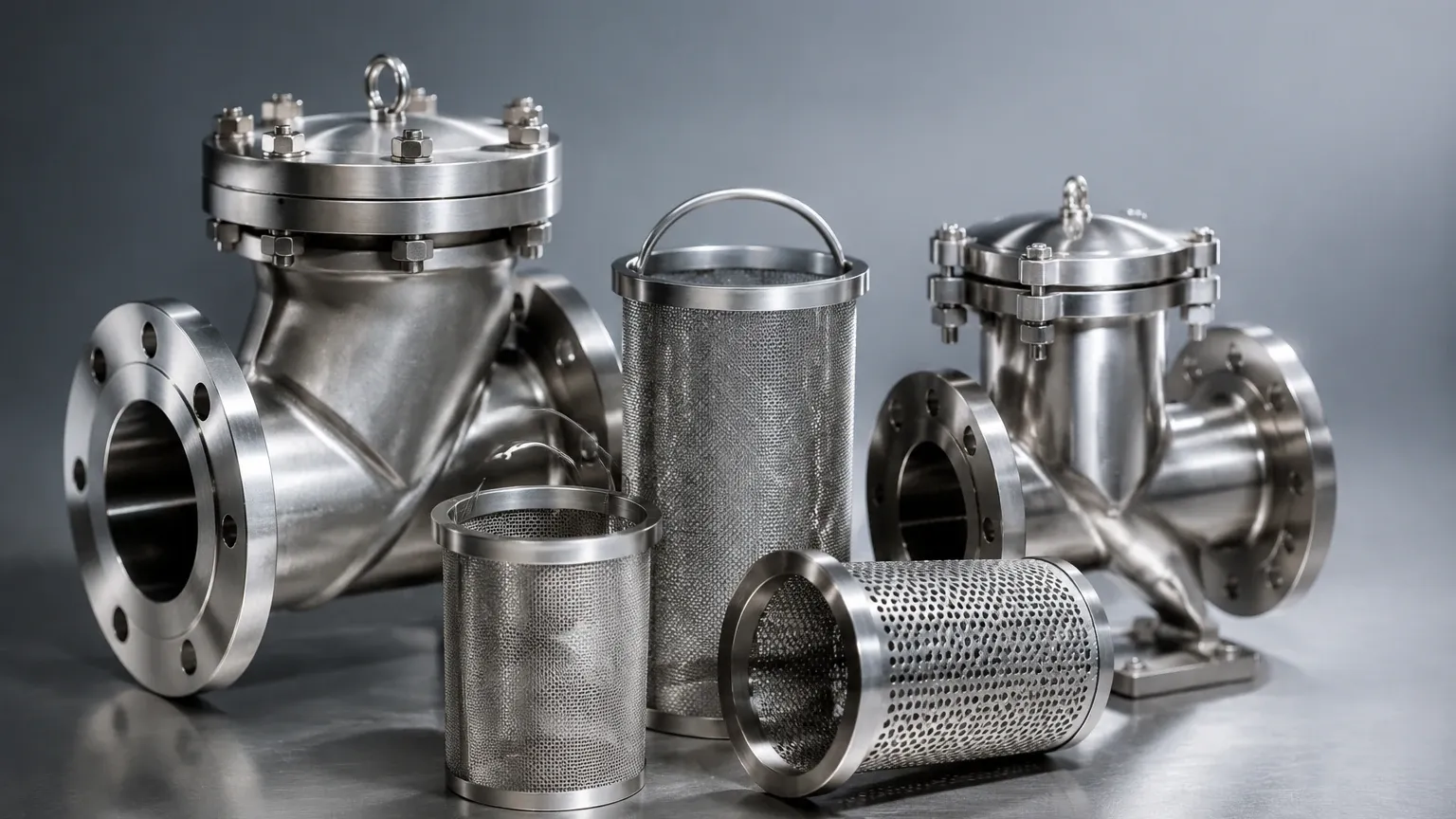
Simplex basket strainers feature a top-loading design with a much larger surface area than Y-strainers. This makes them the preferred choice for suction lines where higher debris loading is expected. The basket design allows for easy removal and cleaning. Because the fluid flows from the inside of the basket to the outside, debris is trapped within the basket, preventing it from falling back into the pipeline during maintenance.
Duplex Basket Strainers
In critical processes where the pump cannot be shut down for cleaning, duplex strainers are used. These consist of two separate strainer chambers connected by a diverting valve. When one side becomes clogged, the flow is switched to the clean chamber, allowing the operator to service the dirty basket without interrupting the flow to the pump. This is essential for lubrication systems, cooling water loops, and continuous chemical processing.
Material Selection and Durability
Industrial pumps often handle aggressive chemicals, high-temperature fluids, or abrasive slurries. Therefore, the materials used in Strainers & Baskets must be selected based on the chemical compatibility and mechanical demands of the environment.
Stainless Steel (304 and 316)
Stainless steel is the industry standard for most filtration components due to its corrosion resistance and structural integrity.
* Type 304: Suitable for general industrial applications, water treatment, and food processing where mild corrosion resistance is required.
* Type 316: Contains molybdenum, providing superior resistance to chlorides and acids. It is the preferred material for pharmaceutical, chemical processing, and marine applications.
Specialized Alloys
For highly corrosive environments involving concentrated acids or high-salinity fluids, specialized alloys like Hastelloy, Monel, or Duplex Stainless Steel may be required. Using a strainer made of an inferior material can lead to galvanic corrosion or structural failure, which could send metal fragments directly into the pump—the very outcome the strainer was intended to prevent.
Installation and Maintenance Best Practices
Proper installation is just as important as selecting the right hardware. When placing strainers on pumps, several geometric and operational factors must be addressed to ensure long-term reliability.
Straight Pipe Requirements
To ensure a uniform velocity profile at the pump inlet, it is generally recommended to have a straight run of pipe between the strainer and the pump suction. This is typically 5 to 10 times the pipe diameter. Placing a strainer too close to the pump inlet can cause turbulent flow, which may lead to uneven loading on the pump impeller and premature bearing wear.
Differential Pressure Monitoring
A strainer is only effective if it is kept clean. The most reliable way to manage maintenance is by installing differential pressure ($ΔP$) gauges across the strainer. By monitoring the pressure difference between the inlet and outlet, operators can identify exactly when the basket is reaching its capacity. Relying on fixed time intervals for cleaning is often inefficient, as debris loading can vary significantly based on process conditions.
Cleaning Cycles and Replacement
When the $ΔP$ reaches a pre-determined limit (usually 5-10 psi depending on the system), the pump should be bypassed or shut down to clean the basket. During cleaning, the basket should be inspected for signs of mesh blinding (where particles are wedged so tightly they cannot be removed) or mechanical damage. Damaged baskets should be replaced immediately to prevent bypass of solids.
Customization and OEM Solutions
Standard off-the-shelf strainers do not always meet the specific needs of complex industrial systems. Factors such as non-standard pipe sizes, unique space constraints, or specific filtration accuracy requirements often necessitate customized solutions.
As a professional manufacturer, Kaifil specializes in engineering custom stainless steel filtration components. When designing Strainers & Baskets for pump applications, we work closely with engineering teams to confirm:
* Filtration Grade: Precise micron ratings or perforation sizes to match pump clearances.
* Structural Reinforcement: Internal supports for baskets subjected to high-pressure differentials to prevent collapsing.
* Connection Types: Flanged, threaded, or sanitary fittings to match existing infrastructure.
* Surface Finishes: Electropolishing or mechanical polishing for food-grade or pharmaceutical applications where bacterial growth must be inhibited.
Conclusion
Integrating strainers on pumps is a fundamental engineering practice that protects capital equipment and ensures process stability. By carefully evaluating the pressure drop, NPSH requirements, and material compatibility, technical professionals can select a filtration solution that provides maximum protection with minimal impact on system efficiency. Whether utilizing a simple Y-strainer for emergency protection or a high-capacity duplex system for continuous operation, the quality of the internal basket and the precision of the mesh are the ultimate determinants of the pump's operational lifespan. For critical applications, partnering with a manufacturer capable of providing customized, high-performance stainless steel components ensures that the filtration system is perfectly aligned with the specific demands of the industrial environment.
