


Strainers Pipeline
In industrial fluid handling, the integrity of downstream equipment such as pumps, valves, meters, and spray nozzles depends heavily on the removal of unwanted solids from the process stream. A strainers pipeline configuration serves as the primary mechanical method for removing these contaminants. Unlike fine filtration systems that target microscopic particles, pipeline strainers are designed to capture larger debris, scale, and foreign matter that could otherwise cause mechanical failure or significant process downtime.
Selecting the correct Strainers & Baskets requires a deep understanding of fluid dynamics, material compatibility, and the specific operational requirements of the system. For engineers and procurement teams, the goal is to balance effective particle removal with minimal pressure loss and ease of maintenance.
The Functional Role of Strainers in Industrial Pipelines
The primary function of a strainer in a pipeline is protection. While the terms "filter" and "strainer" are often used interchangeably, in a technical B2B context, they represent different stages of fluid treatment. A strainer is typically a permanent component of the piping system designed to remove solids that are visible to the naked eye, whereas a filter is often used for finer particle removal, often involving disposable media.
In a strainers pipeline setup, the device creates a barrier that allows the liquid or gas to pass through while retaining solids. This is critical in industries such as chemical processing, where even small amounts of pipe scale can damage expensive centrifugal pumps, or in food and beverage production, where ensuring the purity of the medium is a regulatory and quality requirement. By implementing robust straining solutions, facilities can extend the mean time between failures (MTBF) for their most critical assets.
Common Types of Pipeline Strainers and Their Applications
Industrial pipelines utilize several distinct strainer designs, each suited to specific flow conditions, pressure ratings, and maintenance profiles. Understanding these variations is essential for optimizing system performance.
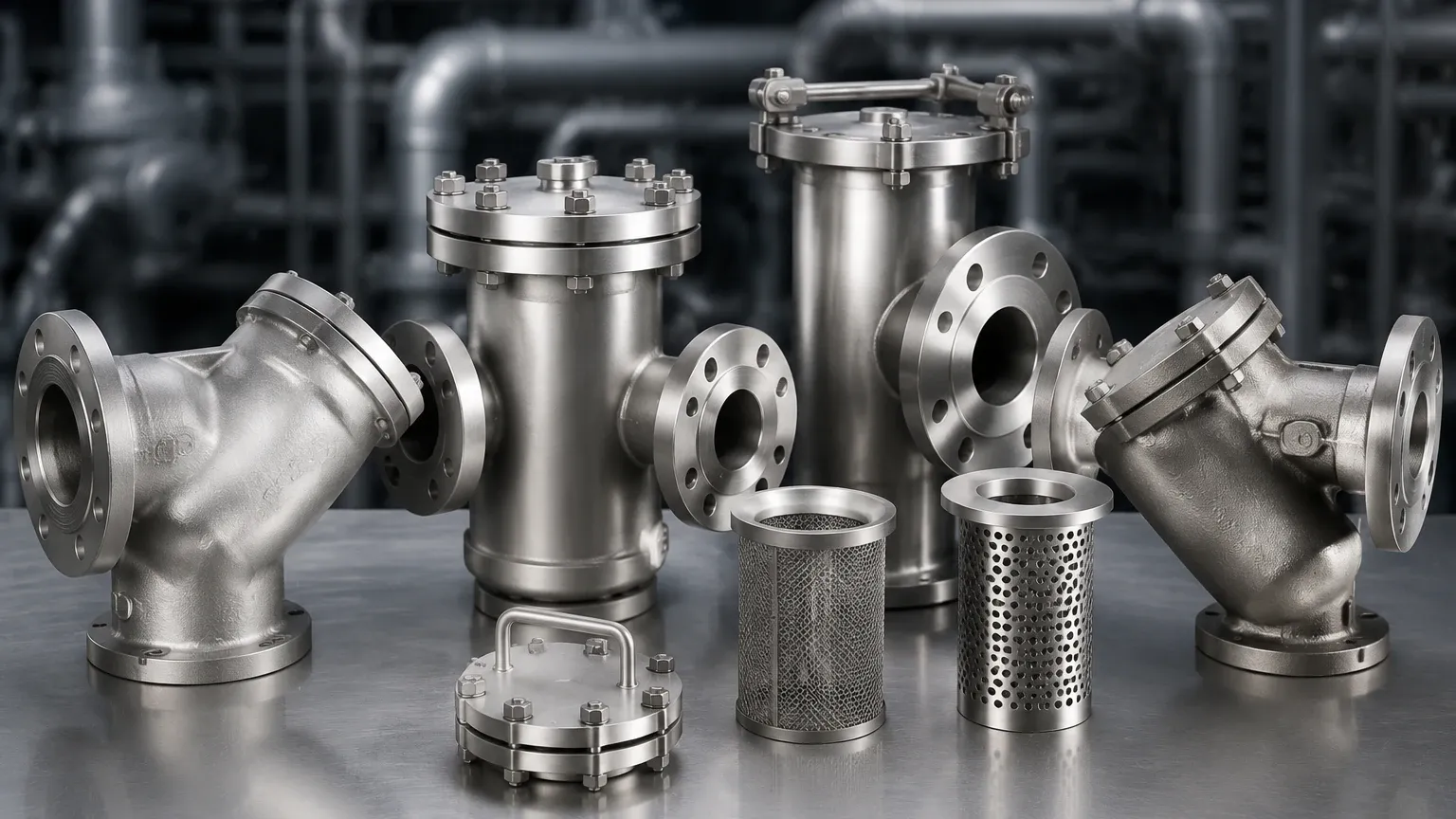
Y-Strainers
Named for their shape, Y-strainers are the most common choice for high-pressure applications, including steam, gas, and liquid lines. They are typically used where the amount of material to be removed is relatively small. Their compact design allows for installation in both horizontal and vertical pipelines (provided the flow is downward), making them highly versatile in tight mechanical spaces. However, because the debris collection chamber is smaller than that of a basket strainer, they require more frequent cleaning if the fluid is heavily contaminated.
Basket Strainers (Simplex)
Basket strainers are designed for horizontal installations and feature a much larger dirt-holding capacity than Y-strainers. The "basket" design allows for a higher open area ratio, which results in a lower initial pressure drop. These are preferred in liquid applications where the flow can be intermittently shut down for cleaning. Because the basket is serviced from the top, maintenance is generally safer and more ergonomic for operators.
Duplex Strainers
In processes where the flow cannot be interrupted—such as in cooling water systems for power plants or continuous chemical reactors—duplex strainers are the standard. A duplex system consists of two separate strainer chambers connected by a diverting valve. When one basket becomes clogged, the flow is diverted to the clean chamber, allowing the operator to service the dirty basket without stopping the process. This ensures 24/7 operational continuity.
T-Type and Suction Diffusers
T-type strainers offer a compact profile with a large filtration area and are often used in large-diameter pipelines. Suction diffusers, on the other hand, are specialized strainers installed at the suction side of a pump. They combine the functions of a strainer, an elbow, and a flow straightener, protecting the pump while reducing the overall footprint of the piping system.
Engineering Considerations: Material Selection and Durability
Material selection is the most critical factor in ensuring the longevity of a strainers pipeline component. The choice of material must account for the chemical nature of the fluid, the operating temperature, and the external environment.
Stainless Steel (304 and 316L)
At Kaifil, we specialize in stainless steel filtration solutions because of the material's superior corrosion resistance and mechanical strength.
- Grade 304: Suitable for general industrial use, water treatment, and less aggressive chemical environments. It provides excellent structural integrity and resistance to oxidation.
- Grade 316L: The preferred choice for pharmaceutical, food and beverage, and marine applications. The addition of molybdenum provides enhanced resistance to pitting and crevice corrosion, particularly in chloride-rich environments.
Mesh vs. Perforated Plate
The internal straining element, often referred to as the "screen" or "basket," can be constructed from perforated metal or wire mesh. Perforated plates are used for coarse straining (removing large stones or bolts), while wire mesh is layered over a perforated backup for finer applications. Engineers must specify the "micron rating" or "mesh count" based on the smallest particle that needs to be removed to protect downstream equipment.
Performance Metrics: Pressure Drop and Flow Rate
One of the most common mistakes in pipeline design is undersizing the strainer, which leads to an excessive pressure drop (delta P). A high pressure drop forces the pump to work harder, increasing energy consumption and potentially leading to cavitation or system failure.
Calculating the Open Area Ratio
The efficiency of a strainer is often measured by its Open Area Ratio (OAR). This is the ratio of the total open area of the strainer screen to the internal cross-sectional area of the inlet pipe. A well-engineered strainers pipeline component typically aims for an OAR of at least 4:1. A higher OAR ensures that as the screen begins to clog, there is still enough open area to maintain the required flow rate without a significant spike in pressure.
Viscosity Impacts
Fluid viscosity significantly affects pressure drop. Thick fluids, such as heavy oils or resins, require larger straining surfaces and coarser mesh to maintain flow. When designing a system for high-viscosity media, engineers must consult flow curves specifically adjusted for the fluid’s centipoise (cP) rating to ensure the strainer does not become a bottleneck.
Installation and Maintenance Best Practices
Even the highest quality Strainers & Baskets will underperform if installed or maintained incorrectly. Proper integration into the pipeline is essential for safety and efficiency.
1. Orientation: Y-strainers must be installed with the "leg" pointing downward to ensure that gravity helps collect the debris. In steam lines, they should be installed horizontally to prevent water pockets that can lead to water hammer.
2. Accessibility: Ensure there is sufficient clearance to remove the basket or screen. For large basket strainers, this may require overhead lifting equipment.
3. Differential Pressure Monitoring: The most effective way to manage maintenance is by installing differential pressure (DP) gauges across the strainer. By monitoring the pressure difference between the inlet and outlet, operators can determine exactly when the strainer needs cleaning, rather than relying on a fixed schedule. A common rule of thumb is to clean the strainer when the DP reaches 5-10 psi above the clean pressure drop.
4. Safety Venting: Before opening any strainer for maintenance, the system must be depressurized and drained. In chemical or high-temperature applications, proper venting and drain valves are mandatory safety features.
Customization for Demanding Industrial Environments
Standard off-the-shelf strainers often fail to meet the specific nuances of complex industrial processes. Customization is frequently required to address unique challenges such as high flow velocities, extremely fine particle removal, or specialized connection types (e.g., sanitary tri-clamp, flanged, or socket weld).
Kaifil provides OEM and customized filtration solutions that allow engineers to specify precise dimensions and filtration accuracies. Whether it is a custom-designed basket for a pharmaceutical reactor or a heavy-duty wire mesh filter for a hydraulic system, custom engineering ensures that the strainer fits the application perfectly, reducing the need for field modifications and ensuring long-term reliability.
Total Cost of Ownership (TCO) in Pipeline Filtration
When evaluating a strainers pipeline solution, procurement teams should look beyond the initial purchase price. The Total Cost of Ownership (TCO) includes:
- Energy Costs: A poorly designed strainer with a high pressure drop increases the electrical load on pumps.
- Maintenance Labor: Easy-to-clean designs (like quick-opening covers) reduce the man-hours required for servicing.
- Replacement Cycles: High-quality stainless steel components may have a higher upfront cost but last significantly longer than cast iron or plastic alternatives in corrosive environments.
- Downstream Protection: The cost of a single pump failure or a contaminated batch of product far outweighs the investment in a premium straining system.
By selecting durable, high-performance filtration components, industrial facilities can achieve a more stable process and lower overall operational expenses.
Conclusion
A well-designed strainers pipeline is fundamental to the health of any industrial fluid system. From selecting the right configuration—be it a Y-strainer for steam or a duplex basket strainer for continuous chemical processing—to ensuring the metallurgy is compatible with the process media, every detail matters.
Engineers must prioritize filtration accuracy, pressure drop management, and ease of maintenance to ensure the system remains efficient over its entire lifecycle. For those seeking specialized solutions, working with a manufacturer that understands the complexities of custom stainless steel filtration is the most effective way to ensure performance and durability in demanding industrial environments.
