


Types of Cocktail Strainers
In the field of precision liquid management and industrial filtration, the separation of solids from liquids is a fundamental process. While often discussed in the context of chemical processing or water treatment, the same engineering principles apply to the specialized tools used in the hospitality and beverage industries. Understanding the different types of cocktail strainers requires an analysis of material science, fluid dynamics, and mechanical separation efficiency. For engineers and procurement specialists looking for high-performance filtration components, these tools represent a specific application of stainless steel wire mesh and perforated metal technology.
From a technical perspective, a strainer acts as a mechanical barrier that allows fluid to pass while retaining unwanted solid matter—such as ice fragments, fruit pulp, or botanical infusions. The efficiency of this process depends on the design of the aperture, the surface area of the filtration medium, and the durability of the construction material. This guide examines the primary types of cocktail strainers through the lens of industrial filtration standards.
The Engineering of Liquid-Solid Separation in Beverage Applications
Filtration in any environment is governed by the need to balance flow rate with particle retention. In the context of beverage preparation, the goal is to achieve a specific "mouthfeel" by removing solids that could negatively impact the clarity or texture of the final product.
When evaluating Strainers & Baskets, engineers look at several key performance indicators:
1. Aperture Size: The size of the openings in the mesh or perforated plate determines the minimum particle size that will be retained.
2. Open Area Percentage: This is the ratio of the total area of the holes to the total area of the strainer surface. A higher open area allows for a faster flow rate but may compromise the structural integrity of the component.
3. Mechanical Strength: The tool must withstand repeated use and mechanical stress without deformation, especially during "tight" straining where pressure is applied to the filtration medium.
Technical Analysis of the Hawthorne Strainer
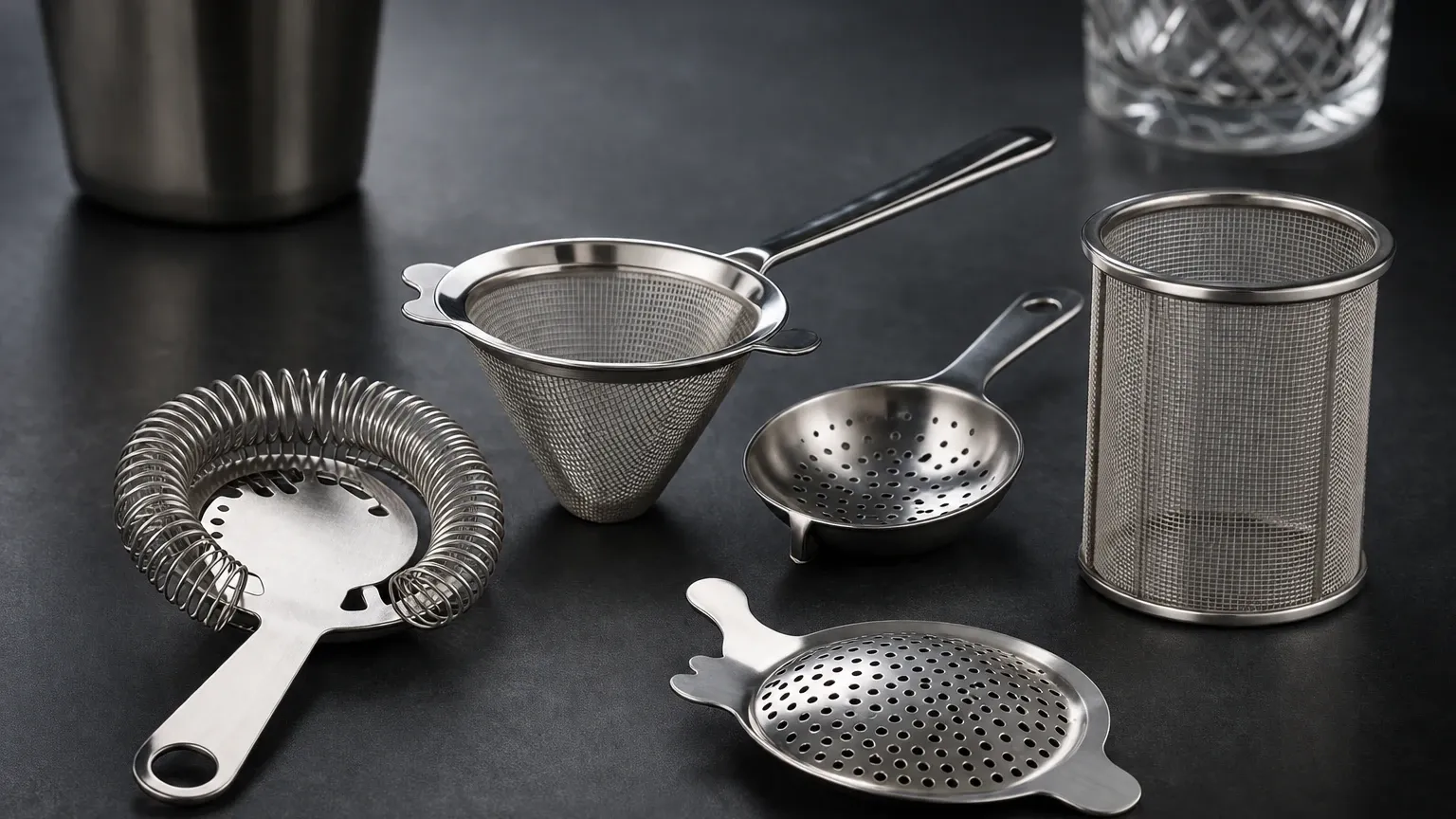
The Hawthorne strainer is perhaps the most versatile filtration tool in the beverage industry, characterized by its flat disc design and an integrated flexible metal spring. From a manufacturing standpoint, the Hawthorne strainer is a complex assembly that combines a perforated plate with a coiled wire element.
The Role of the Coil
The spring, or coil, is the primary filtration element. It is typically made from high-tensile stainless steel wire. The density of the coil—measured by the number of turns per inch—determines the filtration accuracy. A tightly wound coil acts as a variable-pitch filter; when the strainer is pressed against the rim of a mixing vessel, the coil compresses, narrowing the gaps between the wires and increasing the retention of smaller ice shards.
Gate Control and Fluid Dynamics
The "gate" refers to the space between the strainer's edge and the vessel rim. By adjusting the position of the strainer, the operator can control the flow velocity. In industrial terms, this is a manual flow control valve. The Hawthorne design often includes "ears" or tabs that stabilize the device on different diameters of mixing tins, ensuring a consistent seal for effective separation.
Design Characteristics of Julep Strainers
The Julep strainer is a simpler, more robust filtration component, typically consisting of a perforated bowl-shaped plate attached to a handle. It is primarily used for straining drinks stirred with ice, where the goal is to remove large ice cubes while maintaining a high flow rate.
Perforation Patterns
The performance of a Julep strainer is dictated by the hole pattern in the stainless steel bowl. Manufacturers use precision punching or laser cutting to create a series of uniform apertures. For industrial-grade Julep strainers, a staggered hole pattern is often preferred as it maximizes the open area while maintaining the structural rigidity of the bowl.
Durability and Maintenance
Because it lacks moving parts or complex coils, the Julep strainer is highly durable and easy to sanitize. In B2B environments where hygiene and longevity are paramount, the simplicity of the Julep design reduces the risk of material fatigue and bacterial harbor points, making it an ideal choice for high-volume applications.
Fine Mesh Strainers and High-Precision Filtration
When standard separation is insufficient, a fine mesh strainer—often referred to as a conical or tea strainer—is utilized. This tool represents the transition from coarse straining to fine filtration. It is frequently used in a "double-straining" technique, where the liquid passes through a Hawthorne or Julep strainer first, followed by the fine mesh.
Wire Mesh Specifications
The filtration medium in these strainers is a woven stainless steel wire mesh. The performance is defined by the mesh count (the number of wires per linear inch). A higher mesh count results in smaller micron ratings, allowing the strainer to capture micro-ice crystals and fine fruit fibers that would pass through a perforated plate.
* Single vs. Double Mesh: Some high-performance models utilize a double-layer mesh configuration. This increases the depth of the filtration bed, providing higher retention efficiency without significantly increasing the pressure drop across the filter.
* Conical Geometry: The conical shape of many fine mesh strainers is an engineering choice to increase the surface area of the filtration medium within a compact footprint. This allows for faster processing of the liquid while maintaining high clarity.
Material Standards: 304 vs. 316 Stainless Steel
In the manufacturing of industrial filtration components, material selection is critical. For the various types of cocktail strainers, stainless steel is the industry standard due to its corrosion resistance, mechanical strength, and food-grade safety.
Grade 304 Stainless Steel
Grade 304 is the most common austenitic stainless steel used in filtration. It contains chromium and nickel, providing excellent resistance to oxidation and organic acids found in citrus and other beverage ingredients. It is cost-effective and offers good formability for creating complex shapes like the Hawthorne coil or the Julep bowl.
Grade 316 Stainless Steel
For environments where the strainer will be exposed to high concentrations of chlorides or more aggressive cleaning agents, Grade 316 stainless steel is recommended. The addition of molybdenum enhances its pitting resistance. While more expensive, 316 stainless steel components offer a longer service life in demanding industrial or coastal environments.
Manufacturing Considerations for Custom Filtration Components
When sourcing strainers and baskets for industrial or commercial use, purchasing teams must consider the manufacturing processes that ensure product quality and consistency.
Precision Welding and Finishing
The attachment of the mesh to the frame or the handle to the bowl requires precision welding techniques, such as TIG (Tungsten Inert Gas) or spot welding. High-quality welds prevent the accumulation of debris and ensure the component can withstand thermal expansion and contraction during cleaning cycles. Furthermore, an electro-polished finish can be applied to improve the surface smoothness, reducing the adhesion of solids and making the tool easier to clean.
OEM and Customization Options
Many industrial applications require bespoke filtration solutions. Manufacturers like Kaifil provide OEM services, allowing for the customization of:
* Aperture sizes and shapes: Customizing the perforation to target specific particle sizes.
* Dimensions and fitment: Ensuring the strainer fits perfectly within existing processing equipment or vessels.
* Material upgrades: Selecting specific alloys for specialized chemical compatibility.
Performance Evaluation: Flow Rate and Particle Retention
Selecting the right strainer is a trade-off between the desired clarity of the liquid and the speed of the process. In a high-volume B2B setting, a strainer that is too fine will clog quickly (blinding), leading to downtime and inefficiency. Conversely, a strainer that is too coarse will fail to meet the quality standards of the final product.
Engineers should evaluate the "dirt-holding capacity" of the strainer—the amount of solid material the mesh can retain before the flow rate drops below an acceptable level. For applications involving high pulp content, a larger surface area or a multi-stage straining approach is often the most efficient solution.
Selecting Professional-Grade Strainers & Baskets
Whether for a high-end hospitality group or an industrial food processing line, the choice of filtration tools impacts both the quality of the output and the operational cost. By understanding the technical differences between the various types of cocktail strainers—from the variable-pitch coil of the Hawthorne to the precision mesh of the conical strainer—professionals can make informed decisions that optimize their processes.
When evaluating your next procurement of Strainers & Baskets, it is essential to confirm the material grade, the mesh or perforation specifications, and the manufacturing quality. Investing in well-engineered stainless steel filtration components ensures long-term durability, consistent performance, and adherence to strict hygiene standards.
For specialized requirements, working with a manufacturer that understands the nuances of wire mesh and perforated metal fabrication is vital. Custom solutions can address unique challenges in flow dynamics and particle separation, providing a competitive edge in any liquid processing application.
