


Xl Strainers Walmart
In the procurement process for industrial filtration components, technical teams often explore a wide range of sourcing options to meet immediate project needs. Searching for terms like "xl strainers walmart" frequently occurs when a facility requires a large-capacity (XL) straining solution for light-duty applications or when seeking an off-the-shelf temporary fix. However, for engineers and purchasing managers in industries such as chemical processing, pharmaceuticals, and food production, there is a significant distinction between retail-grade consumer products and industrial-grade Strainers & Baskets.
Understanding the technical limitations of retail-sourced filtration equipment versus custom-engineered solutions is critical for maintaining system integrity, ensuring process safety, and optimizing the total cost of ownership. This guide examines the specifications of large-scale strainers, the risks associated with using consumer-grade products in industrial environments, and the engineering criteria that should govern the selection of high-performance filtration components.
Understanding the Context of XL Strainers in Retail
When a professional searches for "xl strainers walmart," they are typically looking for high-volume baskets designed for kitchen use, large-scale catering, or basic drainage. These products are manufactured to meet the needs of the general consumer market, where the primary concerns are price point, ease of cleaning for food particles, and basic durability in a residential or commercial kitchen setting.
Material Composition
Retail XL strainers are commonly labeled as "stainless steel," but they rarely specify the exact grade. In most consumer contexts, this refers to 201 or 304 series stainless steel with a thin gauge. While sufficient for water and food acids, these materials lack the molybdenum content found in 316L stainless steel, which is necessary for resisting chloride-induced pitting and crevice corrosion in industrial chemical or marine environments.
Structural Design
The construction of a retail basket strainer usually involves a simple woven mesh spot-welded to a thin rim. In an industrial setting, where flow rates can be high and pressure drops are a constant factor, these welds are often the first point of failure. Industrial baskets require heavy-duty reinforcement, such as perforated metal backings or structural ribs, to prevent the mesh from deforming or bursting under the weight of the captured solids.
Technical Limitations of Consumer-Grade Filtration
Using a retail-sourced XL strainer in a B2B industrial application presents several technical risks that can lead to unplanned downtime or equipment damage downstream. Engineers must evaluate the following performance gaps:
1. Filtration Accuracy and Micron Ratings
Retail strainers are designed for "visible" filtration—separating pasta, vegetables, or large debris from water. They do not offer certified micron ratings. In contrast, industrial strainers and baskets are engineered to specific filtration thresholds, ranging from coarse perforated plates to fine wire mesh capable of capturing particles as small as 5 to 10 microns. Without a certified micron rating, a process cannot guarantee the protection of sensitive downstream equipment like pumps, nozzles, or heat exchangers.
2. Pressure Drop and Flow Dynamics
Industrial systems are designed based on calculated flow rates and allowable pressure drops (ΔP). Retail strainers do not provide flow coefficient (Cv) data. If a strainer’s open area is insufficient for the system's flow rate, it will create excessive backpressure, forcing the pump to work harder and potentially leading to cavitation or motor failure. Professional filtration manufacturers calculate the "Open Area Ratio" to ensure that the strainer basket has several times the cross-sectional area of the pipe, minimizing flow resistance.
3. Chemical and Thermal Compatibility
In chemical processing or high-temperature steam applications, the gaskets, adhesives, and metal grades must be verified for compatibility. Retail strainers often use plastic handles or low-temperature solder that can degrade or leach contaminants when exposed to industrial solvents or temperatures exceeding 100°C. Industrial-grade baskets are typically all-welded (TIG or plasma) to ensure a monolithic structure that withstands thermal cycling.
Engineering Criteria for Industrial Strainers & Baskets
When moving beyond the "xl strainers walmart" search and into professional procurement, several engineering specifications must be confirmed to ensure the component is fit for purpose.
Material Selection
* SS304/304L: Suitable for general purpose, water treatment, and food-grade applications where corrosion risk is moderate.
* SS316/316L: Required for pharmaceutical and chemical applications where resistance to acids and salts is paramount.
* Specialty Alloys: For highly aggressive environments, materials like Monel, Hastelloy, or Duplex Stainless Steel may be necessary to prevent premature failure.
Construction Styles
Industrial baskets are not one-size-fits-all. Depending on the application, engineers might choose:
* Slant-Top Baskets: Designed for easy removal in certain housing types.
* Heavy-Duty Perforated Baskets: Used as a primary filter for large debris or as a support structure for finer mesh liners.
* Multi-Layer Sintered Mesh: Provides high mechanical strength and precise filtration for high-pressure environments.
* Magnetic Inserts: Often added to baskets in hydraulic or lubrication systems to capture fine ferrous particles that mesh alone might miss.
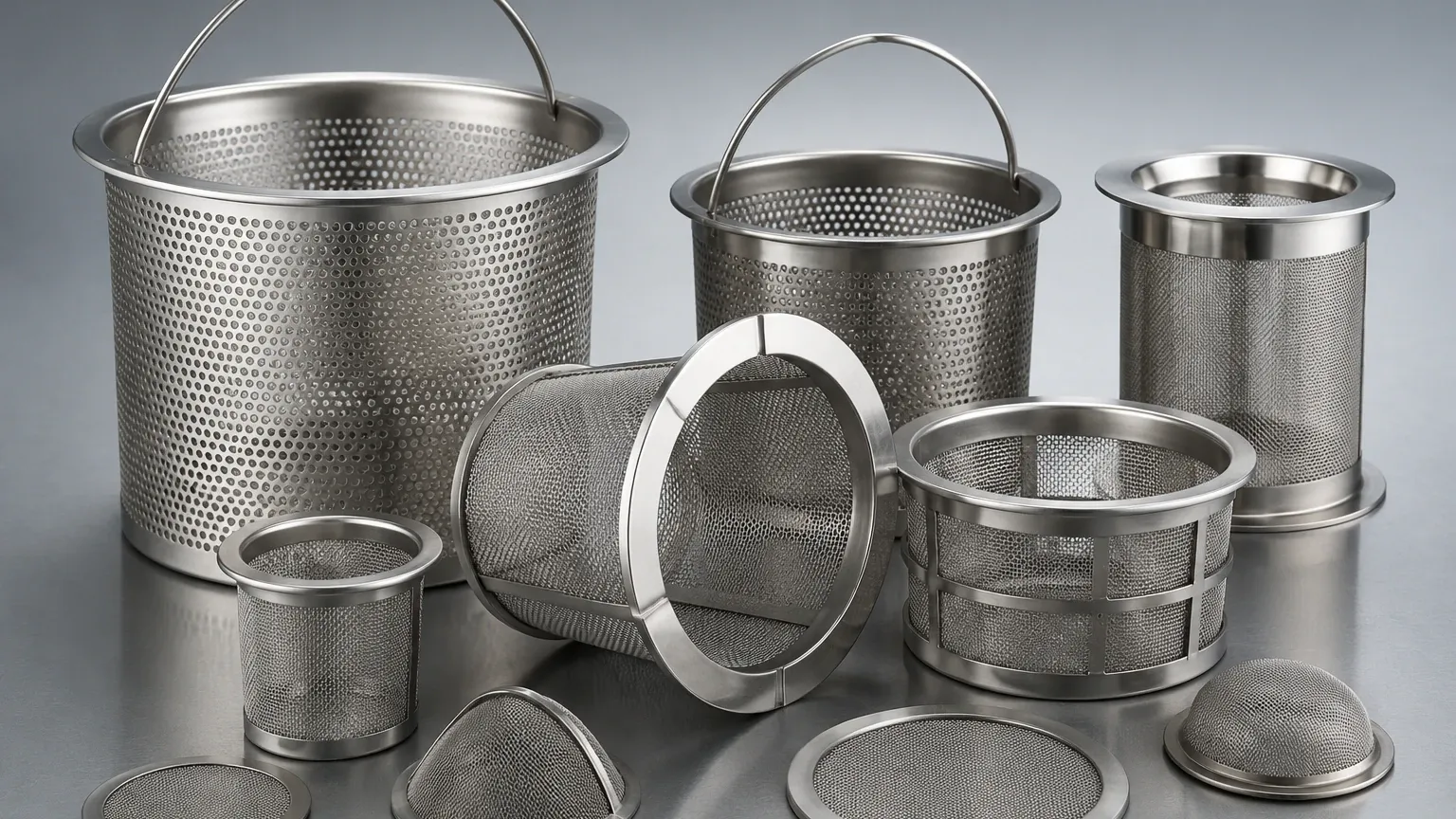
The Role of Customization in Industrial Filtration
One of the primary reasons engineers move away from off-the-shelf retail options is the need for customization. A manufacturer like Kaifil provides the ability to tailor every dimension of the filtration component to fit existing housings or specific process requirements.
Dimensional Precision
In industrial housings, the seal between the basket and the housing body is critical. If the basket is even a few millimeters off in diameter or flange thickness, fluid will "bypass" the filter, allowing contaminants to move downstream. Custom manufacturing ensures a precision fit with machined flanges and specialized gaskets (EPDM, Viton, or PTFE) to ensure 100% filtration efficiency.
Handle and Lifting Configurations
For large (XL) industrial baskets, ergonomics and safety are vital. Retail strainers may have simple wire handles. Industrial versions can be equipped with heavy-duty lifting bails, T-handles, or even threaded connections for mechanical lifting equipment, ensuring that maintenance teams can safely remove and clean heavy, debris-laden baskets.
Total Cost of Ownership: Retail vs. Industrial
While the initial purchase price of a retail XL strainer at a store like Walmart is significantly lower than a custom-engineered industrial basket, the Total Cost of Ownership (TCO) often tells a different story.
1. Replacement Frequency: A retail strainer used in a high-flow industrial line may last only weeks before the mesh tears or the frame warps. An industrial basket is designed for years of service and repeated cleaning cycles.
2. Downstream Protection: The cost of replacing a damaged high-pressure pump or a fouled heat exchanger far outweighs the savings gained from using a low-cost strainer.
3. Process Consistency: In regulated industries like pharmaceuticals or food production, using non-certified components can lead to batch rejection and regulatory fines. Industrial filters come with material certifications (MTRs) and certificates of conformance that are essential for quality audit trails.
Conclusion: Making an Informed Procurement Decision
While searching for "xl strainers walmart" may provide a quick solution for non-critical, low-pressure, or domestic tasks, it rarely meets the rigorous demands of the industrial sector. For engineers and technical buyers, the priority must remain on structural integrity, material verification, and precise filtration performance.
When specifying Strainers & Baskets for a facility, it is essential to partner with a manufacturer that understands the nuances of industrial filtration. By focusing on the specific flow dynamics, chemical environment, and particle load of your application, you can select a filtration solution that enhances system reliability and reduces long-term operational costs.
Before finalizing a purchase, always confirm the following with your supplier:
* The exact grade of stainless steel and availability of material test reports.
* The calculated burst pressure and maximum allowable pressure drop.
* The compatibility of all sealing elements with your process fluid.
* The availability of custom dimensions to ensure a bypass-free fit in your existing strainer housings.
