


Y Pattern Strainers
In industrial fluid handling and piping systems, the protection of sensitive downstream equipment—such as pumps, control valves, meters, and steam traps—is a critical engineering priority. Among the various mechanical devices designed to remove unwanted solids from liquid, gas, or steam lines, y pattern strainers are perhaps the most versatile and widely utilized. Their name is derived from their physical configuration, where the straining element is housed in a branch that intersects the main flow at an angle, creating a "Y" shape.
As a specialized manufacturer of stainless steel filtration solutions, Kaifil understands that selecting the correct strainer involves more than just matching pipe sizes. It requires a deep understanding of flow dynamics, material compatibility, and the specific mechanical stresses of the application environment. This guide provides a technical overview of y pattern strainers, their engineering considerations, and their role within the broader category of Strainers & Baskets.
Design and Engineering Principles of Y Pattern Strainers
The fundamental advantage of the y pattern strainer lies in its compact design and its ability to handle high pressures. Unlike basket strainers, which often feature a larger, perpendicular housing, the Y-shape allows for a more streamlined flow path with a relatively low pressure drop when the screen is clean.
The internal component of a Y strainer is the screen or element, typically constructed from perforated metal or a combination of perforated metal and fine wire mesh. The fluid enters the strainer, passes through the screen, and exits through the outlet, while debris is trapped inside the screen's cylinder. Because the debris is collected in the leg of the "Y," it can often be cleared without stopping the flow if the strainer is equipped with a blow-off valve.
From an engineering perspective, the angle of the branch is significant. A shallower angle may reduce the pressure drop but can also limit the volume of the collection chamber. Conversely, a steeper angle might provide more space for debris but introduce more turbulence. Standard industrial designs balance these factors to optimize the ratio of the screen's open area to the pipe's cross-sectional area, typically aiming for a ratio of at least 3:1 to 4:1 to ensure longevity between cleaning cycles.
Material Selection and Chemical Compatibility
In demanding industrial sectors such as chemical processing, pharmaceuticals, and food and beverage production, the material of construction is paramount. While cast iron or carbon steel may suffice for basic water applications, stainless steel is the industry standard for corrosive environments or high-purity requirements.
Stainless Steel 304 vs. 316
Kaifil specializes in custom stainless steel filtration, primarily utilizing 304 and 316 grades.
- Grade 304: Offers excellent durability and resistance to oxidation, making it suitable for most food-grade applications and general industrial use.
- Grade 316: Contains molybdenum, which provides superior resistance to chlorides and acetic acids. This is the preferred choice for marine environments, pharmaceutical manufacturing, and aggressive chemical processing.
Beyond the housing, the metallurgy of the internal mesh is equally important. The screen must withstand the differential pressure (DP) that increases as the filter becomes loaded with contaminants. If the material is too thin or the alloy is inappropriate for the fluid's pH, the screen can collapse or suffer from localized pitting, leading to bypass and downstream damage.
Key Performance Metrics: Pressure Drop and Filtration Accuracy
When specifying y pattern strainers, engineers must evaluate the trade-off between filtration fineness and pressure drop. The pressure drop (ΔP) is the difference in pressure between the inlet and the outlet. As the mesh size becomes finer, the resistance to flow increases.
Mesh and Micron Ratings
Filtration accuracy is typically defined by mesh count (the number of openings per linear inch) or micron rating (the size of the smallest particle the screen will reliably intercept). For example, a 40-mesh screen has openings of approximately 400 microns. If an application requires the removal of very fine particulates, a multi-layer sintered wire mesh might be integrated into the Y strainer's basket to provide both structural rigidity and high-precision filtration.
The Importance of Open Area Ratio
The "Open Area Ratio" (OAR) is the relationship between the total area of the holes in the screen and the cross-sectional area of the inlet pipe. A higher OAR means the strainer can accumulate more debris before the pressure drop reaches a critical level. For viscous fluids, a larger OAR is essential to prevent the system from reaching the maximum allowable differential pressure too quickly.
Installation and Orientation Guidelines
One of the most common causes of strainer failure or inefficiency is improper installation. Y pattern strainers are unique because they can be installed in either horizontal or vertical positions, provided specific conditions are met.
1. Horizontal Installation: This is the most common orientation. The "leg" of the Y should point downward. This allows gravity to help trap debris in the collection chamber and prevents the debris from falling back into the main pipe during cleaning or blow-down.
2. Vertical Installation: Y strainers can be installed in vertical lines only if the flow is downward. If the flow is upward, gravity will cause the trapped debris to fall toward the bottom of the pipe rather than into the strainer's collection leg, potentially causing a blockage or damaging the screen.
Furthermore, engineers must ensure there is sufficient clearance to remove the strainer cap and screen for manual cleaning. In high-pressure steam systems, the orientation must also consider condensate management; installing a Y-strainer on its side (horizontally) in a steam line can prevent the collection of water pockets that lead to water hammer.
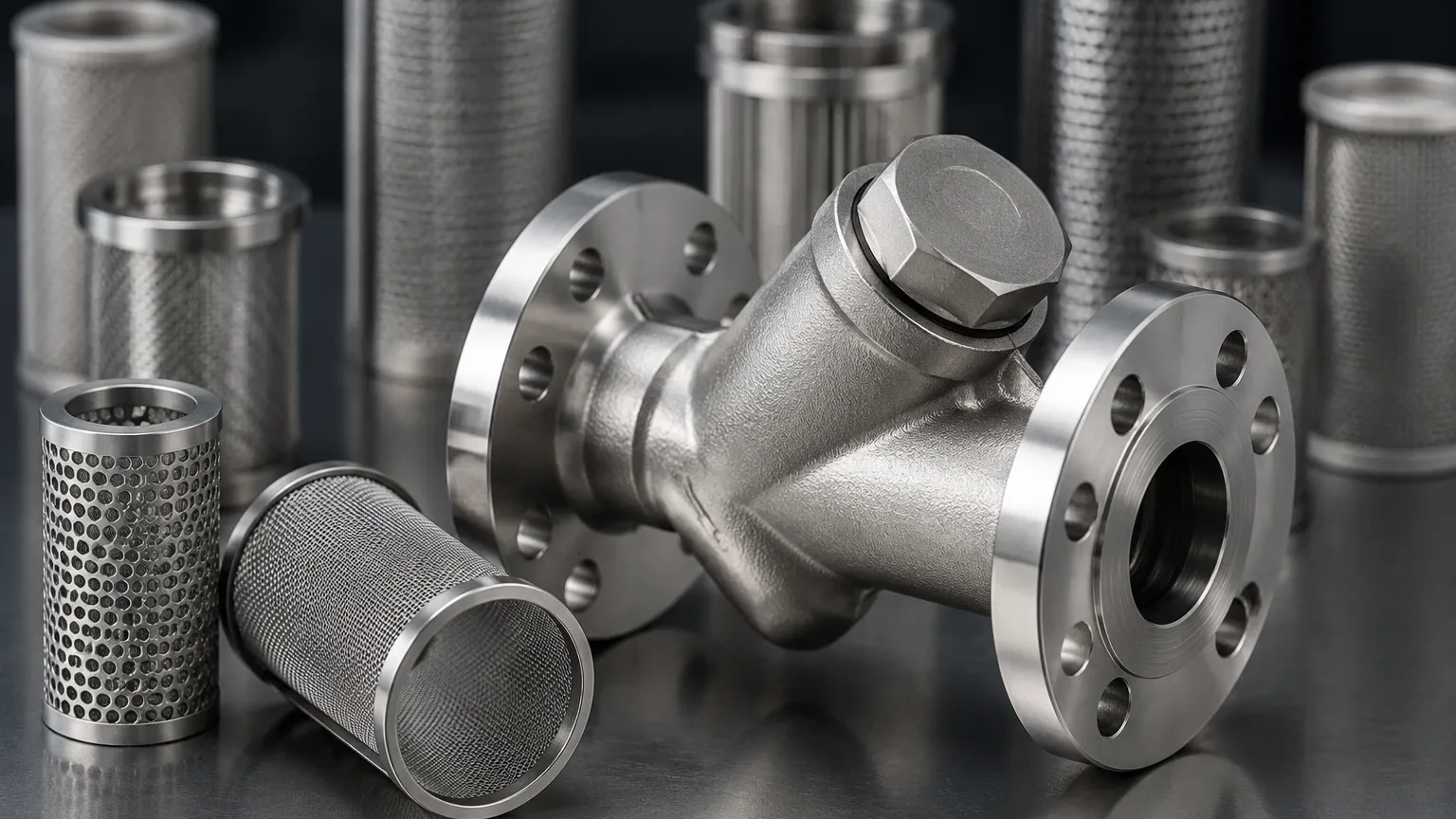
Comparing Y Pattern Strainers with Basket Strainers
While both fall under the category of Strainers & Baskets, the choice between a Y pattern and a basket (or Simplex/Duplex) strainer depends on the specific application requirements.
* Pressure Handling: Y strainers are generally designed for higher pressures than basket strainers. They are commonly used in steam applications where pressures can exceed 600 PSI.
* Debris Loading: Basket strainers have a much larger holding capacity for solids. If the fluid contains a high concentration of particulates, a Y strainer will clog rapidly, necessitating frequent maintenance. Y strainers are best suited for "clean" systems where only occasional or trace amounts of solids are expected.
* Maintenance: Basket strainers are easier to clean manually because the basket is accessed from the top. Y strainers often require the removal of a bolted or threaded cap from the bottom or side, which can be more cumbersome unless a blow-off valve is used for self-cleaning.
Maintenance, Cleaning, and Total Cost of Ownership
The total cost of ownership (TCO) of a filtration system is not just the purchase price, but the cumulative costs of downtime, labor for cleaning, and replacement parts. For y pattern strainers, effective maintenance is centered on monitoring differential pressure.
Blow-off Valves
Many industrial Y strainers feature a "blow-off" port in the screen cover. By installing a ball valve on this port, operators can flush out accumulated debris using the system's internal pressure without shutting down the flow. This is a highly effective way to extend the interval between manual cleanings.
Screen Replacement
Over time, even the most durable stainless steel screens can suffer from erosion or fatigue. It is a best practice to keep replacement screens on hand. When inspecting a screen, technical teams should look for signs of wire fraying, distorted perforations, or gasket degradation. Using high-quality, precision-manufactured screens from an OEM provider like Kaifil ensures that the replacement component meets the original engineering specifications for fit and filtration accuracy.
Customization and OEM Solutions for Specialized Applications
Standard off-the-shelf strainers often fail to meet the rigorous demands of specialized industrial processes. Customization is frequently required in the following areas:
* Custom Dimensions: Fitting a strainer into an existing piping footprint with non-standard flange ratings or face-to-face dimensions.
* High-Performance Linings: Adding layers of fine wire mesh to a heavy-duty perforated support cylinder to achieve sub-100 micron filtration in a high-pressure Y-body.
* Specialty Alloys: Utilizing Hastelloy, Monel, or Duplex stainless steel for extreme chemical resistance.
* Magnetic Inserts: In hydraulic or lubrication systems, magnetic rods can be added to the center of the Y-strainer screen to capture fine ferrous particles that might otherwise pass through the mesh.
As a manufacturer, Kaifil works closely with engineering teams to develop these tailored solutions, ensuring that the filtration component is optimized for the specific flow rate, viscosity, and particle size distribution of the application.
Conclusion
Y pattern strainers are an essential line of defense in industrial piping, offering a compact and high-pressure-capable solution for protecting downstream assets. However, their effectiveness is entirely dependent on correct specification—balancing material choice, mesh size, and orientation. By understanding the technical nuances of these devices and partnering with a manufacturer capable of providing precision-engineered components, facilities can significantly reduce maintenance costs and prevent catastrophic equipment failure. For those evaluating their current filtration setup, exploring the full range of Strainers & Baskets is the first step toward an optimized, reliable system.
