


Y Strainer vs Basket Strainer
In industrial piping systems, the protection of downstream equipment such as pumps, valves, meters, and spray nozzles is a critical engineering priority. Debris, scale, and foreign particulates can cause catastrophic mechanical failure or significant process downtime. To mitigate these risks, engineers rely on mechanical filtration components, primarily categorized into Y strainers and basket strainers.
Selecting the appropriate component requires a technical understanding of fluid dynamics, pressure constraints, and maintenance accessibility. When evaluating a Strainers & Baskets solution, the choice between a Y-pattern and a basket-pattern design is dictated by the specific requirements of the application, including the nature of the fluid, the expected debris load, and the physical layout of the piping system.
Understanding the Role of Industrial Strainers
Industrial strainers serve as a coarse filtration stage, designed to remove larger particles from a process stream. Unlike fine filters that may require frequent element replacement, strainers are typically designed for longevity and can be cleaned and reused. They function by intercepting solids via a perforated metal screen or a wire mesh lining.
From an engineering perspective, the strainer is the first line of defense. In chemical processing, pharmaceutical manufacturing, and food production, the integrity of the fluid is paramount. A well-selected strainer not only protects hardware but also ensures the consistency of the end product. Kaifil specializes in manufacturing these components using high-grade stainless steel to ensure corrosion resistance and structural integrity under high-pressure conditions.
Technical Characteristics of Y Strainers
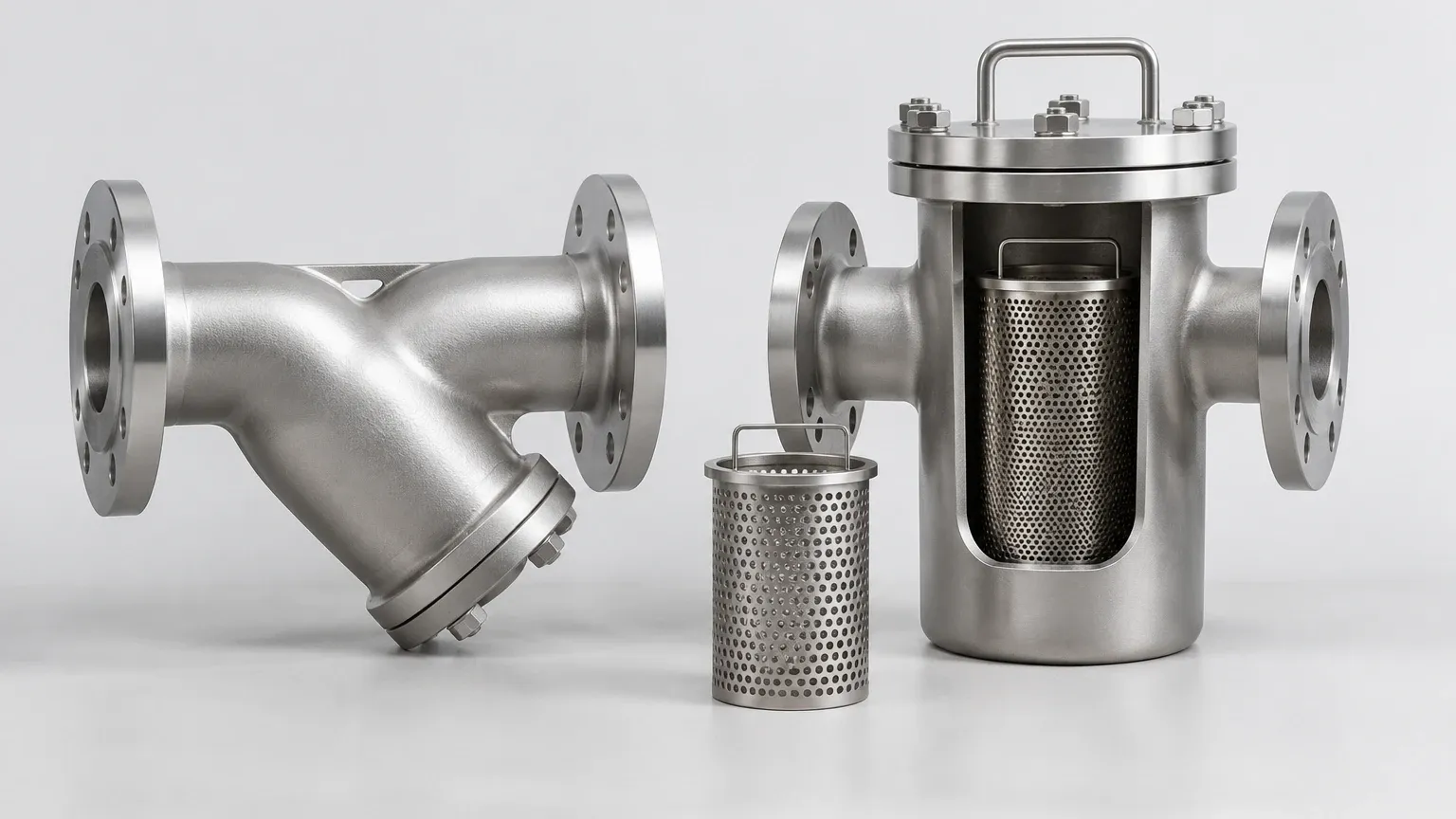
The Y strainer derives its name from its "Y" shaped configuration. This design features a leg that intersects the main pipe at an angle, housing the straining element.
Design and Orientation
One of the primary advantages of the Y strainer is its versatility in installation. It can be installed in either horizontal or vertical piping runs. In vertical installations, the flow must be downward so that the trapped debris is collected in the sediment leg by gravity. This flexibility is essential in compact industrial skids where space is at a premium.
High-Pressure Capabilities
Y strainers are inherently robust. Because of their compact and streamlined shape, they can withstand higher operating pressures than many basket-style alternatives. They are the standard choice for steam applications, as well as high-pressure gas and liquid lines.
Debris Capacity
The main limitation of the Y strainer is its relatively small dirt-holding capacity. The straining element is typically smaller than that found in a basket strainer, meaning it will clog faster if the fluid contains a high concentration of solids. Consequently, Y strainers are best suited for applications where the amount of debris is expected to be minimal.
Design and Functionality of Basket Strainers
Basket strainers, often referred to as pot strainers, feature a vertical cylinder that houses a large, basket-shaped straining element. This design is optimized for liquid applications where high flow rates and high debris loads are common.
Large Surface Area
The defining characteristic of a basket strainer is the significant surface area of its internal element. This large "open area ratio" allows for a greater volume of debris to be captured before the pressure drop across the strainer reaches a critical level. For engineers, this translates to longer intervals between maintenance cycles.
Installation Constraints
Unlike Y strainers, basket strainers are almost exclusively designed for horizontal piping installations. Because the basket must be oriented vertically to hold the captured material, they cannot be used in vertical lines. Additionally, basket strainers generally have a larger footprint, requiring more physical space within the facility.
Ease of Maintenance
Basket strainers are designed for accessibility. Most models feature a top-loading cover that can be removed quickly, often without specialized tools if a swing-bolt or quick-opening cover is used. This allows the operator to lift the basket out, clean it, and replace it with minimal effort. In processes that cannot be shut down, duplex basket strainers—which consist of two strainer housings connected by a diverting valve—allow for continuous flow while one basket is being serviced.
Detailed Comparison: Y Strainer vs Basket Strainer
When conducting a technical y strainer vs basket strainer comparison, several performance metrics must be analyzed to determine the optimal fit for a specific industrial process.
| Feature | Y Strainer | Basket Strainer |
| :— | :— | :— |
| Primary Application | Steam, Gas, High-Pressure Liquid | Liquid, High-Flow Systems |
| Installation Orientation | Horizontal or Vertical (downward) | Horizontal only |
| Dirt Holding Capacity | Low | High |
| Pressure Drop | Moderate to High | Low |
| Maintenance Effort | Higher (requires line depressurization) | Lower (top-access) |
| Space Requirement | Compact | Large |
Pressure Drop Considerations
Pressure drop (ΔP) is a critical factor in pump sizing and system efficiency. Because Y strainers have a more restricted flow path and a smaller screen area, they typically exhibit a higher pressure drop than basket strainers of the same pipe size. Engineers must calculate the clean pressure drop and the maximum allowable pressure drop before cleaning is required. If the system has a low NPSH (Net Positive Suction Head) requirement for a pump, a basket strainer is usually preferred to minimize resistance on the suction side.
Particle Loading and Fluid Type
The choice between y strainer vs basket strainer often comes down to the fluid medium. Steam is almost always handled by Y strainers because of the high pressures involved and the nature of the debris (usually pipe scale). In contrast, cooling water, chemicals, and food products often contain higher particulate loads, making the basket strainer’s capacity a necessity.
Engineering Selection Criteria: Fluid Dynamics and Operating Conditions
To specify the correct strainer, procurement teams and engineers should confirm several parameters before finalizing a design.
1. Micron Rating and Mesh Size: The filtration accuracy is determined by the size of the openings in the mesh or perforated plate. Kaifil provides custom stainless steel wire mesh liners that can be tailored to capture specific particle sizes while balancing flow requirements.
2. Material Compatibility: The strainer housing and the element must be compatible with the process fluid. Stainless steel (304 or 316) is preferred for its resistance to corrosion and temperature extremes. In pharmaceutical and food applications, 316L stainless steel is often required for its superior chemical resistance and ease of sterilization.
3. Operating Pressure and Temperature: Ensure the strainer's pressure rating (e.g., ASME Class 150, 300, or 600) exceeds the maximum system pressure. Y strainers are generally more capable of handling thermal shock in steam systems.
4. Flow Rate: Determine the maximum and minimum flow rates. High-velocity flows can cause erosion or vibration in the strainer element if it is not structurally reinforced.
Material Science and Customization in Strainer Manufacturing
As a specialized manufacturer, Kaifil emphasizes the importance of material selection in the longevity of filtration components. The internal straining element is the most vulnerable part of the assembly. Under high-pressure differentials, a standard mesh might collapse or bypass.
Custom Wire Mesh Solutions
For demanding applications, we offer reinforced baskets and Y-strainer screens. This may involve a heavy-gauge perforated metal support cylinder lined with a fine stainless steel wire mesh. This combination provides both the structural strength required to withstand pressure surges and the fine filtration accuracy needed for process purity.
Surface Treatments
In some industries, such as chemical processing, additional surface treatments like electropolishing are applied to the stainless steel components. This reduces surface roughness, preventing bacterial growth and making the cleaning process more efficient.
Maintenance Protocols and Operational Longevity
The total cost of ownership for a strainer is heavily influenced by its maintenance requirements.
Y Strainer Maintenance
To clean a Y strainer, the system must typically be shut down and depressurized. The blow-off port in the cap can be used to flush out loose debris without removing the screen, provided a blow-off valve is installed. However, for a thorough cleaning, the cap must be unscrewed and the screen removed manually. This can be cumbersome in large pipe sizes.
Basket Strainer Maintenance
Basket strainers are designed for frequent cleaning. The top-opening design means that operators do not have to contend with fluid draining out of the bottom of the pipe, as is often the case with Y strainers. For critical systems, we recommend installing differential pressure gauges across the strainer. When the pressure drop reaches a predetermined limit (usually 5-10 psi), it signals that the basket requires cleaning.
Replacement Cycles
While the housings of these strainers can last for decades, the internal elements are wear parts. Factors such as corrosion, erosion from high-velocity particles, and mechanical fatigue from pressure fluctuations will eventually necessitate replacement. Keeping spare Strainers & Baskets elements on-site is a standard best practice to prevent extended downtime.
Conclusion: Making the Informed Choice
Deciding between a y strainer vs basket strainer involves balancing installation space, pressure drop tolerances, and maintenance capabilities.
* Choose a Y Strainer if you are handling steam, high-pressure gases, or liquids with very low debris levels, especially if space is limited or vertical installation is required.
* Choose a Basket Strainer for liquid systems with significant debris loads, where low pressure drop is essential, or where ease of maintenance and frequent cleaning are operational priorities.
At Kaifil, we provide technical support to help engineers navigate these variables. Our focus on precision-engineered stainless steel filtration ensures that whether you require a standard Y strainer or a custom-designed high-capacity basket, the component will perform reliably in the most demanding industrial environments. By understanding the mechanical and fluid-dynamic differences between these two designs, you can optimize your system's efficiency and protect your capital equipment investments.
