


Y Strainer Baskets
In industrial fluid handling systems, the protection of sensitive downstream components—such as pumps, meters, control valves, and steam traps—is a critical engineering priority. The Y strainer is a ubiquitous mechanical device designed to remove unwanted solids from liquid, gas, or steam lines by means of a perforated or wire mesh straining element. While the strainer housing provides the pressure-containing vessel, the internal component, often referred to as the y strainer baskets or screens, is the functional core of the assembly.
Selecting the correct configuration for these baskets is not merely a matter of sizing; it involves a complex evaluation of flow dynamics, material compatibility, and filtration precision. As a specialized manufacturer of stainless steel filtration solutions, Kaifil provides high-performance Strainers & Baskets designed to withstand the rigorous demands of chemical processing, pharmaceutical production, and heavy industrial applications.
The Engineering Role of Y Strainer Baskets
The "Y" configuration of a strainer is named for its shape, which allows for the collection of debris in a branch that can be serviced without removing the entire strainer from the pipeline. The basket or screen is positioned within this branch. As fluid enters the strainer, it is forced through the basket, which captures particles larger than the openings in the mesh or perforation.
For engineers, the primary objective is to balance filtration efficiency with system pressure. A basket with extremely fine openings will capture more contaminants but will also create a higher pressure drop (ΔP) and require more frequent cleaning. Conversely, a basket with openings that are too large may allow harmful particulates to pass through, leading to equipment wear or product contamination. Understanding the specific requirements of the application—including the nature of the solids being removed and the flow velocity—is essential for optimizing the performance of y strainer baskets.
Technical Specifications: Perforation and Mesh
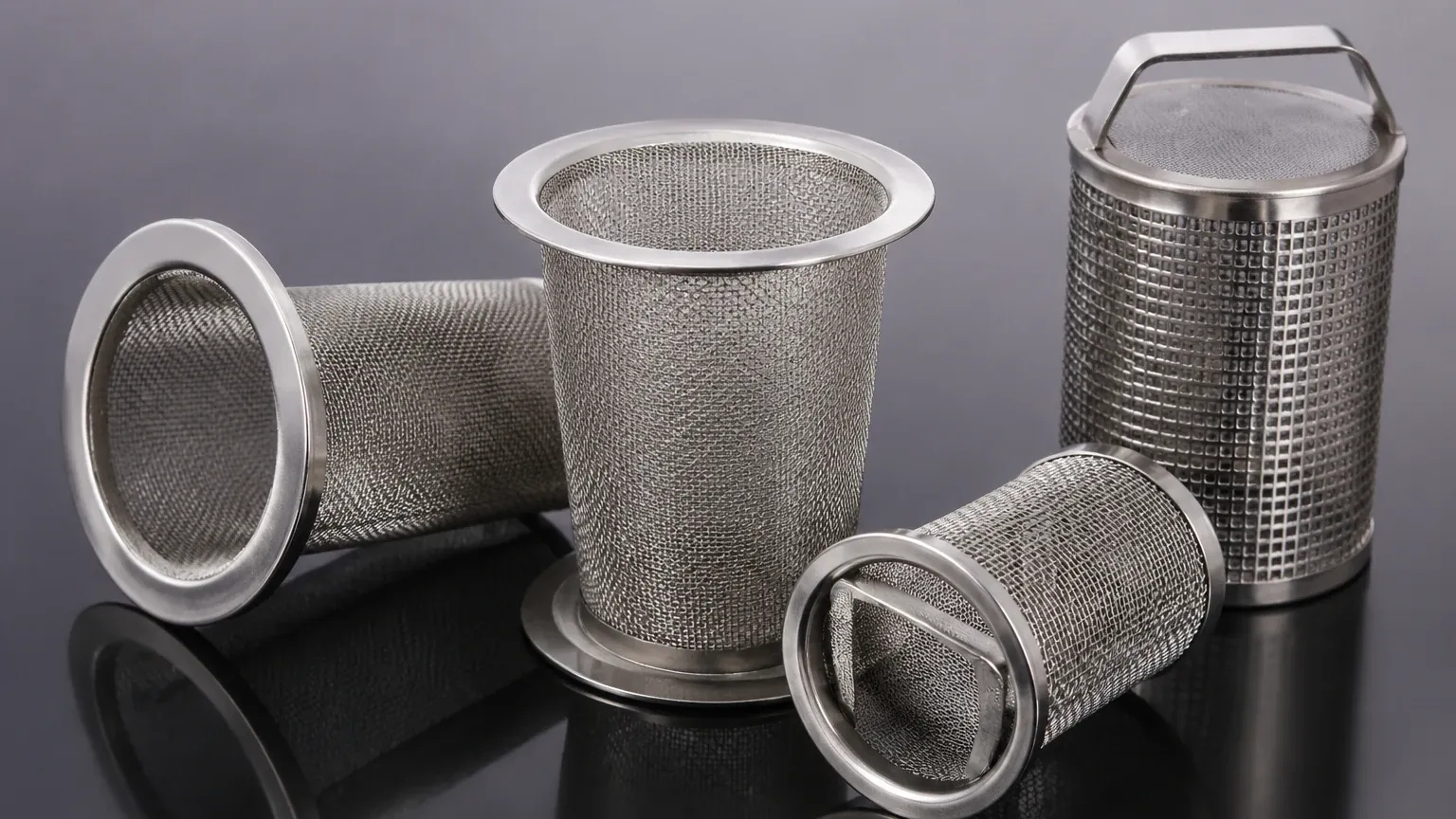
Most industrial y strainer baskets are constructed using one of two primary methods: perforated metal or wire mesh. In many high-precision applications, these two methods are combined to provide both structural strength and fine filtration.
Perforated Metal Screens
Perforated screens are typically used for coarse filtration or as a support structure for finer mesh. They are manufactured by punching a series of holes into a metal sheet. The most common patterns include staggered round holes, which provide the best balance of strength and open area. Engineers must specify the hole diameter and the "pitch" (the distance between the centers of the holes). Common perforation sizes range from 1/32" to 1/2", depending on the debris expected in the line.
Wire Mesh Liners
For finer filtration requirements, a stainless steel wire mesh is used. This mesh is woven from fine wires to create precise openings, often measured in microns or mesh count (the number of openings per linear inch). Because wire mesh is inherently flexible and less robust than perforated plate, it is frequently "lined" or "wrapped" around a perforated metal basket. This composite construction allows the basket to handle high differential pressures without collapsing while still providing filtration down to 5 or 10 microns.
Material Selection and Chemical Compatibility
The durability of y strainer baskets depends heavily on the materials used in their construction. In industrial environments, stainless steel is the industry standard due to its corrosion resistance and mechanical strength. Kaifil specializes in several grades of stainless steel to meet varying environmental challenges:
* Type 304 Stainless Steel: The most common grade, offering excellent strength and basic corrosion resistance. It is suitable for water treatment, food and beverage applications, and general industrial use where highly corrosive chemicals are not present.
* Type 316/316L Stainless Steel: Contains molybdenum, which provides superior resistance to chlorides and pitting. This is the preferred choice for marine environments, chemical processing, and pharmaceutical applications where hygiene and resistance to aggressive cleaning agents are paramount.
* Specialty Alloys: For extreme environments involving high temperatures or highly acidic fluids, alloys such as Monel, Hastelloy, or Duplex stainless steel may be required to prevent premature failure due to stress corrosion cracking or chemical erosion.
Evaluating Open Area Ratio and Pressure Drop
One of the most critical metrics in the design of y strainer baskets is the "Open Area Ratio" (OAR). This is the ratio of the total area of the holes in the basket to the cross-sectional area of the inlet pipe. A common engineering standard is to maintain an OAR of at least 4:1.
A higher OAR ensures that the strainer can accumulate a significant amount of debris before the pressure drop becomes excessive. If the OAR is too low, the fluid velocity through the remaining open holes increases, which can lead to "jetting." This high-velocity flow can cause erosion of the basket material or force soft particles through the mesh, compromising downstream equipment. When specifying custom baskets, engineers should calculate the OAR to ensure the design matches the pump capacity and system flow requirements.
Customization and OEM Capabilities
Standard off-the-shelf strainer baskets often fail to meet the specific nuances of complex industrial systems. Customization is frequently necessary to address unique challenges such as high-viscosity fluids, non-standard housing dimensions, or the need for reinforced structural supports.
Kaifil’s manufacturing capabilities allow for the production of bespoke y strainer baskets tailored to exact technical drawings. Customization options include:
* Reinforced Frames: Adding longitudinal or circumferential ribs to prevent basket deformation under high-pressure surges.
* Magnetic Inserts: Incorporating high-strength magnets within the basket to capture fine iron and steel particles that might otherwise pass through a standard mesh.
* Handle Designs: Custom lifting handles or bails to facilitate easier removal and cleaning in tight spaces.
* Multi-Layer Construction: Sintered mesh or multiple layers of varying mesh counts to provide depth filtration and increased dirt-holding capacity.
Maintenance, Cleaning, and Replacement Cycles
The performance of a Y strainer is only as good as its maintenance regime. As the basket captures debris, the effective open area decreases, and the differential pressure across the strainer increases. Most industrial systems utilize differential pressure gauges to monitor this change.
Cleaning Procedures
In steam or gas lines, Y strainers often feature a "blow-down" valve connected to the strainer cap. This allows for the removal of accumulated debris without stopping the flow. However, for liquid systems or when the basket is heavily fouled, manual cleaning is required. The system must be depressurized, the cap removed, and the basket extracted. It is vital to clean the basket using methods that do not damage the mesh, such as ultrasonic cleaning or gentle pressure washing with compatible solvents.
Identifying the Need for Replacement
Engineers should inspect y strainer baskets for signs of mechanical fatigue, such as broken wires in the mesh, thinning of the perforated plate, or distortion of the basket frame. A compromised basket can lead to "bypass," where fluid and contaminants flow around the basket rather than through it. In high-stakes applications like hydraulic systems or pharmaceutical blending, maintaining a stock of replacement baskets is a standard risk-mitigation strategy to ensure zero downtime during maintenance cycles.
Selection Checklist for Engineers and Purchasing Teams
Before procuring or specifying new y strainer baskets, technical teams should confirm the following parameters to ensure long-term reliability:
1. Fluid Characteristics: What is the viscosity, temperature, and chemical composition of the media?
2. Contaminant Profile: What is the size, shape, and concentration of the particles being removed? Is the debris hard (sand, scale) or soft (algae, polymers)?
3. Flow Rate and Pressure: What is the maximum operating pressure and the allowable pressure drop across the strainer?
4. Filtration Rating: What is the required micron or mesh size to protect the most sensitive downstream component?
5. Housing Compatibility: Are the dimensions (length, diameter, flange thickness) exactly matched to the existing strainer body to prevent bypass?
6. Regulatory Compliance: Does the material need to meet FDA, 3A, or ASME standards for specific industry use?
Conclusion
While often viewed as a simple component, the Y strainer basket is a precision-engineered tool vital to the health of industrial piping systems. By selecting the appropriate materials, perforation patterns, and structural reinforcements, engineers can significantly extend the life of their equipment and improve the purity of their processes.
Kaifil remains committed to providing the technical expertise and manufacturing precision required to produce high-quality Strainers & Baskets. Whether you require a standard replacement or a custom-designed filtration solution for a demanding chemical environment, our focus on durability and filtration accuracy ensures that your systems remain protected and efficient.
