


Cylindrical Wedge Wire Screens
In industrial filtration and separation processes, the structural integrity and efficiency of the filter media directly impact operational uptime and product quality. Cylindrical wedge wire screens represent a specialized engineering solution designed to overcome the limitations of traditional woven wire mesh and perforated plates. Known for their non-clogging surface and high mechanical strength, these components are essential in demanding environments ranging from petrochemical processing to food and beverage production.
Selecting the appropriate cylindrical wedge wire screens requires a deep understanding of fluid dynamics, material science, and mechanical engineering. This guide examines the technical specifications, design considerations, and performance benchmarks that engineers and purchasing teams must evaluate to ensure optimal filtration performance.
Understanding the Engineering of Cylindrical Wedge Wire Screens
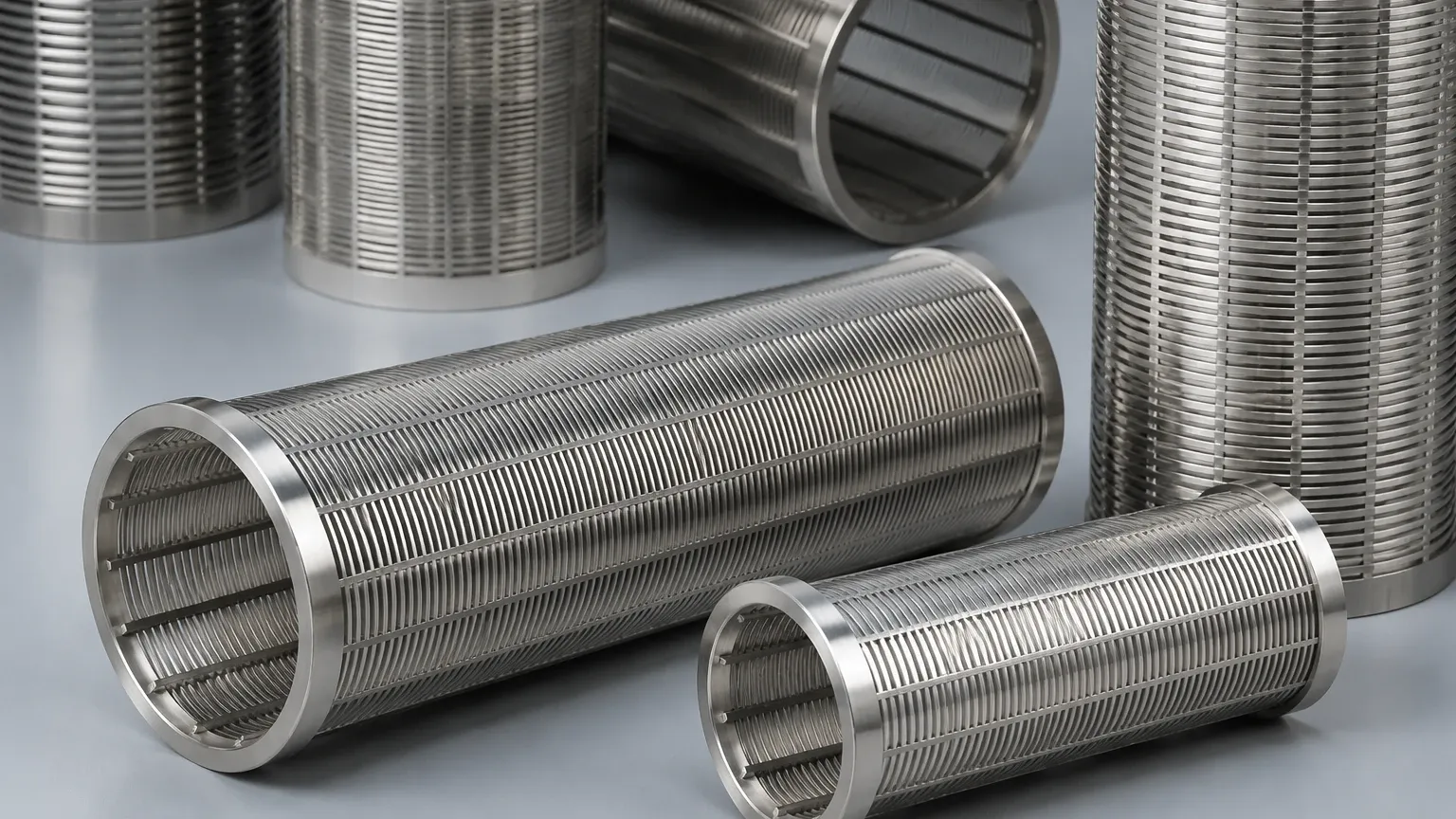
At its core, a wedge wire screen is a welded steel structure composed of two primary elements: the surface profile wire and the support rods. The surface wire is typically V-shaped or wedge-shaped, which is where the technology derives its name. These wires are resistance-welded onto the support rods at every intersection, creating a rigid, single-piece unit.
The V-Shaped Profile Advantage
The most significant technical advantage of cylindrical wedge wire screens is the V-shaped profile of the surface wire. In traditional mesh filters, particles often become wedged within the openings, leading to "blinding" or clogging. With wedge wire, the narrowest part of the opening is at the surface. As the fluid flows through, the aperture widens inwardly. This means that any particle capable of passing through the surface opening will continue through the screen without getting stuck. This geometry is critical for applications involving sticky or abrasive solids where continuous operation is required.
Structural Integrity and Construction
Unlike woven mesh, which can shift under high pressure, the welded construction of Wedge Wire Screens provides exceptional dimensional stability. The cylindrical shape further enhances this strength, allowing the screen to withstand significant collapse or burst pressures. This makes them suitable for high-pressure hydraulic systems and deep-well water intake applications where mechanical failure is not an option.
Key Design Parameters for Industrial Applications
When specifying cylindrical wedge wire screens, engineers must define several critical parameters to match the screen to the specific process requirements. These parameters dictate the flow rate, filtration accuracy, and the screen's lifespan.
1. Slot Size (Aperture)
The slot size is the distance between adjacent profile wires. It determines the filtration rating of the screen. Because wedge wire is manufactured with high precision, slot sizes can be controlled down to 20 microns or expanded to several millimeters. Selecting the correct slot size involves a balance: a smaller slot provides finer filtration but increases pressure drop and may require more frequent cleaning.
2. Flow Direction: FOTI vs. FITO
The direction of fluid flow relative to the screen surface is a fundamental design choice:
* Flow-Out-To-In (FOTI): The fluid moves from the exterior of the cylinder toward the center. In this configuration, the smooth surface of the profile wires is on the outside. This is common in intake screens and drum filters.
* Flow-In-To-Out (FITO): The fluid moves from the center toward the exterior. Here, the smooth surface is on the inside of the cylinder. This is often used in centrifuge baskets and internal piping filters to facilitate easier internal cleaning.
3. Profile Wire and Support Rod Selection
The choice of wire profile (width and height) affects the open area percentage and the mechanical wear resistance. A heavier profile wire provides a longer wear life in abrasive environments but reduces the total open area, which can limit flow capacity. Support rods must be spaced and sized to handle the calculated differential pressure (ΔP) of the system.
Material Selection and Corrosion Resistance
Cylindrical wedge wire screens are subjected to diverse chemical and thermal environments. Material selection is the primary defense against corrosion and premature failure. Kaifil specializes in manufacturing these components from high-grade stainless steel and specialized alloys to meet these challenges.
* Grade 304/304L: The standard choice for general industrial applications, offering good corrosion resistance and excellent welding characteristics. It is widely used in food processing and standard water treatment.
* Grade 316/316L: Contains molybdenum, which provides superior resistance to chlorides and pitting. This is the preferred material for pharmaceutical, chemical processing, and marine environments.
* Duplex Stainless Steels: For extremely high-pressure or highly corrosive environments (such as oil and gas or brine filtration), duplex alloys offer higher yield strength and enhanced resistance to stress corrosion cracking.
* Specialty Alloys: In cases of extreme temperature or aggressive chemical exposure, alloys like Monel, Hastelloy, or Titanium may be specified to ensure the longevity of the filtration system.
Performance Advantages in High-Demand Filtration
Switching to cylindrical wedge wire screens offers several measurable performance improvements over conventional filtration media.
Low Pressure Drop and High Flow Rates
Because of the continuous slot design, wedge wire screens typically offer a higher percentage of open area compared to perforated pipes or heavy-duty mesh. This results in a lower initial pressure drop across the filter, which reduces energy consumption for pumps and allows for higher throughput within a smaller footprint.
Backwashing and Cleaning Efficiency
In automated filtration systems, the ability to clean the filter in-situ is vital. The smooth, non-clogging surface of the wedge wire allows for highly effective backwashing. Whether using air-scouring or high-pressure water backpulses, the V-shaped slots release accumulated solids much more efficiently than the interlocking wires of a woven mesh, leading to shorter cleaning cycles and reduced water/solvent waste.
Durability and Reduced Total Cost of Ownership
While the initial capital expenditure for a custom-engineered wedge wire screen may be higher than for disposable cartridges or mesh liners, the total cost of ownership (TCO) is often significantly lower. The mechanical robustness of the welded stainless steel construction allows these screens to be cleaned and reused for years, eliminating the recurring costs of replacement filters and the labor associated with frequent change-outs.
Common Risks and Evaluation Criteria
Engineers must be aware of potential risks when integrating cylindrical wedge wire screens into their systems. Proper evaluation during the procurement phase can prevent costly operational issues.
Mechanical Stress and Vibration
In high-velocity flow environments, screens can be subject to flow-induced vibration. If the natural frequency of the screen assembly matches the vortex shedding frequency of the fluid, fatigue failure can occur at the weld points. It is essential to confirm that the support rod spacing and cylinder wall thickness are engineered to withstand these dynamic loads.
Erosion and Abrasion
In mining or sand filtration applications, the abrasive nature of the particles can wear down the profile wires, eventually widening the slot size and compromising filtration accuracy. Evaluating the hardness of the material and potentially specifying surface treatments or thicker wire profiles is necessary for high-solids loading applications.
Quality of the Resistance Welds
The integrity of a wedge wire screen depends entirely on the quality of the welds between the profile wire and the support rods. Poor welding can lead to "unraveling" of the screen under pressure. When evaluating a manufacturer, engineers should look for precision in weld penetration and consistency across the entire surface of the cylinder.
Procurement and Technical Confirmation
Before finalizing a purchase order for cylindrical wedge wire screens, the following technical details should be confirmed with the manufacturer to ensure the product meets the application’s specific needs:
1. Exact Slot Opening: Define the required tolerance (e.g., 0.5mm ± 0.05mm).
2. End Connection Requirements: Specify whether the screen requires NPT threads, flanges, weld rings, or custom fittings for installation into the housing.
3. Maximum Differential Pressure: Provide the expected operating and surge pressures to ensure the structural design (support rod density) is adequate.
4. Surface Finish: For food and pharmaceutical applications, specify the required Ra (roughness average) and whether electropolishing is necessary to prevent bacterial growth.
5. Roundness and Straightness: For screens used in rotary equipment or tight-tolerance housings, the ovality and straightness tolerances are critical for mechanical fit.
By focusing on these technical benchmarks, engineering and purchasing teams can secure filtration components that provide reliable, long-term service in even the most challenging industrial environments. Kaifil’s expertise in custom stainless steel fabrication ensures that each cylindrical wedge wire screen is tailored to the precise hydraulic and mechanical demands of the client's process, optimizing both performance and durability.
