


Wedge Wire Screen Manufacturers in China
In the global industrial filtration market, wedge wire screens—also known as V-wire screens—are essential components for solid-liquid separation, sizing, and dewatering. As industrial processes in chemical processing, water treatment, and food production become increasingly complex, the demand for high-precision, durable filtration media has grown. Consequently, many procurement teams and engineers look toward wedge wire screen manufacturers in China to balance technical performance with cost-efficiency.
Navigating the landscape of Chinese manufacturing requires a technical understanding of the product and a rigorous evaluation process. This guide provides an engineering-focused perspective on selecting a manufacturer, understanding technical specifications, and ensuring that the final product meets the rigorous demands of industrial environments.
Understanding the Role of Wedge Wire Screens in Industrial Filtration
Wedge Wire Screens are characterized by their unique construction: a series of V-shaped profile wires are resistance-welded onto support rods at each intersection. This design creates a continuous slot that widens inwardly, which is a critical feature for preventing clogging and ensuring a smooth flow of media.
From a technical standpoint, the V-shape profile provides two primary advantages:
1. Non-Clogging Surface: The two-point contact between the particles and the slot ensures that any particle passing through the surface opening will continue through the screen without getting wedged.
2. High Open Area: Compared to perforated plates or woven wire mesh, wedge wire can be engineered with a high percentage of open area, which reduces pressure drop and increases flow capacity.
When evaluating wedge wire screen manufacturers in China, it is vital to confirm they understand these mechanical principles. A manufacturer must be able to calculate the required slot width and profile wire size based on the specific particle size distribution and flow rate of your application.
Key Factors When Evaluating Wedge Wire Screen Manufacturers in China
The manufacturing of wedge wire is a precision-heavy process. Small deviations in welding temperature or wire tension can lead to inconsistent slot widths, which compromises filtration efficiency. When vetting potential partners, engineers should focus on several key technical indicators.
Welding Technology and Precision
Modern wedge wire production relies on advanced resistance welding. The quality of the weld at the intersection of the profile wire and the support rod determines the mechanical strength of the screen. A reputable manufacturer should utilize automated CNC welding machines that maintain constant pressure and current. This ensures that the slot tolerance—often required to be within ±0.01mm for high-precision applications—is consistent across the entire surface of the screen.
Material Traceability
Industrial filters often operate in corrosive or high-temperature environments. Therefore, the grade of stainless steel used is paramount. Most manufacturers offer SS304, SS316L, and occasionally Duplex steels or Hastelloy. However, "industrial grade" claims are insufficient. Reliable wedge wire screen manufacturers in China must provide Material Test Reports (MTRs) that verify the chemical composition and mechanical properties of the raw wire used in production. This prevents premature failure due to pitting corrosion or stress cracking.
Material Selection and Technical Specifications
Selecting the right material and wire profile is the first step in the engineering process. The choice of material should be dictated by the chemical compatibility of the fluid being filtered and the cleaning protocols (such as CIP or high-pressure backwashing).
* SS304: Suitable for general industrial applications where corrosion risk is moderate.
* SS316L: Preferred for pharmaceutical, food and beverage, and marine applications due to its superior resistance to chlorides and organic acids.
* Duplex Stainless Steel: Used in high-stress environments where both high strength and exceptional corrosion resistance are required, such as in deep-well oil and gas applications.
Beyond material, the geometry of the profile wire (the "V" shape) and the support rod (round, teardrop, or rectangular) must be optimized. For instance, a heavier profile wire increases the wear life in abrasive mining applications but reduces the total open area. A knowledgeable manufacturer will provide technical data sheets showing the relationship between slot width, wire profile, and the resulting open area percentage.
Customization Capabilities: Beyond Standard Dimensions
One of the primary reasons to work with specialized wedge wire screen manufacturers in China is the ability to obtain highly customized components. Industrial filtration rarely follows a "one size fits all" approach. Manufacturers like Kaifil specialize in tailoring these components to fit existing housings or unique process requirements.
Flow Direction and Orientation
Engineers must specify the flow direction, which dictates how the screen is constructed:
* FOTI (Flow Out To In): The smooth surface of the profile wire is on the outside of the cylinder. This is common for outside-in filtration where solids are collected on the exterior.
* FITO (Flow In To Out): The smooth surface is on the inside. This is used in applications like screw press separators or internal rotary screens.
Geometric Configurations
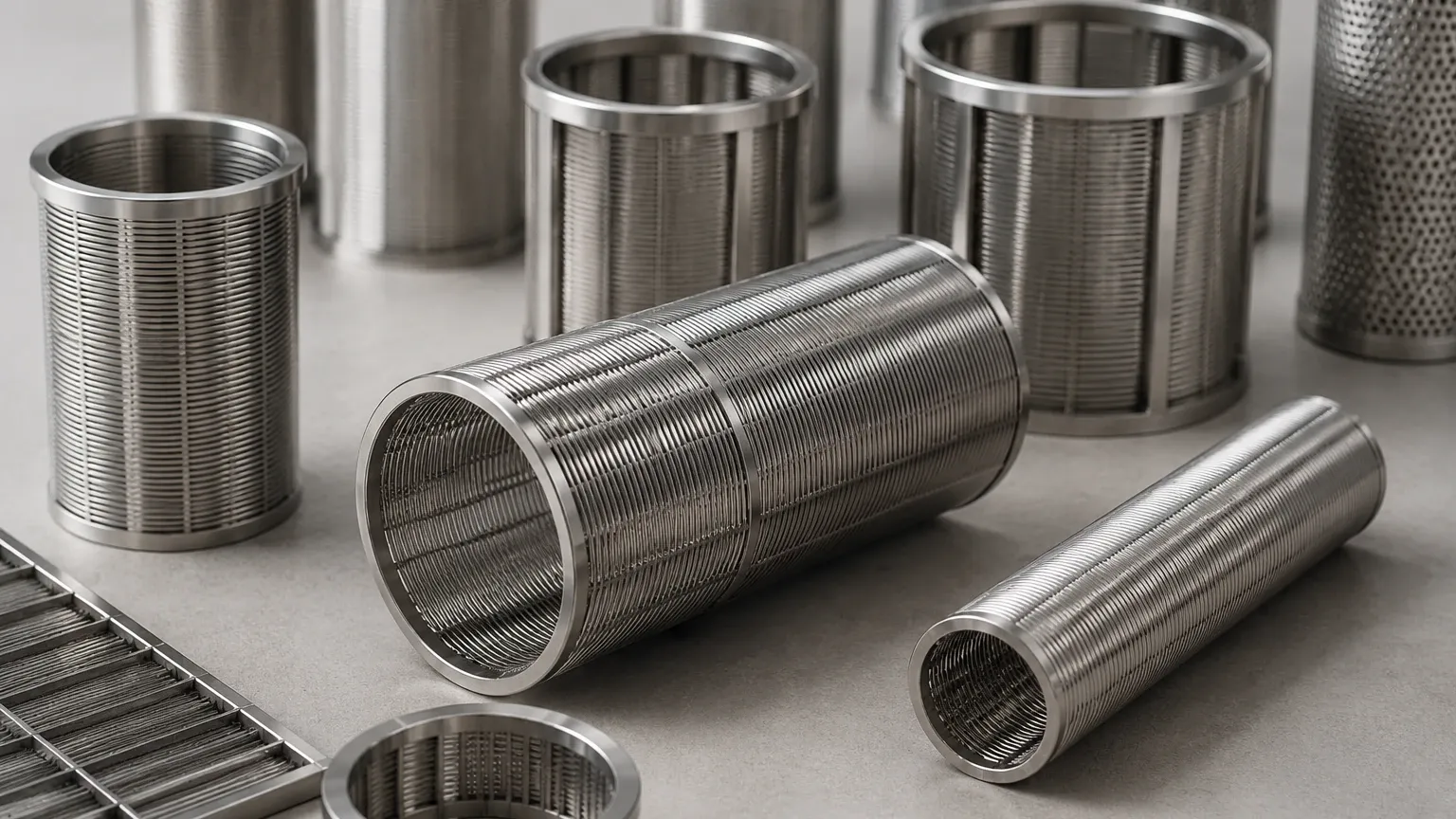
Wedge wire can be fabricated into various shapes including:
* Cylindrical Filter Cartridges: Used in pressurized housing for fine filtration.
* Flat Panels: Ideal for vibrating screens or drainage floors.
* Sieve Bends: Curved screens used in mineral processing and wastewater for gravity-fed dewatering.
* Conical Baskets: Frequently used in centrifuges.
Quality Control and Performance Testing Standards
Quality assurance in the production of wedge wire screens should not be limited to a final visual inspection. A robust quality control (QC) program at a Chinese manufacturing facility should include several stages of verification.
1. Slot Width Verification: Using digital calipers or optical comparators to measure the slot gap at multiple points across the screen. For critical applications, 100% inspection of slots may be required.
2. Verticality and Roundness: For cylindrical screens, ensuring the tube is perfectly round and the support rods are perfectly vertical is essential for proper fitment into housings and for the operation of internal scrapers or backwash arms.
3. Pressure and Load Testing: In applications where the screen acts as a structural element (such as resin traps or hub and lateral systems), the manufacturer should be able to provide collapse strength calculations or physical pressure test results.
4. Surface Finish: Depending on the industry, screens may require electropolishing, pickling, or passivating to enhance corrosion resistance and reduce bacterial adhesion in food-grade applications.
Navigating the Supply Chain: Risks and Best Practices
While sourcing from wedge wire screen manufacturers in China offers significant advantages in terms of production scale and cost, it also introduces supply chain variables that must be managed.
Communication and Technical Documentation
The most common cause of procurement failure is a lack of detailed technical communication. When requesting a quote, provide detailed CAD drawings that specify tolerances, weld requirements, and material grades. A professional manufacturer will review these drawings and may suggest modifications to improve manufacturability or performance. If a manufacturer accepts a complex drawing without asking clarifying questions, it may be a sign of inadequate technical review.
Lead Times and Logistics
Wedge wire production is often a multi-stage process involving wire drawing, winding, welding, and finishing. It is important to confirm lead times and account for international shipping schedules. Many manufacturers in China are located near major port cities like Ningbo or Shanghai, which facilitates efficient sea freight, but air freight may be necessary for urgent replacement parts.
Total Cost of Ownership in Filtration Procurement
When evaluating wedge wire screen manufacturers in China, the lowest unit price does not always result in the lowest total cost of ownership (TCO). A poorly manufactured screen that fails prematurely or clogs frequently will lead to expensive downtime and increased maintenance costs.
Factors that contribute to a lower TCO include:
* Durability: High-quality welds and correct material selection extend the service life of the screen.
* Efficiency: Precise slot widths ensure that the filtration process meets the required purity standards, reducing the need for downstream processing.
* Cleanability: A well-finished V-wire surface is easier to clean, reducing the volume of backwash fluid required and shortening cleaning cycles.
By focusing on technical competence and manufacturing transparency, engineers can identify partners who provide high-performance filtration solutions that stand up to the rigors of industrial use. Whether you are designing a new water treatment system or replacing components in a chemical reactor, the choice of manufacturer is the most critical variable in the success of your filtration strategy.
