


Gujarat Wedge Wire Screens Ltd Halol
In the landscape of industrial filtration, the precision and durability of separation components are paramount. Among the various technologies available, wedge wire screens stand out for their mechanical strength and non-clogging characteristics. Regional manufacturing hubs, such as the Halol industrial area in Gujarat, India, have become significant centers for the production of these components. For global procurement teams and engineers, understanding the capabilities of regional players like Gujarat Wedge Wire Screens Ltd Halol, while comparing them against international engineering standards, is essential for optimizing process efficiency.
Industrial filtration requirements in sectors such as mining, food and beverage processing, and chemical manufacturing demand high-performance solutions. The selection of Wedge Wire Screens involves a deep dive into material science, slot geometry, and structural integrity to ensure long-term operational stability.
Technical Fundamentals of Wedge Wire Screen Technology
Wedge wire, often referred to as profile wire, is characterized by its V-shaped cross-section. This design is not merely aesthetic; it serves a critical functional purpose. The V-shape creates a continuous slot that widens inwardly, ensuring that particles only make contact at two points on the leading edges of the wire. This geometry significantly reduces the risk of blinding or clogging, as any particle that passes through the initial opening will easily clear the widening gap.
From an engineering perspective, the construction of these screens involves the resistance welding of the profile wire onto support rods at every intersection. This creates a robust, three-dimensional structure that can withstand significant hydrostatic pressure and mechanical loads. Unlike woven wire mesh, which may shift under pressure, wedge wire maintains a fixed slot opening, ensuring consistent filtration accuracy throughout the service life of the component.
Key technical specifications to consider include:
- Slot Opening: Ranging from as small as 20 microns to several millimeters, depending on the application.
- Profile Wire Dimensions: The width and height of the V-wire dictate the open area and the mechanical strength.
- Support Rod Configuration: The spacing and shape of support rods (round, rectangular, or teardrop) influence the overall rigidity of the screen.
Engineering Specifications and Material Selection
Material selection is perhaps the most critical factor in determining the lifespan of a filtration component. In the context of manufacturers in industrial zones like Halol, the availability of high-grade alloys is a primary consideration for engineers. Stainless steel remains the industry standard due to its corrosion resistance and thermal stability.
1. AISI 304/304L: Suitable for general-purpose applications where moderate corrosion resistance is required, such as in water treatment or architectural installations.
2. AISI 316/316L: The preferred choice for chemical processing and marine environments. The addition of molybdenum provides superior resistance to pitting and crevice corrosion in chloride-rich environments.
3. Duplex and Super Duplex Steels: For highly aggressive environments or high-pressure applications, these alloys offer nearly double the yield strength of standard austenitic stainless steels and exceptional resistance to stress corrosion cracking.
When evaluating Wedge Wire Screens, engineers must also account for the surface finish. Electropolishing or passivating the stainless steel can further enhance corrosion resistance by removing surface impurities and strengthening the protective chromium oxide layer. This is particularly vital in the pharmaceutical and food industries, where hygiene and cleanability are non-negotiable.
Evaluating Manufacturers in Regional Hubs like Halol
Gujarat has established itself as a cornerstone of India’s manufacturing sector, with Halol serving as a strategic industrial base. When researching entities like Gujarat Wedge Wire Screens Ltd Halol, procurement professionals often look for a combination of local manufacturing advantages and global quality compliance.
The concentration of engineering expertise in this region allows for a competitive manufacturing environment. However, for international buyers, the evaluation must go beyond geographical proximity. It is necessary to confirm that the manufacturer adheres to international standards such as ISO 9001 for quality management and relevant ASTM or DIN standards for material and welding specifications.
A critical aspect of evaluating a regional supplier is their ability to provide comprehensive documentation. This includes Material Test Reports (MTRs), pressure test certifications, and dimensional inspection reports. In high-stakes industrial environments, the traceability of the raw material is as important as the final product's performance.
Critical Quality Control Parameters for Industrial Filtration
Quality control in wedge wire production is centered on the precision of the slot opening. Even minor deviations in slot width can lead to bypass—where oversized particles pass through the filter—or excessive pressure drop if the slots are too narrow.
Advanced manufacturing facilities utilize automated welding systems that monitor the pitch and tension of the wire in real-time. Post-production, several inspection methods are employed:
- Optical Measurement: High-resolution cameras and software are used to verify slot uniformity across the entire surface of the screen.
- Hydrostatic Testing: Ensuring the structural integrity of the screen under simulated operating pressures.
- Load Testing: Particularly important for screens used in heavy-duty applications like vibrating sifters or centrifuge baskets, where the material must withstand constant cyclical loading.
For engineers, the "open area" calculation is a vital metric. It represents the ratio of the total slot area to the total screen surface. A higher open area allows for higher flow rates and lower pressure drops, but it must be balanced against the mechanical strength required to support the filter medium and the processed material.
Customization and OEM Capabilities in Wedge Wire Production
Standardized filtration components rarely meet the specific needs of complex industrial systems. This is where the capability for customization becomes a deciding factor in supplier selection. Manufacturers like Kaifil emphasize the importance of tailor-made solutions that integrate seamlessly into existing infrastructure.
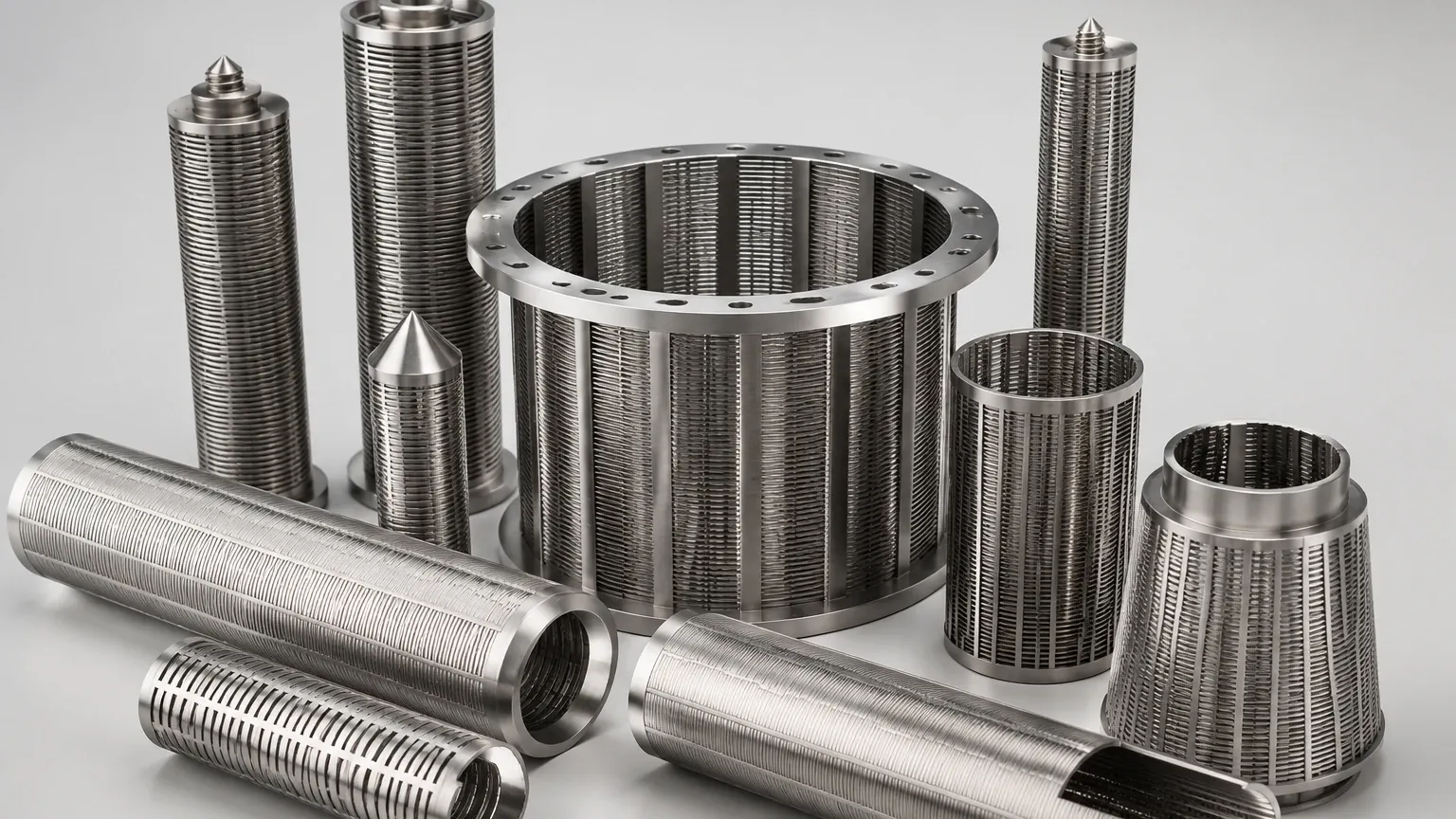
Customization options for Wedge Wire Screens include:
- Cylindrical Screens: Used in internal-fed or external-fed rotary screens, often requiring precise tolerances for fitment into housings.
- Flat Panels: Utilized in static sieves, vibrating screens, and architectural grilles.
- Conical and Sieve Bend Shapes: Designed for specific flow dynamics to optimize solid-liquid separation in gravity-fed systems.
- End Fittings: Custom flanges, reinforcement rings, and handles can be welded to the screen to facilitate easy installation and removal during maintenance cycles.
When working with an OEM partner, providing detailed application data—including flow rate, fluid viscosity, particle size distribution, and operating temperature—is essential. This allows the engineering team to recommend the optimal wire profile and support structure to maximize the filter's service life.
Maintenance, Longevity, and Total Cost of Ownership
While the initial purchase price is a significant factor in procurement, the total cost of ownership (TCO) is a more accurate measure of value. Wedge wire screens are often preferred over disposable filters because they are cleanable and reusable.
Maintenance strategies for wedge wire include:
- Backwashing: Utilizing a reverse flow of fluid to dislodge particles from the screen surface. The V-wire profile makes this process highly efficient.
- Ultrasonic Cleaning: For screens used in fine filtration, ultrasonic baths can remove microscopic particles trapped in the slots without damaging the metal structure.
- Mechanical Scraping: In some applications, a scraper blade moves across the surface of the screen to continuously remove solids.
Because stainless steel wedge wire is highly durable, it can often remain in service for years, provided it is correctly specified for the chemical and mechanical environment. This longevity reduces the frequency of replacement, lowers waste, and minimizes downtime, which are critical considerations for high-volume production facilities.
Conclusion: Selecting the Right Filtration Partner
Whether sourcing from established hubs like Halol or looking for specialized global manufacturers, the focus must remain on technical excellence and application-specific design. The role of Wedge Wire Screens in modern industry is to provide a reliable, efficient, and durable barrier that ensures product purity and protects downstream equipment.
For engineers and purchasing teams, the journey from identifying a need to implementing a solution requires a partner who understands the nuances of filtration physics and metallurgical integrity. By prioritizing quality control, material verification, and customized engineering, companies can achieve optimized filtration performance that supports their broader operational goals. Evaluating the regional expertise of manufacturers like those found in Gujarat, while maintaining a global standard for precision, ensures that the chosen filtration solution will meet the demanding rigors of the industrial environment.
