


What Is a Screen Wire
In the context of industrial filtration and mechanical separation, the term "screen wire" refers to a specialized engineered component designed to allow the passage of fluids or gases while retaining solid particles. While a layperson might associate the term with simple household window screens, for engineers and procurement professionals in the chemical, pharmaceutical, and water treatment sectors, a screen wire represents a critical piece of infrastructure that dictates the efficiency, safety, and longevity of a production line.
Understanding what is a screen wire requires a deep dive into material science, mechanical design, and fluid dynamics. In high-demand industrial environments, these components are rarely off-the-shelf commodities. Instead, they are precision-manufactured tools—often taking the form of Wedge Wire Screens—that must withstand extreme pressures, corrosive chemicals, and continuous mechanical stress.
Defining Screen Wire in Industrial Applications
At its core, industrial screen wire is a surface filtration medium. Unlike depth filters, which trap particles within a thick matrix of fibers, screen wire functions by providing a precise physical barrier. The geometry of the wire and the spacing between individual strands determine the "cut point" or the minimum particle size that will be retained.
In B2B manufacturing, screen wire is categorized by its construction method. The two most prevalent types are woven wire mesh and welded wedge wire. While woven mesh is suitable for lighter duties or very fine filtration, heavy-duty industrial processes typically rely on welded structures. These structures utilize longitudinal support rods and transverse surface wires to create a rigid, non-deforming filter surface. This rigidity is essential in applications like vibrating screens, intake filters, and catalyst bed supports where the material must maintain its structural integrity under high flow rates.
Material Science: Why Stainless Steel Dominates
The performance of a screen wire is fundamentally limited by its material composition. In the industrial sector, stainless steel is the gold standard due to its unique combination of mechanical strength and chemical resistance.
Grade 304 vs. Grade 316
Most industrial screen wires are fabricated from austenitic stainless steels. Grade 304 offers excellent strength and basic corrosion resistance, making it suitable for food and beverage applications or general water filtration. However, for environments involving chlorides, acids, or high-salinity water, Grade 316 (or 316L for welding stability) is preferred. The addition of molybdenum in Grade 316 significantly enhances resistance to pitting and crevice corrosion, which is vital for the longevity of the screen in chemical processing plants.
Specialized Alloys
In extreme cases, such as high-temperature petrochemical refining or highly aggressive chemical synthesis, engineers may specify exotic alloys like Duplex stainless steel, Monel, or Hastelloy. These materials ensure that the screen wire does not suffer from stress corrosion cracking or rapid oxidation, which could lead to catastrophic failure and downstream contamination.
Comparing Woven Mesh and Wedge Wire Screens
When evaluating what is a screen wire for a specific project, engineers must choose between different structural configurations. The choice significantly impacts the total cost of ownership and the frequency of maintenance.
Woven Wire Mesh
Woven wire is created by weaving individual wires over and under each other. It is excellent for achieving very fine filtration (down to several microns). However, woven mesh is susceptible to "blinding" or clogging because particles can become wedged within the overlapping wire junctions. Furthermore, under high pressure, the wires can shift, altering the filtration accuracy.
Wedge Wire Screens
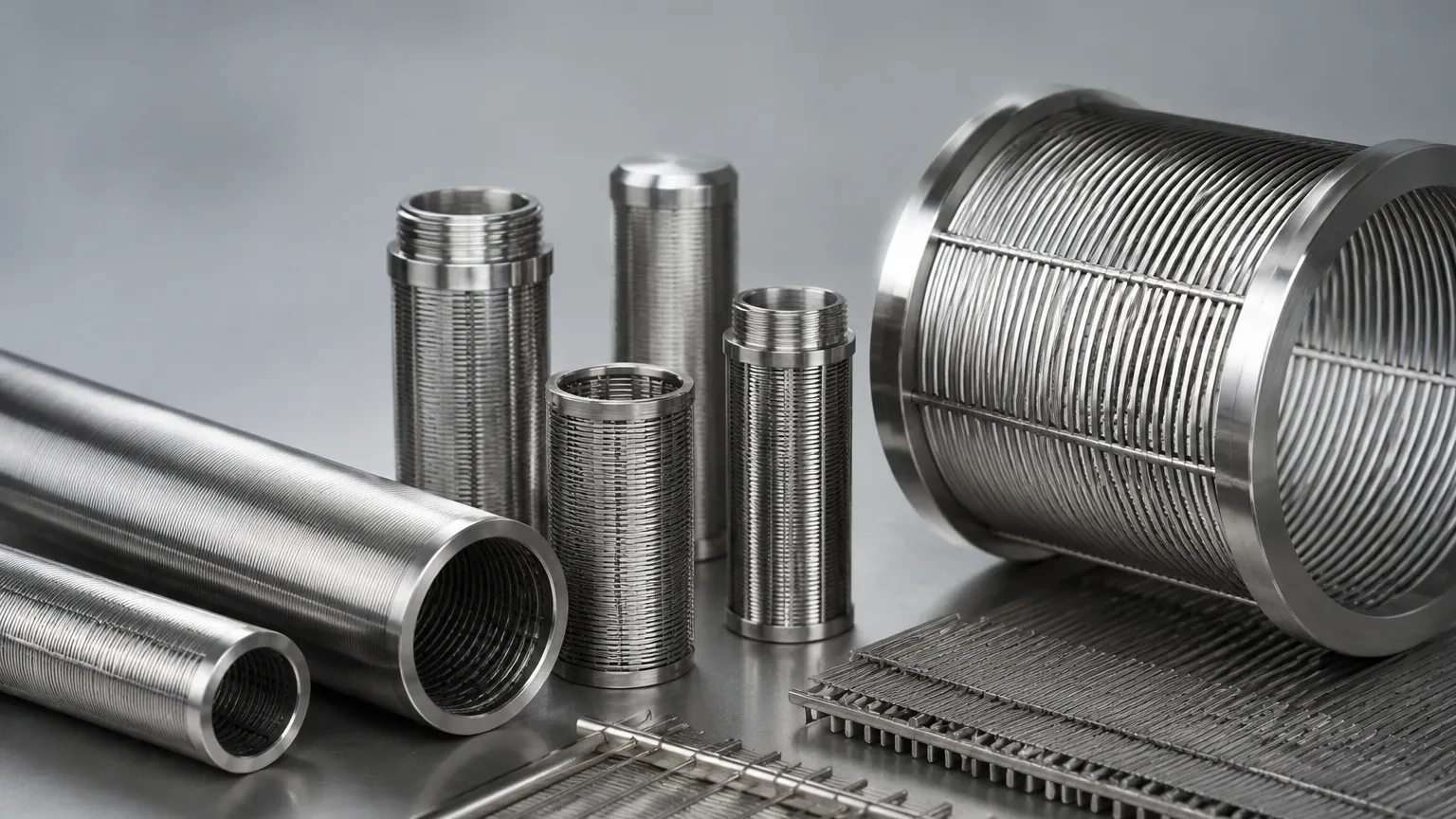
Wedge Wire Screens represent the pinnacle of industrial screen wire technology. These are constructed using V-shaped wires that are resistance-welded onto support rods at each contact point. This design offers several engineering advantages:
1. Non-Clogging Surface: The V-shaped profile creates a slot that widens inwardly. If a particle passes the initial surface edge, it will easily pass through the rest of the screen without getting stuck.
2. Structural Rigidity: Because every intersection is welded, the screen can handle massive pressure differentials without deforming.
3. High Open Area: The precision of the welding allows for a high ratio of slot opening to wire surface, maximizing flow rates and minimizing energy consumption in pumping systems.
Key Performance Metrics: Flow Rate and Filtration Precision
When an engineer asks "what is a screen wire" in the context of a new system design, they are really asking about performance parameters. A screen is not just a barrier; it is a flow-control device.
Slot Opening and Micron Rating
The slot opening is the distance between two adjacent wires. In wedge wire designs, this is controlled with extreme precision, often down to 20 microns. The accuracy of this gap determines the reliability of the separation process. In pharmaceutical manufacturing, for instance, a variance of even a few microns can result in a batch failing quality control.
Open Area Calculations
The percentage of open area is a critical metric for calculating pressure drop (delta P). A higher open area allows for higher flow rates and lower energy costs but may compromise the mechanical strength of the screen if the wires are too thin. Professional manufacturers like Kaifil work with engineers to balance the wire profile size against the slot width to optimize both throughput and durability.
Engineering Customization: Meeting Specific Industrial Needs
One of the most important aspects of industrial screen wire is its ability to be customized into various geometries. The application dictates the form factor:
* Cylindrical Filter Cartridges: Used in pressurized pipe systems for liquid filtration. These can be designed for outside-in or inside-out flow.
* Flat Panels: Commonly used in mining and aggregate industries for dewatering or sizing materials on vibrating decks.
* Sieve Bends: Curved screens that use centrifugal force to enhance separation, frequently seen in corn wet milling and waste management.
* Conical and Basket Filters: Specialized shapes used in strainers to protect pumps and valves from large debris.
Customization also extends to the "surface treatment." Depending on the application, screen wires can be passivated to enhance corrosion resistance, electropolished to create a mirror-smooth surface that resists bacterial growth (critical for food and pharma), or hardened to resist abrasion from sand or minerals.
Total Cost of Ownership and Maintenance
From a B2B procurement perspective, the initial purchase price of a screen wire is only one part of the equation. The "total cost of ownership" includes the costs of downtime, replacement frequency, and cleaning labor.
Cleaning and Backwashing
One of the primary benefits of high-quality Wedge Wire Screens is their compatibility with automated cleaning systems. Because the surface is smooth and the slots are non-clogging, these screens can be cleaned in-situ using backpulsing (reversing the flow) or mechanical scrapers. This reduces the need for manual intervention and keeps the production line running longer.
Durability and Replacement Cycles
A cheap, poorly manufactured screen wire may suffer from weld failure or wire breakage within months. In contrast, a precision-welded stainless steel screen can last for years, even in abrasive environments. Engineers must confirm the weld integrity and material certifications before purchasing to ensure that the component will meet the expected service life of the equipment.
Common Risks and Evaluation Criteria
When sourcing screen wire, technical professionals should be aware of several risks that can compromise system performance:
1. Inconsistent Slot Widths: If the manufacturing process is not tightly controlled, variations in the gap between wires will lead to "bypass," where oversized particles pass through the wider sections of the screen.
2. Poor Weld Penetration: In wedge wire construction, the strength of the bond between the V-wire and the support rod is paramount. Weak welds can lead to "unzipping" of the screen under hydraulic shock.
3. Material Substitution: Lower-grade alloys being passed off as high-grade stainless steel can lead to rapid corrosion and product contamination.
To mitigate these risks, it is essential to partner with a manufacturer that provides full material traceability and utilizes advanced CNC welding technology. Verification of the slot opening through optical measurement and pressure testing are standard procedures for high-performance industrial filters.
Conclusion: Selecting the Right Solution
So, what is a screen wire? It is the frontline of defense in industrial processing. Whether it is protecting a high-pressure hydraulic pump, ensuring the purity of a life-saving drug, or reclaiming water in a municipal treatment plant, the screen wire is a silent but vital component.
For engineers and purchasing teams, the focus should always be on the specific requirements of the application: the chemical environment, the required micron rating, the mechanical load, and the desired maintenance interval. By choosing high-quality, customized Wedge Wire Screens, industries can achieve a level of filtration precision and structural reliability that simple woven materials cannot match. Investing in the right screen wire technology today prevents the costly failures and inefficiencies of tomorrow.
