


Gujarat Wedge Wire Screens Ltd
In the landscape of industrial filtration, the selection of high-precision components is a critical decision for engineers and procurement professionals. Among the various technologies available, wedge wire screens stand out for their mechanical strength, durability, and non-clogging characteristics. Companies such as Gujarat Wedge Wire Screens Ltd have long been recognized in the global market for providing these specialized components. Understanding the technical nuances of these products, from material selection to slot precision, is essential for optimizing industrial processes across the chemical, water treatment, and food processing sectors.
As a professional manufacturer of custom stainless steel filtration solutions, Kaifil recognizes the importance of evaluating technical specifications when sourcing Wedge Wire Screens. This guide examines the engineering principles, application requirements, and supplier evaluation criteria that technical teams must consider when integrating these components into their systems.
Technical Principles of Wedge Wire Screens
Wedge wire, also known as profile wire or V-wire, is a specialized metallic filter medium characterized by its unique triangular cross-section. Unlike traditional woven wire mesh, wedge wire is constructed by resistance-welding V-shaped stainless steel wires onto support rods at every intersection.
The V-Wire Advantage
The primary engineering advantage of this design is the creation of a continuous slot that widens inwardly. This geometry ensures that particles only make contact at two points on the leading edges of the wire. If a particle passes through the surface opening, it will easily clear the widening gap below, significantly reducing the risk of blinding or clogging. This makes wedge wire an ideal choice for high-viscosity fluids or applications with high solid concentrations.
Structural Integrity and Support Rods
The structural performance of the screen is determined by the relationship between the surface profile wire and the underlying support rods. In heavy-duty industrial applications, such as those served by Gujarat Wedge Wire Screens Ltd and other precision manufacturers, the spacing and diameter of support rods are calculated to withstand specific differential pressures and mechanical loads. For rotating screens or vibratory equipment, the weld integrity at each intersection is paramount to prevent fatigue failure.
Material Selection and Corrosion Resistance
Material science plays a pivotal role in the longevity of filtration components. Most industrial wedge wire screens are fabricated from austenitic stainless steels, though specialty alloys are utilized for extreme environments.
1. AISI 304/304L: The standard choice for general industrial use, offering good corrosion resistance and excellent welding properties. It is commonly used in water treatment and general food processing.
2. AISI 316/316L: Contains molybdenum, which provides enhanced resistance to pitting and crevice corrosion in chloride-rich environments. This is the preferred material for chemical processing and marine applications.
3. Duplex Stainless Steels: For applications involving high stress and highly corrosive media (such as phosphoric acid production), duplex alloys provide superior mechanical strength and resistance to stress corrosion cracking.
4. Specialty Alloys: In high-temperature or highly acidic environments, materials like Monel, Hastelloy, or Inconel may be required to ensure the structural stability of the screen over its service life.
Key Evaluation Criteria for Industrial Suppliers
When evaluating a supplier like Gujarat Wedge Wire Screens Ltd or looking for OEM alternatives, engineering teams should focus on several critical performance indicators. High-performance filtration is not merely about the material; it is about the precision of the manufacturing process.
Slot Width Precision
The most critical specification of a wedge wire screen is the slot width, which determines the filtration rating. Precision manufacturers can achieve slot tolerances as tight as +/- 0.05mm. For applications requiring fine particle separation, such as catalyst recovery or fine sand control, consistent slot uniformity across the entire surface of the screen is non-negotiable. Variations in slot width can lead to "bypass," where oversized particles pass through the filter, potentially damaging downstream equipment.
Surface Smoothness and Finish
In the food and beverage and pharmaceutical industries, the surface finish of the wedge wire is a hygiene requirement. Electropolishing is often employed to remove surface impurities and create a mirror-like finish that prevents bacterial growth and facilitates Clean-in-Place (CIP) procedures. Suppliers must be able to provide documented surface roughness (Ra) values to meet regulatory standards.
Welding Technology
The transition from manual to automated resistance welding has greatly improved the consistency of wedge wire products. High-frequency welding ensures a deep, uniform fusion between the profile wire and the support rod without compromising the metallurgical properties of the stainless steel. This is particularly important for screens used in high-vibration environments, such as centrifugal separators or vibratory sieves.
Industrial Applications and Engineering Considerations
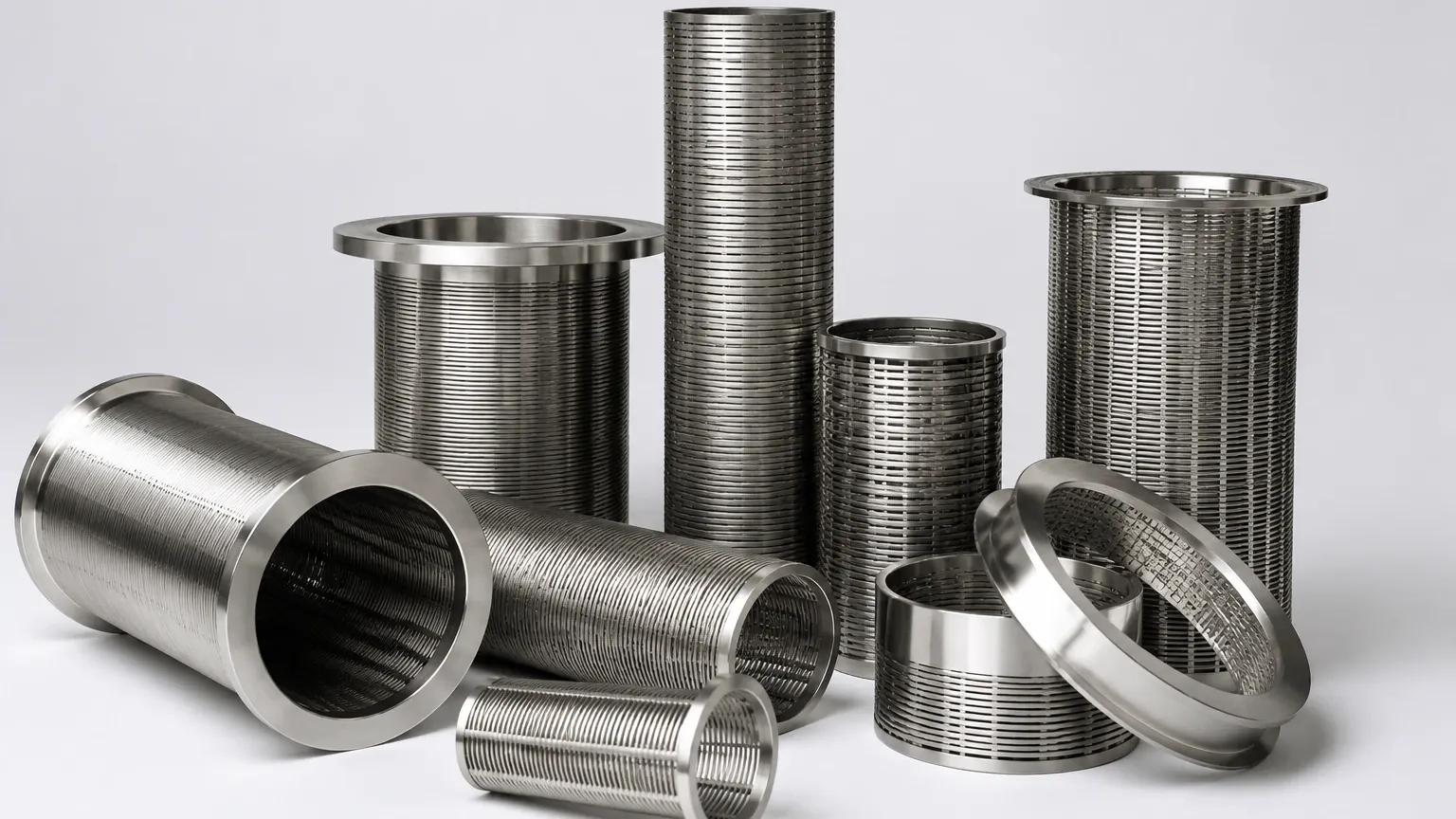
Wedge wire screens are versatile components used in diverse configurations, including flat panels, cylindrical cartridges, and curved sieve bends.
Water and Wastewater Treatment
In municipal and industrial water treatment, wedge wire is used in intake screens, resin traps, and underdrain systems. The high open area of the Wedge Wire Screens allows for high flow rates with minimal pressure drop. For ion exchange processes, the precision slots prevent the loss of expensive resins while maintaining efficient flow distribution.
Food and Beverage Processing
From malting floors in breweries to starch extraction in corn processing, wedge wire provides a robust surface that can withstand mechanical scraping and high-pressure washing. In the sugar industry, centrifugal baskets made of wedge wire are essential for separating sugar crystals from molasses, requiring high rotational strength and abrasion resistance.
Mining and Mineral Processing
The abrasive nature of mining requires screens with high hardness and impact resistance. Heavy-duty wedge wire panels are used for dewatering, media recovery, and sizing. In these environments, the "total cost of ownership" is heavily influenced by the wear life of the screen, making the choice of profile wire shape and material hardness critical.
Customization and OEM Capabilities
Standardized off-the-shelf solutions rarely meet the specific needs of complex industrial systems. This is where the capabilities of a manufacturer like Kaifil or Gujarat Wedge Wire Screens Ltd become vital. Customization options typically include:
* Variable Slot Sizes: Designing screens with different slot widths in different sections to optimize flow and separation.
* Custom Framing and Reinforcement: Integrating the screen into existing housings with specialized flanges, bolt holes, or reinforcement bars.
* Geometric Variations: Producing conical, semi-cylindrical, or complex curved shapes to fit proprietary machinery.
* Flow Direction: Designing for "outside-in" or "inside-out" flow, which dictates whether the profile wire or the support rod is on the exterior surface.
Addressing Common Engineering Questions
Before finalizing a purchase order for wedge wire components, technical professionals should confirm the following details with their supplier:
What is the calculated Open Area?
The open area percentage is a function of the slot width and the wire width. A higher open area reduces pressure drop but may decrease the mechanical strength of the screen. Engineers must find the optimal balance for their specific flow requirements.
How is the screen cleaned?
Wedge wire is inherently easier to clean than woven mesh. However, for sticky or fibrous materials, backwashing or mechanical scraping may be necessary. The supplier should provide guidance on the maximum allowable backwash pressure to avoid deforming the wires.
What is the expected replacement cycle?
While wedge wire is durable, it is not permanent. In abrasive or corrosive applications, the slot widths will eventually widen due to wear. Establishing a monitoring protocol for slot integrity is essential for maintaining filtration performance. Suppliers can often provide wear-resistant coatings or thicker profile wires to extend the service life in demanding environments.
Total Cost Considerations
While the initial capital expenditure for wedge wire screens may be higher than for disposable cartridges or woven mesh, the long-term value is found in reduced downtime and lower maintenance costs. Because wedge wire can be cleaned and reused multiple times, the "per-gallon" filtration cost is often significantly lower over the life of the equipment. Furthermore, the high structural integrity reduces the risk of catastrophic filter failure, which can lead to expensive production halts and downstream contamination.
Conclusion
Selecting the right wedge wire solution requires a deep understanding of both the process requirements and the manufacturing capabilities of the supplier. Whether considering established players like Gujarat Wedge Wire Screens Ltd or seeking customized, high-precision manufacturing from Kaifil, the focus must remain on technical excellence. By prioritizing slot precision, material integrity, and application-specific design, engineers can ensure efficient and reliable filtration performance in even the most demanding industrial environments.
For those seeking to optimize their filtration systems, reviewing detailed product options and engineering support is the first step toward achieving superior process results. Exploring the range of Wedge Wire Screens available today allows technical teams to leverage advanced manufacturing techniques for their specific industrial challenges.
