


Wedge Wire Screen Machine
In the landscape of industrial filtration and separation, the precision of the manufacturing equipment directly dictates the performance of the final product. The wedge wire screen machine is the specialized piece of industrial equipment responsible for producing high-performance wedge wire screens, which are utilized across diverse sectors including water treatment, mining, food and beverage, and petrochemical processing. For engineers and procurement professionals, understanding the mechanics, capabilities, and limitations of the wedge wire screen machine is essential for evaluating the quality and reliability of the filtration components they source.
Unlike traditional woven wire mesh, wedge wire is a welded structure. The manufacturing process involves a sophisticated interplay of mechanical tension, electrical resistance welding, and precise CNC (Computer Numerical Control) movement. This article explores the technical nuances of the wedge wire screen machine and how its operational parameters influence the durability and efficiency of industrial filtration solutions.
The Engineering Principles of Wedge Wire Production
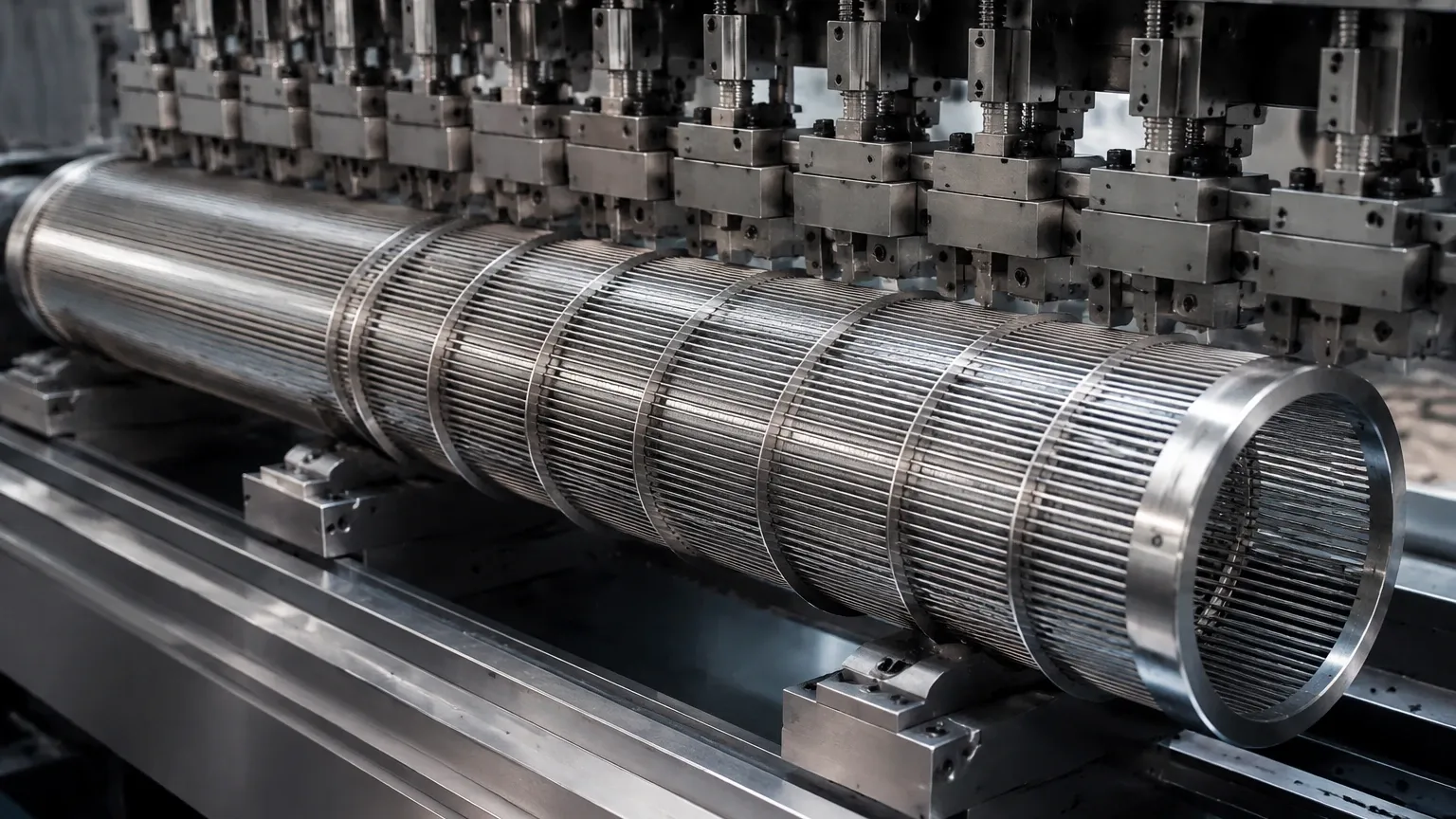
A wedge wire screen machine operates on the principle of continuous resistance welding. The machine is designed to wrap a profile wire (the "V-shaped" or wedge-shaped wire) around a series of longitudinal support rods. At every point where the profile wire intersects a support rod, a high-strength weld is formed.
The Resistance Welding Process
In a professional-grade wedge wire screen machine, the welding process is critical. The machine applies a specific amount of electrical current and forging pressure at the intersection of the wires. Because the contact point is small, the electrical resistance generates localized heat, melting the metal just enough to fuse the profile wire to the support rod without compromising the structural integrity of either component. This results in a rigid, one-piece construction that can withstand high pressure and mechanical stress, far exceeding the capabilities of standard mesh screens.
CNC Control and Slot Precision
The defining characteristic of a high-quality wedge wire screen is its slot opening—the gap between the profile wires. The wedge wire screen machine uses CNC technology to control the pitch of the profile wire as it is wrapped around the rods. By precisely managing the rotation speed of the drum and the lateral movement of the wire guide, the machine can create slot openings as small as 20 microns with extremely tight tolerances. For engineers, this precision is vital because inconsistent slot widths lead to bypass or premature clogging in critical filtration systems.
Key Components of a Wedge Wire Screen Machine
To achieve the required filtration accuracy, several sub-systems within the machine must work in perfect synchronization. Understanding these components helps technical professionals assess whether a manufacturer can meet their specific project requirements.
1. The Mandrel/Drum Assembly: This is the core of the machine where the support rods are positioned. The diameter of the mandrel determines the internal diameter (ID) of the resulting screen cylinder.
2. Wire Feed System: This system provides a constant, tension-controlled supply of the V-shaped profile wire. Proper tensioning is necessary to prevent the wire from twisting or deforming during the welding process.
3. Welding Transformer and Electrodes: These components deliver the precise electrical pulse needed for each weld. Modern machines use inverter-based power supplies to ensure weld consistency even at high production speeds.
4. Control Interface: Advanced machines feature PLC (Programmable Logic Controller) systems that allow operators to input parameters such as slot width, cylinder length, and weld frequency. This allows for rapid switching between different product specifications.
Material Compatibility and Engineering Considerations
The choice of material is a primary concern for industrial applications, particularly those involving corrosive fluids or high temperatures. A versatile wedge wire screen machine must be capable of working with various alloys without sacrificing weld quality.
* Stainless Steel (304, 316L, 321): These are the most common materials due to their corrosion resistance and mechanical strength. The machine must be calibrated for the specific thermal conductivity of these alloys to ensure clean, strong welds.
* Duplex and Super Duplex Steels: Often used in offshore and chemical processing, these materials require higher welding pressures and more precise heat control, which only high-end wedge wire screen machines can provide.
* Specialty Alloys (Monel, Hastelloy): For extreme environments, the machine’s ability to handle harder or more heat-resistant materials is a key differentiator for specialized manufacturers.
When sourcing Wedge Wire Screens, engineers should confirm that the manufacturer’s equipment is optimized for the specific alloy required by the application. Improper machine settings on high-alloy materials can lead to "cold welds," which may fail under the vibration or pressure cycles typical of industrial filtration.
Customization Capabilities in Wedge Wire Manufacturing
The flexibility of the wedge wire screen machine allows for a wide range of product configurations. Depending on the machine’s setup, manufacturers can produce different types of screens tailored to specific flow dynamics and mechanical requirements.
Radial vs. Axial Flow
The machine can be configured to produce screens where the support rods are on the inside (FOTI – Flow Out-To-In) or the outside (FITO – Flow In-To-Out). In FOTI configurations, the smooth flat surface of the V-wire faces inward, which is often preferred for internal rotary drum filters. Conversely, FITO configurations are standard for most well screens and intake filters where the filtration occurs on the exterior surface.
Flat Panels and Sieve Bends
While the machine naturally produces cylindrical shapes, these can be cut and flattened into panels or curved into sieve bends. The precision of the initial cylindrical weld is what ensures the slot openings remain uniform after the flattening or curving process. If the wedge wire screen machine produces inconsistent welds, the internal stresses during flattening can cause the slots to warp, leading to inaccurate filtration.
Evaluating Performance and Quality Control
For procurement teams, the quality of the wedge wire screen machine used by a supplier is a proxy for the quality of the final product. Several performance metrics should be evaluated before finalizing a purchase order:
* Slot Uniformity: A high-quality machine will produce slots with a variation of less than ±5% of the nominal slot width. This is verified using digital calipers or optical measurement systems.
* Weld Integrity: Destructive testing (such as pull tests) and non-destructive testing (such as ultrasonic or X-ray) can confirm that the machine is achieving full penetration welds. This is essential for screens used in high-pressure backwashing systems.
* Roundness and Straightness: For screens that must be integrated into tight-tolerance housings or rotating equipment, the machine’s ability to maintain a true cylindrical shape is critical. Deviations in roundness can lead to installation difficulties or mechanical interference.
Common Risks and Selection Advice
One of the primary risks in wedge wire procurement is the use of outdated or poorly maintained machinery. Older machines may lack the CNC precision required for fine slot openings, leading to "drifting" slot widths over the length of a long screen cylinder. Additionally, inconsistent welding can result in "wire popping," where individual profile wires detach from the support rods under thermal expansion or mechanical load.
To mitigate these risks, engineers should ask manufacturers the following questions:
1. What is the minimum and maximum slot width capability of your machines?
2. How is slot width monitored during the production run?
3. What are the maximum length and diameter constraints of your equipment?
4. Can the machine handle high-tensile alloys like Duplex stainless steel?
Total Cost of Ownership and Maintenance
While the initial cost of a wedge wire screen may be higher than that of a woven mesh or perforated plate, the total cost of ownership is often lower due to the durability of the welded structure. The precision provided by a modern wedge wire screen machine ensures that the screens are easy to clean (due to the V-shaped profile which minimizes contact points for particles) and have a long service life.
Properly manufactured screens require fewer replacement cycles, reducing downtime and maintenance labor. This efficiency is only possible when the manufacturing machine is capable of producing a perfectly consistent product that adheres to the engineering specifications of the application.
Conclusion
The wedge wire screen machine is the foundation of high-performance industrial filtration. By combining CNC precision with advanced resistance welding, these machines produce screens that offer superior strength, accuracy, and longevity. For engineers and technical buyers, understanding the capabilities of these machines is the first step in ensuring that the filtration components they select will perform reliably in demanding industrial environments. Whether the application involves chemical processing, water treatment, or food production, the quality of the weld and the accuracy of the slot—both products of the manufacturing machine—are the ultimate determinants of operational success.
