


Wedge Wire Screen Size
In industrial filtration and separation, the performance of a system often hinges on the precise specification of its components. Among the most versatile and durable options available to engineers are Wedge Wire Screens, which utilize a unique V-shaped wire profile to achieve high-efficiency filtration. However, selecting the correct wedge wire screen size is not a singular decision; it involves a complex interplay of slot openings, wire profiles, support rod dimensions, and overall structural geometry.
Understanding these variables is critical for technical professionals in the chemical, food and beverage, and water treatment sectors. A mismatch in sizing can lead to premature clogging, structural failure under pressure, or inadequate separation of solids. This guide examines the engineering considerations behind wedge wire screen size and how to optimize these specifications for demanding industrial environments.
Defining the Core Dimensions of Wedge Wire
When engineers discuss wedge wire screen size, they are typically referring to three distinct but related categories of measurement: the slot opening, the wire profile dimensions, and the overall physical dimensions of the screen unit (such as diameter or length).
The Slot Opening (Aperture)
The slot opening is the gap between two adjacent V-shaped wires. This is the primary factor determining the filtration accuracy or the "cut-off" point of the screen. In industrial applications, slot sizes can range from as small as 20 microns to several millimeters, depending on the particle size of the media being processed.
Consistency in the slot opening is a hallmark of high-quality manufacturing. Unlike woven wire mesh, which can shift under mechanical stress, the wires in a wedge wire screen are resistance-welded to support rods at every intersection. This ensures that the wedge wire screen size remains constant, providing predictable performance even under high pressure or heavy vibration.
Profile Wire and Support Rod Dimensions
The "wedge" in wedge wire refers to the triangular or trapezoidal cross-section of the surface wire. These profiles are categorized by their width and height. For example, a common profile might be 1.5mm wide and 2.5mm high. The choice of profile wire size directly affects the mechanical strength of the screen and its resistance to wear.
Similarly, the support rods—the structural members to which the surface wires are welded—come in various shapes (round, rectangular, or teardrop) and sizes. The spacing and size of these rods determine the collapse strength and the total load-bearing capacity of the screen.
The Impact of Size on Open Area and Flow Rates
One of the most critical calculations in filtration engineering is the percentage of "Open Area." This value dictates the flow capacity and the pressure drop across the screen. The wedge wire screen size, specifically the ratio between the slot width and the wire width, determines this percentage.
Calculating Open Area
The formula for calculating the open area of a wedge wire screen is:
Open Area (%) = [S / (S + W)] × 100
Where:
* S = Slot width (opening)
* W = Width of the surface profile wire
For instance, if a screen has a 0.5mm slot and uses a 1.5mm wide wire, the open area would be 25%. If the application requires a higher flow rate without increasing the overall footprint of the equipment, an engineer might specify a narrower profile wire to increase the open area. However, this must be balanced against the need for structural durability, as thinner wires may be more susceptible to abrasion or deformation.
Pressure Drop Considerations
A larger open area generally results in a lower initial pressure drop (Delta P). In hydraulic and chemical processing, maintaining a low pressure drop is essential for reducing energy consumption and preventing cavitation in pumps. By precisely tailoring the wedge wire screen size, manufacturers can optimize the balance between filtration efficiency and hydraulic performance.
Structural Geometry: Cylinders, Panels, and Tubes
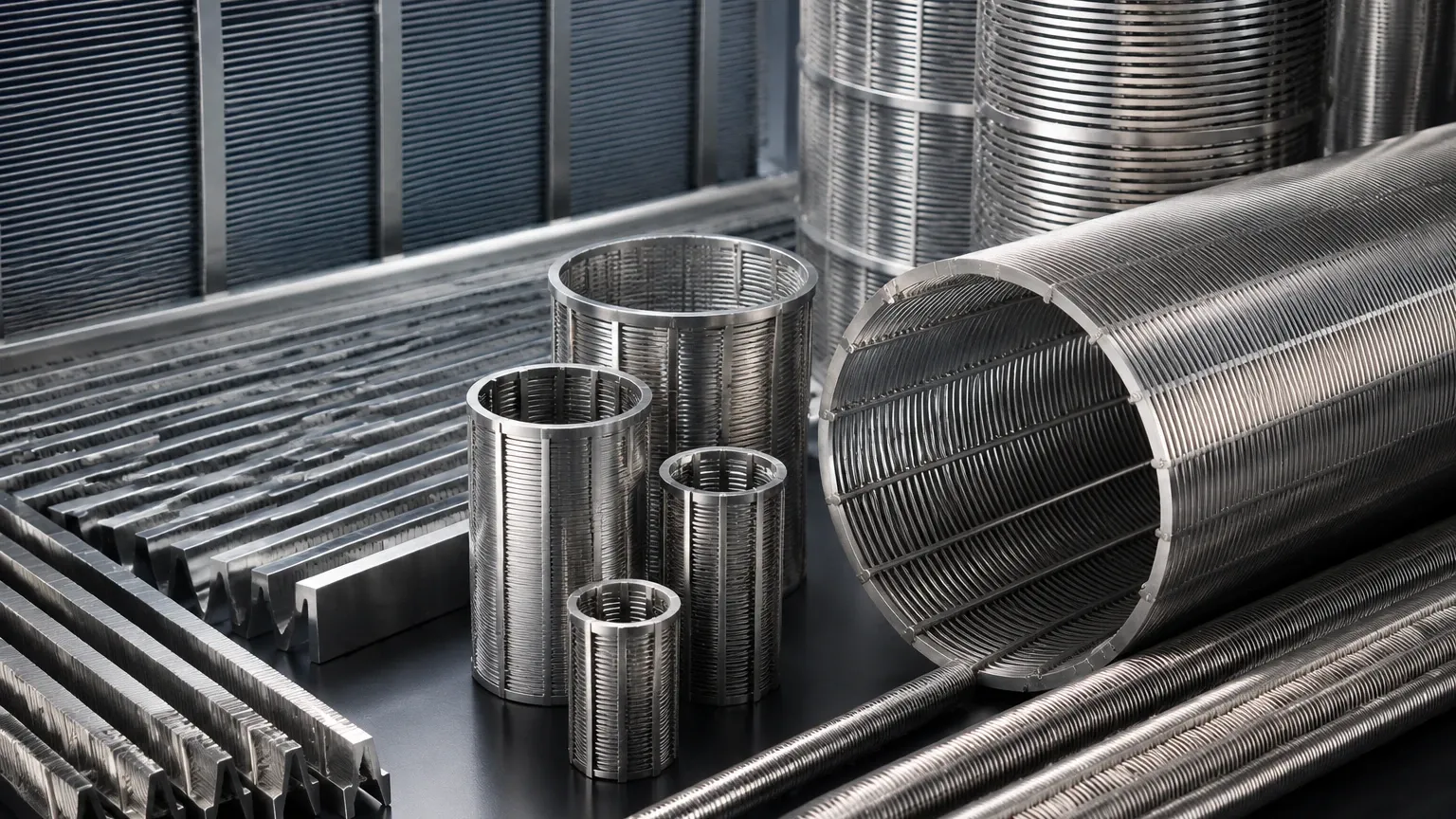
Beyond the microscopic dimensions of the slots and wires, the macroscopic wedge wire screen size—the physical shape and footprint—must be integrated into the existing machinery. Industrial wedge wire is typically fabricated into three primary forms:
1. Cylindrical Screens (Filter Cartridges)
Used extensively in pressurized housings and intake systems, cylindrical screens are defined by their outside diameter (OD), inside diameter (ID), and overall length. In these designs, the direction of flow is a vital specification:
* FOTI (Flow Out-To-In): The flat side of the wedge wire is on the outside, and the support rods are on the inside.
* FITO (Flow In-To-Out): The flat side is on the inside, often used in screw press separators or internal rotary filters.
2. Flat Panels and Sieve Bends
Flat panels are used in vibrating screens and drainage decks. The size is defined by width and length, but the orientation of the wires (parallel to the width or length) is equally important for the movement of material across the surface. Sieve bends add a curvature dimension (radius and arc length), which utilizes centrifugal force to enhance separation.
3. Custom OEM Components
Many industrial applications require bespoke geometries. This might include conical baskets for centrifuges or hub-and-lateral systems for water treatment resin traps. In these cases, the wedge wire screen size must adhere to strict tolerances to ensure a leak-proof fit within the assembly.
Material Selection and Environmental Factors
While dimensions define the physical boundaries, the material of construction determines the longevity of those dimensions. Most industrial wedge wire screens are manufactured from stainless steel (304, 316L, or Duplex) to resist corrosion and maintain slot integrity.
Thermal Expansion
In high-temperature chemical processing, engineers must account for thermal expansion. If the wedge wire screen size is calculated only for ambient temperatures, the expansion of the metal at 300°C could potentially alter the slot openings or cause the screen to buckle if it is constrained within a rigid housing. Specifying the correct alloy and allowing for thermal movement in the design is essential for high-temperature reliability.
Abrasion and Wear
In mining or pulp and paper applications, the abrasive nature of the slurry will gradually wear down the profile wires. As the top of the V-shape wears away, the slot opening may slightly widen over time. Selecting a deeper profile wire (greater height) can provide a larger "wear life" before the wedge wire screen size deviates beyond acceptable tolerances.
Engineering Checklist for Specifying Screen Size
Before finalizing a purchase or design, technical teams should confirm the following parameters to ensure the specified wedge wire screen size meets the application demands:
1. Target Particle Size: What is the smallest particle that must be retained? This determines the minimum slot size.
2. Flow Rate Requirements: What is the maximum volume of fluid per hour? This determines the required open area and overall surface area.
3. Operating Pressure and Differential Pressure: What is the maximum Delta P the screen will encounter before cleaning? This determines the support rod spacing and wire profile height.
4. Chemical Compatibility: Does the media require 316L, Duplex, or a specialty alloy like Hastelloy to prevent corrosive widening of the slots?
5. Cleaning Mechanism: Will the screen be cleaned via backpulsing, mechanical scraping, or ultrasonic baths? Mechanical cleaning requires more robust surface wires.
The Role of Precision Manufacturing
Achieving the perfect wedge wire screen size requires advanced manufacturing capabilities. At Kaifil, the focus is on providing customized filtration solutions that meet the exact engineering specifications of global industrial clients. Whether it is a high-precision Wedge Wire Screen for a pharmaceutical application or a heavy-duty cylindrical intake screen for water treatment, the accuracy of the weld and the consistency of the slot are paramount.
By working closely with an experienced manufacturer, engineers can move beyond standard off-the-shelf sizes and develop components optimized for their specific flow dynamics and structural requirements. This collaborative approach ensures that the resulting filtration system delivers the lowest total cost of ownership through extended service life and reduced maintenance downtime.
Conclusion
The specification of wedge wire screen size is a foundational element of industrial system design. By understanding the relationship between slot width, wire profile, and structural geometry, engineers can specify screens that offer the ideal balance of filtration precision and mechanical durability. In demanding environments where downtime is costly, the reliability of a precisely manufactured wedge wire component is an investment in process stability and efficiency.
