


Wedge Wire Screens South Africa
In the industrial landscape of South Africa, where mining, mineral processing, and large-scale water treatment form the backbone of the economy, the demand for high-precision separation technology is constant. Wedge wire screens have emerged as a critical component in these sectors due to their unique structural integrity and efficient filtration capabilities. For engineers and procurement specialists, understanding the technical nuances of Wedge Wire Screens is essential for optimizing process efficiency and reducing long-term operational costs.
As a specialized manufacturer, Kaifil provides custom stainless steel filtration solutions designed to meet the rigorous demands of industrial environments. This guide explores the engineering principles, material considerations, and application-specific requirements for wedge wire screens, particularly within the context of the South African market.
Understanding the Engineering of Wedge Wire Screens
Wedge wire, also known as profile wire, is a precision-engineered metallic screen characterized by its V-shaped profile. Unlike traditional woven wire mesh or perforated plates, wedge wire is manufactured through a specialized resistance welding process. Surface wires are welded onto support rods at each intersection, creating a robust, one-piece structure.
The V-Shaped Profile Advantage
The defining feature of wedge wire is the V-shaped profile of the surface wire. This geometry creates a slot that widens inwardly. In a filtration or separation process, particles that pass through the narrowest part of the slot (the aperture) continue freely through the widening gap without becoming trapped. This design significantly reduces the risk of "blinding" or clogging, which is a common failure point in conventional mesh filters.
Precision Slot Openings
The slot opening is the distance between two adjacent surface wires. In industrial applications, these slots can be engineered to tolerances as tight as 20 microns. For South African mining operations, where fine particle separation is critical for mineral recovery, the consistency of these slot openings determines the efficiency of the entire processing circuit. A uniform slot ensures that the cut point remains stable, preventing valuable material loss or downstream contamination.
Material Selection for Demanding Industrial Environments
South Africa’s industrial sectors often operate in harsh conditions, involving abrasive slurries, corrosive chemicals, and high-temperature processes. Selecting the correct material grade is the first step in ensuring the longevity of a wedge wire screen.
Stainless Steel Grades
* Grade 304/304L: The most common choice for general industrial applications. It offers excellent strength and basic corrosion resistance, suitable for many food and beverage and standard water treatment applications.
* Grade 316/316L: Contains molybdenum, which provides superior resistance to chlorides and pitting. This is the preferred grade for chemical processing and wastewater treatment plants where the environment is more aggressive.
* Duplex Stainless Steels: In highly corrosive or high-stress environments, such as deep-level mining or marine applications, Duplex steels offer nearly double the yield strength of austenitic grades and exceptional resistance to stress corrosion cracking.
Surface Treatments
To further enhance durability, wedge wire screens can undergo various surface treatments. Pickling and passivation are standard procedures to remove surface contaminants and restore the protective chromium oxide layer. For applications requiring extreme smoothness or enhanced hygiene, electropolishing is utilized to reduce surface roughness, making the screens even easier to clean.
Critical Applications in the South African Industrial Sector
The versatility of wedge wire allows it to be integrated into diverse machinery across South Africa. Each industry has specific requirements for flow rates, mechanical strength, and filtration accuracy.
Mining and Mineral Processing
South Africa is a global leader in the production of platinum, gold, and coal. In these mines, wedge wire screens are utilized in sieve bends, vibratory screens, and interstage screens. They are essential for dewatering, media recovery, and sizing. The high mechanical strength of the resistance-welded structure allows these screens to withstand the heavy loads and abrasive nature of mineral slurries.
Water and Wastewater Treatment
With water scarcity being a significant concern in many regions, efficient water management is vital. Wedge wire is used in intake screens for river and sea water, preventing debris and aquatic life from entering pump systems. In municipal wastewater plants, wedge wire cylinders and panels are used in primary filtration and sludge dewatering, where their non-clogging nature ensures continuous operation with minimal manual intervention.
Food and Beverage Production
In the South African agricultural and food processing sectors, hygiene is paramount. Wedge wire screens are used in malting floors for breweries, sugar juice filtration, and vegetable processing. The smooth surface and lack of crevices in a well-manufactured wedge wire screen prevent bacterial growth and facilitate CIP (Clean-in-Place) procedures.
Technical Selection Criteria for Engineers
When sourcing wedge wire screens South Africa, engineers must evaluate several technical parameters to ensure the product is fit for purpose. A "one-size-fits-all" approach rarely works in precision filtration.
Open Area Calculation
The open area of a screen determines the flow capacity and pressure drop. It is calculated based on the slot width and the width of the surface wire. A higher open area allows for higher flow rates but may compromise the mechanical strength of the screen if the surface wires are too thin. Engineers must find the optimal balance between throughput and structural integrity.
Flow Direction
Wedge wire screens can be designed for flow from the outside in (FOTI) or from the inside out (FITO). The orientation of the V-shaped wire must be matched to the flow direction to ensure the non-clogging benefit is realized. For example, in a rotary drum screen, if the filtration occurs on the exterior, the flat side of the wire faces outward, and the V-profile widens toward the center of the drum.
Support Structure and Load Bearing
The spacing and size of the support rods are as important as the surface wire. These rods provide the framework that prevents the screen from collapsing under pressure or vibrating excessively. In high-pressure hydraulic systems or heavy-duty mining screens, the support structure must be calculated to withstand the maximum expected differential pressure without permanent deformation.
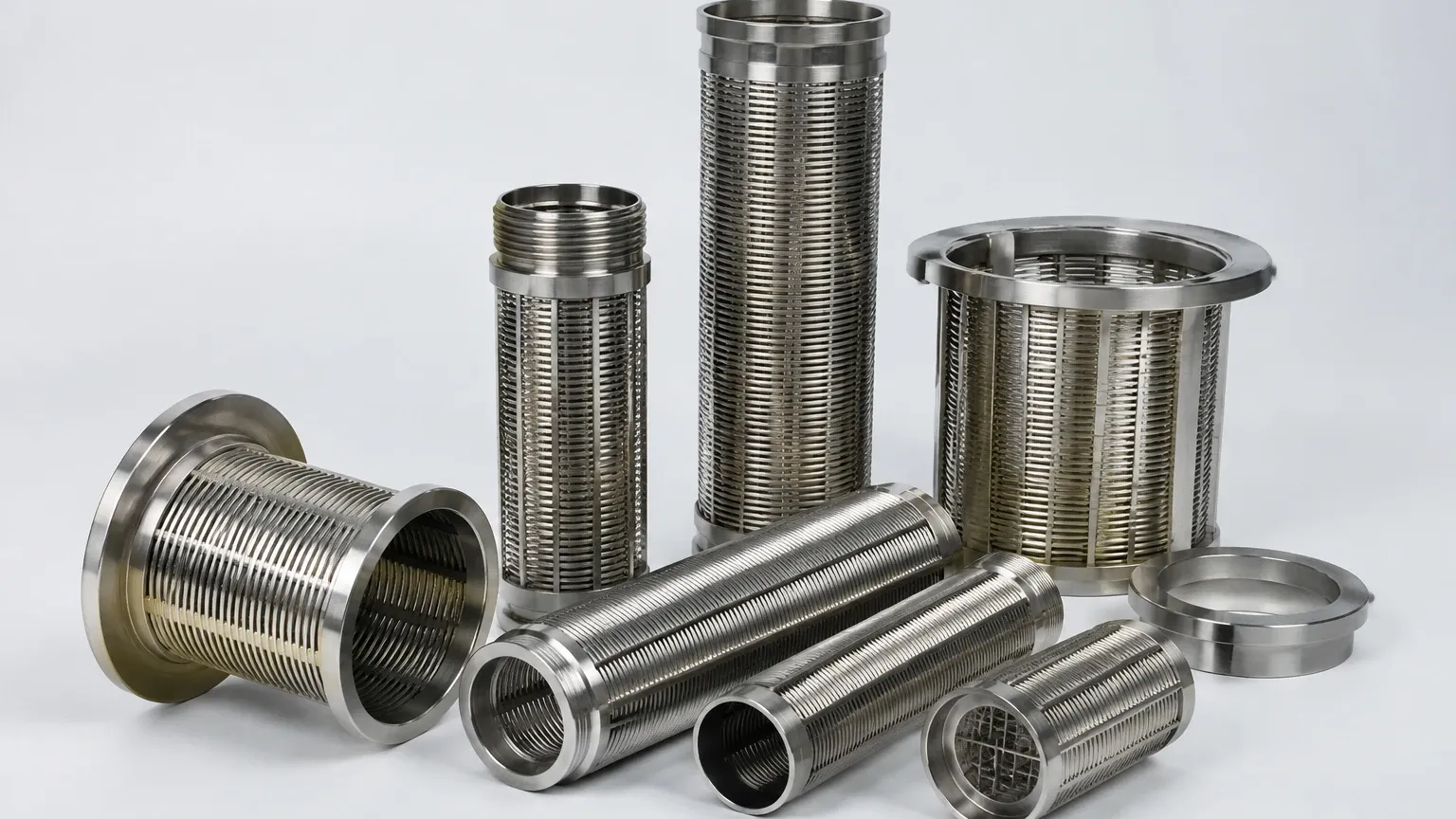
Customization and OEM Integration
Standard catalog items often fall short of the specific needs of complex industrial systems. This is where the value of a manufacturer like Kaifil becomes apparent. Customization allows for the integration of wedge wire technology into existing equipment with minimal modification.
Bespoke Shapes and Configurations
Wedge wire is not limited to flat panels. It can be formed into:
* Cylindrical Cartridges: Used in candle filters and automatic backwashing filters.
* Sieve Bends (Parabolic Screens): Ideal for gravity-fed dewatering.
* Conical Baskets: Used in centrifuges for solid-liquid separation.
* Lateral Systems: Used in the bottom of ion exchange or sand filter vessels to ensure uniform flow distribution.
Tailored Slot Tolerances
For specialized applications like resin traps in water treatment, the slot must be precisely sized to retain the resin beads while allowing the treated water to pass with minimal resistance. Custom manufacturing ensures that these tolerances are met consistently across the entire surface of the screen.
Evaluating Total Cost of Ownership and Maintenance
While the initial purchase price of a wedge wire screen may be higher than that of woven mesh, the total cost of ownership (TCO) is often significantly lower. This is a crucial consideration for South African businesses looking to optimize their CAPEX and OPEX.
Durability and Longevity
The robust construction of wedge wire means it can withstand repeated cleaning cycles, including high-pressure washing and chemical cleaning, without losing its shape or slot accuracy. In many industrial applications, a single wedge wire screen can outlast dozens of mesh replacements, reducing downtime and labor costs.
Maintenance Efficiency
The inherent resistance to clogging means that systems can run for longer periods between cleaning cycles. When cleaning is required, the smooth, V-shaped slots allow for rapid removal of the filter cake. This efficiency is particularly beneficial in continuous processes where any interruption leads to significant production losses.
Risk Mitigation
Using inferior filtration components carries the risk of screen failure, which can lead to downstream equipment damage (such as pump cavitation or valve blockage) and product contamination. By investing in high-quality wedge wire screens, engineers mitigate these risks, ensuring the reliability of the entire production line.
Conclusion
For industrial operations in South Africa, wedge wire screens represent a pinnacle of separation technology. Their ability to handle high loads, resist clogging, and provide precise filtration makes them indispensable in mining, water treatment, and food processing. When selecting a partner for these components, it is vital to choose a manufacturer that understands the technical complexities of the application.
Kaifil’s expertise in stainless steel filtration ensures that every wedge wire product is engineered for performance and durability. Whether you are designing a new system or looking to upgrade existing components, focusing on slot precision, material grade, and structural design will lead to more efficient and cost-effective filtration outcomes. By confirming these technical details before procurement, South African engineers can ensure their operations remain competitive and reliable in a demanding global market.
