


Wedge Wire Water Intake Screen
In industrial and municipal water management, the initial stage of extraction from natural sources—rivers, lakes, or oceans—is the most critical for protecting downstream equipment and local ecosystems. A wedge wire water intake screen serves as the primary barrier, engineered to provide high-capacity flow while preventing the ingress of debris and aquatic life. Unlike traditional mesh or perforated plates, these screens utilize a specialized geometric profile to ensure continuous operation in demanding environments.
For engineers and procurement specialists, selecting the appropriate intake technology involves balancing hydraulic efficiency, material longevity, and environmental compliance. This guide examines the technical specifications, engineering considerations, and maintenance protocols associated with high-performance Wedge Wire Screens.
Engineering Principles of Wedge Wire Screens
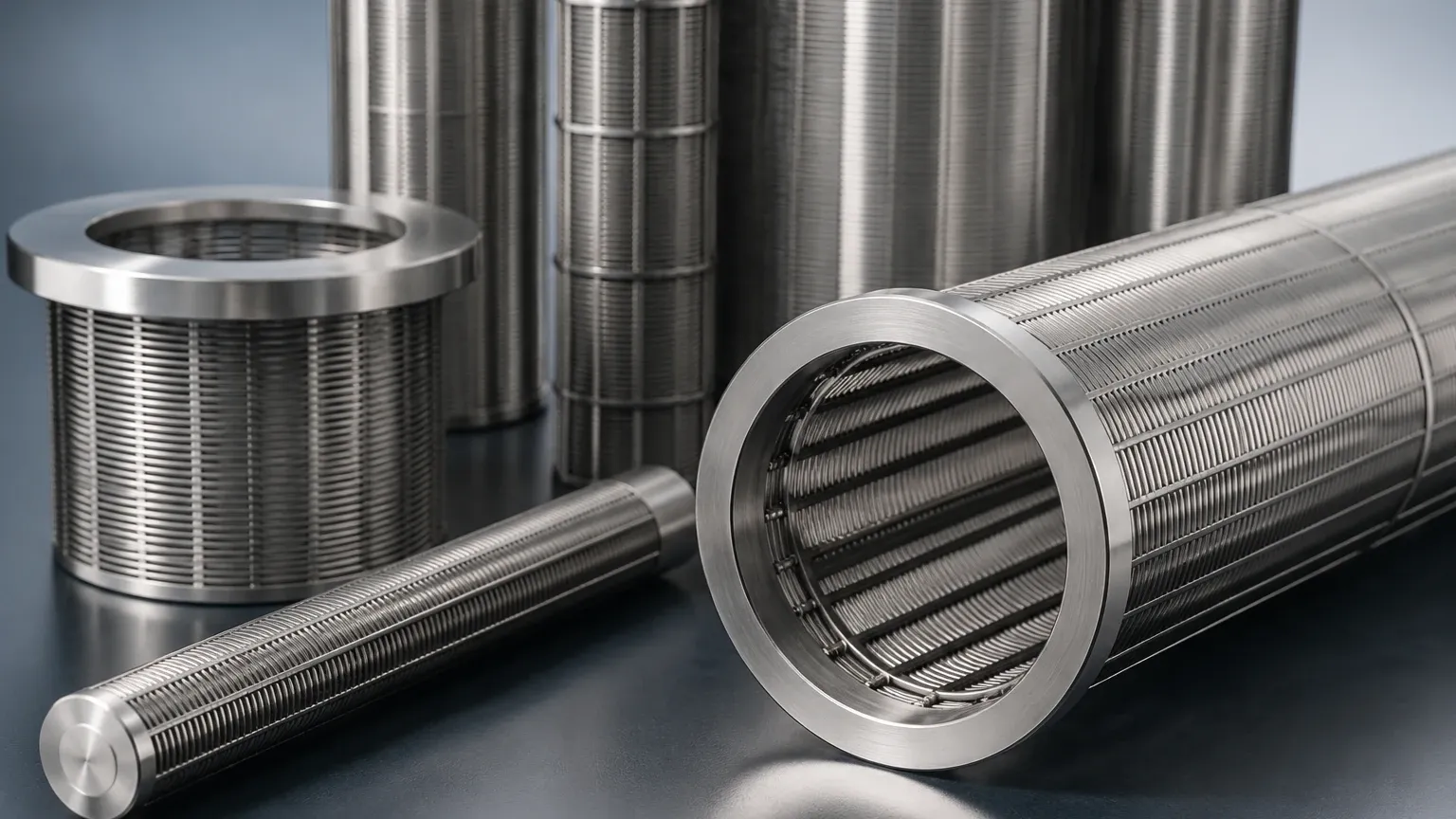
The fundamental advantage of wedge wire lies in its "V-shaped" profile wire. These wires are resistance-welded onto internal support rods at every intersection, creating a rigid, high-strength structure. This construction method offers several mechanical benefits over woven wire or punched metal:
1. Non-Clogging Geometry: The V-shaped wire creates an aperture that widens inwardly. If a particle is small enough to pass the outer edges of the slot, it will continue through the screen without becoming wedged. This "two-point contact" principle is essential for maintaining consistent flow rates in water sources containing silt or organic matter.
2. High Open Area: By optimizing the ratio between the wire width and the slot opening, manufacturers can achieve a high percentage of open area. This allows for lower approach velocities, which is a critical factor in both pump efficiency and environmental safety.
3. Structural Integrity: The fusion-welded points provide a robust framework capable of withstanding significant hydrostatic pressure and mechanical impacts from floating debris.
Functional Advantages of a Wedge Wire Water Intake Screen
A wedge wire water intake screen is typically designed as a passive system. Unlike traveling water screens or mechanical rakes, passive wedge wire systems have no moving parts submerged in the water. This design philosophy significantly reduces the risk of mechanical failure and lowers the total cost of ownership.
From a filtration perspective, these screens are engineered to distribute flow evenly across the entire surface area. This uniform distribution prevents "hot spots" where high-velocity suction might occur. By maintaining a low and consistent velocity, the screen ensures that sediment remains in the natural flow of the water body rather than being pulled toward the intake.
Furthermore, the smooth surface of the wedge wire minimizes the attachment points for biofouling organisms, such as zebra mussels or algae. When combined with specific metallurgical choices, these screens provide a reliable first line of defense for desalination plants, power station cooling systems, and municipal water treatment facilities.
Material Selection for Harsh Aquatic Environments
Material science plays a pivotal role in the lifespan of a wedge wire water intake screen. Because these components are often permanently or semi-permanently submerged, they must resist various forms of corrosion, including pitting, crevice corrosion, and galvanic action.
* Stainless Steel 304/304L: Suitable for freshwater applications with low chloride content. It provides excellent structural strength and moderate corrosion resistance at a cost-effective price point.
* Stainless Steel 316L: The industry standard for brackish water or industrial process water. The addition of molybdenum enhances resistance to chloride-induced pitting.
* Duplex and Super Duplex Stainless Steels: For seawater intakes and desalination projects, Duplex 2205 or Super Duplex 2507 is often required. These materials offer superior yield strength and exceptional resistance to stress corrosion cracking in high-salinity environments.
* Copper-Nickel Alloys: In environments where biofouling is an extreme concern, CuNi alloys may be used due to their natural antimicrobial properties, though they generally offer lower mechanical strength than stainless steel.
Hydraulic Design and Flow Distribution
The efficiency of a wedge wire water intake screen is measured by its ability to provide the required volume of water with minimal head loss. Engineers must calculate the "Approach Velocity" and the "Through-Slot Velocity."
To protect aquatic life, many environmental regulations (such as the EPA 316(b) rule in the United States) mandate a maximum through-slot velocity—often 0.15 meters per second (0.5 feet per second). Achieving this requires a precise calculation of the screen's surface area relative to the pump's intake capacity.
Internal flow modifiers, such as distribution pipes or baffles, are often integrated within the screen cylinder. These components ensure that the suction is not concentrated solely at the end of the pipe closest to the pump. Without proper internal distribution, the "near-end" of the screen would experience high velocities (leading to clogging and fish impingement), while the "far-end" would remain underutilized.
Environmental Protection and Regulatory Compliance
One of the primary drivers for implementing wedge wire water intake screens is the protection of the local ecosystem. Traditional intake structures often suffer from two main issues: impingement and entrainment.
* Impingement: Occurs when aquatic organisms are trapped against the intake screen by the force of the moving water.
* Entrainment: Occurs when smaller organisms, such as larvae or eggs, are pulled through the screen and into the industrial process.
Because wedge wire screens allow for very fine slot openings (often ranging from 1mm to 10mm for intake applications) and maintain low approach velocities, they are recognized as a "Best Technology Available" (BTA) for minimizing environmental impact. The narrow slots physically exclude most organisms, while the low velocity allows fish to swim away from the intake flow easily.
Maintenance Strategies and Cleaning Systems
While the passive nature of wedge wire screens reduces maintenance, they are not entirely "fit and forget" components. Over time, silt, debris, and biological growth can accumulate on the screen surface. To address this without requiring divers or manual scrubbing, most systems utilize an Air-Burst (GIE) Cleaning System.
An air-burst system works by releasing a controlled volume of compressed air into the center of the screen. This creates a high-energy "blast" that travels outward through the slots, effectively purging any accumulated debris from the surface. The frequency of these bursts can be automated based on differential pressure sensors; when the pressure drop across the screen exceeds a set threshold, the system triggers a cleaning cycle.
In addition to air-bursting, some designs incorporate sacrificial anodes to provide cathodic protection in saltwater, further extending the interval between major inspections.
Selection Criteria for Industrial and Municipal Procurement
When specifying a wedge wire water intake screen for a project, engineers should confirm several critical parameters to ensure the solution is fit for purpose:
1. Water Source Characteristics: Is the water fresh, brackish, or saline? What is the maximum and minimum water level (depth)?
2. Flow Requirements: What is the peak design flow rate (m³/h or GPM)?
3. Debris Load: What type of debris is common in the area (e.g., leaves, plastic, sand, or heavy silt)?
4. Regulatory Standards: What are the local environmental requirements for slot velocity and aperture size?
5. Installation Constraints: Is the screen to be mounted on a riverbed, a gravity-fed intake tower, or a floating barge?
By addressing these factors during the design phase, facilities can ensure that their Wedge Wire Screens provide reliable, long-term performance with minimal environmental footprint. As a professional manufacturer, Kaifil specializes in customizing these filtration components to meet the exact mechanical and hydraulic needs of global industrial applications, ensuring that every intake system is optimized for its specific operating environment.
