


Welded Wedge Wire Screens
In the landscape of industrial separation and filtration, the structural integrity and precision of the filter media directly dictate the efficiency of the entire process. Among the various technologies available, welded wedge wire screens have emerged as a critical component for demanding applications where high pressure, abrasive materials, and the need for minimal maintenance are paramount. These screens are not merely passive filters; they are engineered components designed to optimize flow dynamics while providing a robust mechanical barrier.
For engineers and procurement professionals, understanding the technical nuances of welded wedge wire construction is essential for selecting the right solution for chemical processing, water treatment, or food production. This guide explores the engineering principles, material considerations, and application-specific advantages of these high-performance filtration elements.
The Engineering Behind Welded Wedge Wire Screens
At its core, a welded wedge wire screen consists of two primary components: the surface profile wire and the support rods. The "wedge" refers to the V-shaped profile of the surface wire, which is the defining characteristic of this technology.
The Resistance Welding Process
Unlike woven wire mesh or perforated plates, Wedge Wire Screens are manufactured through a sophisticated resistance welding process. The profile wire is wrapped around a series of longitudinal support rods. At every point where the profile wire intersects a support rod, a high-precision weld is made.
This fusion creates a single, rigid structure. The welding process is critical because it ensures that the slot width—the gap between the profile wires—remains constant even under significant mechanical stress or thermal expansion. In high-pressure hydraulic or chemical applications, the stability of these slots is the difference between successful separation and catastrophic bypass.
The V-Profile Advantage
The V-shaped profile is oriented with the widest part of the "V" facing the incoming flow. This geometry creates a widening gap behind the leading edge of the screen. In practice, this means that any particle small enough to pass through the initial slot opening will continue to flow through the screen without getting wedged or trapped. This "self-cleaning" or non-clogging characteristic is a primary reason why engineers specify welded wedge wire screens over traditional mesh for continuous-run industrial processes.
Material Selection and Durability
Material science plays a pivotal role in the longevity of filtration components. Because these screens often operate in corrosive or high-temperature environments, the choice of alloy is a fundamental engineering decision.
1. Stainless Steel 304: This is the standard grade for many industrial applications. It offers excellent strength and good corrosion resistance for general water treatment and non-acidic food processing.
2. Stainless Steel 316L: For more aggressive environments, such as chemical processing or marine applications, 316L is the preferred choice. The addition of molybdenum provides enhanced resistance to pitting and crevice corrosion, particularly in chloride-rich environments.
3. Specialty Alloys: In extreme cases involving high-concentration acids or extreme temperatures, manufacturers like Kaifil can utilize duplex stainless steels or high-nickel alloys to ensure the mechanical integrity of the welded joints remains intact over the long term.
Beyond the alloy type, the surface finish of the welded wedge wire screens can be customized. Electropolishing or pickling can be applied to enhance corrosion resistance and reduce the adhesion of organic materials, which is particularly important in pharmaceutical and food-grade applications.
Performance Evaluation: Slot Precision and Open Area
When specifying a screen, two metrics are paramount: slot precision and the percentage of open area.
Slot Width Precision
In precision filtration, the slot width (often measured in microns or millimeters) determines the cut-point of the separation. Welded construction allows for extremely tight tolerances, often down to 20 microns. Because the wires are welded to support rods, the risk of "wire shifting"—a common failure mode in woven mesh—is eliminated. This ensures that the filtration performance is consistent across the entire surface of the screen.
Calculating Open Area
The open area is the ratio of the total slot area to the total screen surface area. A higher open area results in lower pressure drops and higher flow rates. However, there is an engineering trade-off: increasing the open area usually requires thinner profile wires or wider slot gaps, which can impact the structural strength of the screen. Engineers must balance the hydraulic requirements of the system with the mechanical loads (such as the weight of the filter cake or the pressure of the backwash cycle) to determine the optimal configuration.
Key Applications Across Industries
Welded wedge wire screens are versatile components found in various forms, including flat panels, cylinders, baskets, and curved sieves. Their application is dictated by the specific separation needs of the industry.
Water Treatment and Intake
In municipal and industrial water treatment, these screens are used for raw water intake, protecting downstream pumps and membranes from debris. Their high strength allows them to withstand the force of river or sea currents, while the non-clogging V-wire design minimizes the frequency of manual cleaning.
Food and Beverage Processing
In the brewing industry, welded wedge wire is the standard for lauter tun screens. The precision slots allow for efficient wort drainage while retaining the grain bed. Similarly, in juice extraction and sugar processing, these screens provide a hygienic, easy-to-clean surface that meets stringent food safety standards.
Chemical and Petrochemical Sectors
Reactors often utilize wedge wire as catalyst support grids or resin traps. The ability of the welded structure to withstand high temperatures and chemical attack ensures that expensive catalysts are retained within the vessel, preventing downstream contamination and equipment damage.
Pulp and Paper
Screening and fractionation of wood fibers require screens that can handle high-consistency slurries. The durability of welded wedge wire is essential here, as the screens must resist the abrasive nature of the fibers and the high-frequency vibrations often used to assist the screening process.
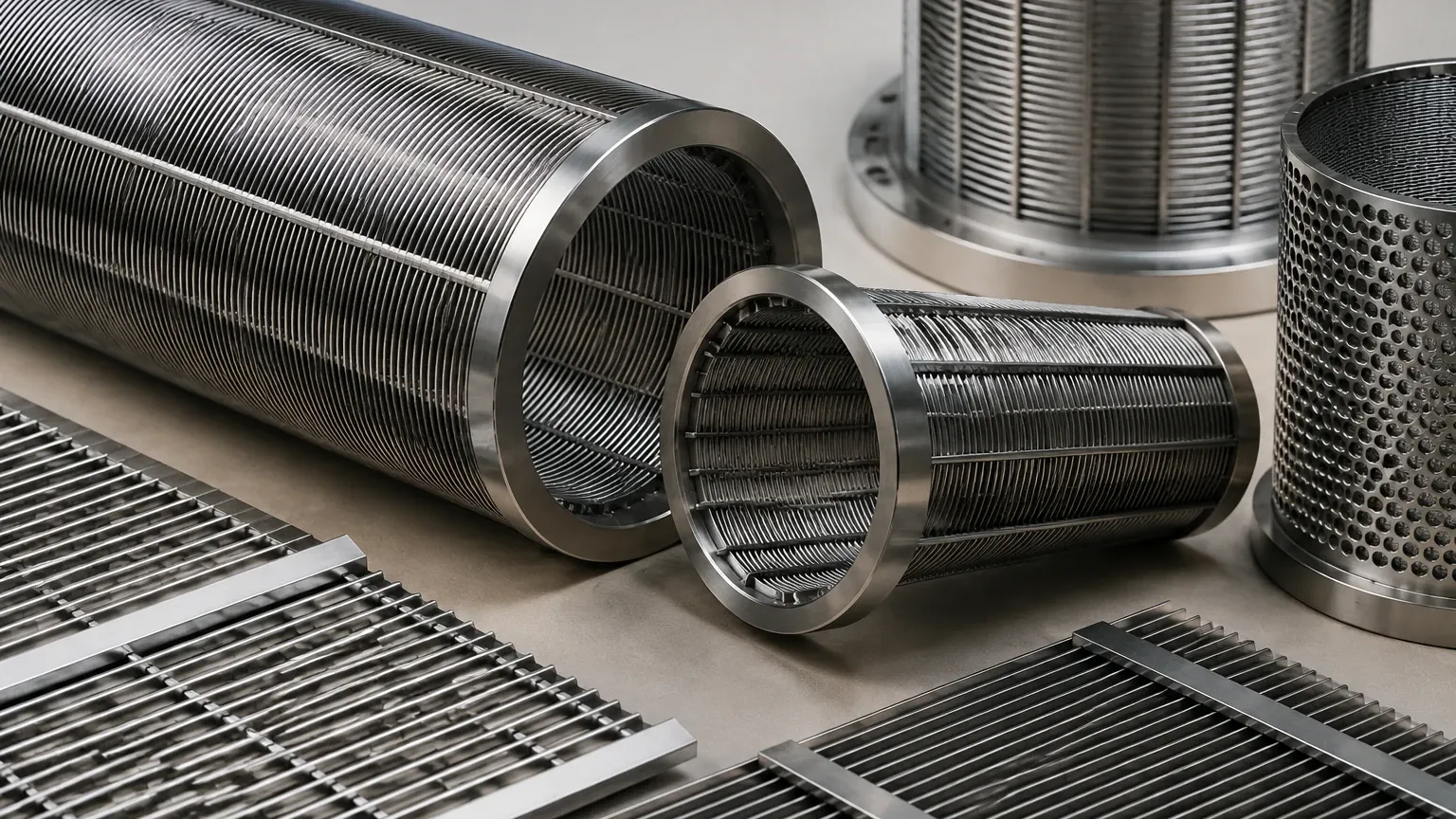
Customization and Engineering Considerations
One of the primary advantages of working with a specialized manufacturer like Kaifil is the ability to customize the screen geometry to the specific mechanical constraints of the equipment. When designing a custom filtration solution, several factors must be confirmed:
* Direction of Flow: Is the flow from out-to-in or in-to-out? This determines whether the profile wire is wrapped on the outside or the inside of the support rods.
* Support Rod Configuration: The spacing and shape of the support rods (round, rectangular, or teardrop) affect the overall collapse strength of the screen.
* Reinforcement: For high-pressure applications, additional stiffening rings or outer cages may be required to prevent deformation.
* End Fittings: Custom flanges, threaded connectors, or reinforced margins are often necessary to ensure a leak-proof installation within the housing.
Total Cost of Ownership and Maintenance
While the initial capital expenditure (CAPEX) for welded wedge wire screens may be higher than for disposable media or simple woven mesh, the total cost of ownership (TCO) is often significantly lower. This is due to several factors:
1. Extended Service Life: The robust welded construction resists wear and mechanical fatigue, leading to fewer replacements.
2. Reduced Downtime: The non-clogging nature of the V-wire reduces the frequency of cleaning cycles. When cleaning is required, the smooth surface responds well to backwashing, ultrasonic cleaning, or mechanical scraping.
3. Process Efficiency: Consistent slot openings and low pressure drops lead to lower energy consumption for pumps and more predictable product quality.
4. Recyclability: Being made of solid stainless steel, these screens are fully recyclable at the end of their long service life, aligning with corporate sustainability goals.
Conclusion for Technical Buyers
Selecting Wedge Wire Screens is a decision that impacts the reliability and efficiency of industrial processes. By focusing on the mechanical integrity of the resistance-welded joints, the precision of the slot openings, and the appropriateness of the material grade, engineers can ensure they are implementing a solution that withstands the rigors of their specific environment.
As a professional manufacturer, Kaifil provides the technical expertise required to navigate these engineering choices. From initial material selection to the final customized design, the focus remains on delivering filtration components that offer dependable performance in the most demanding industrial applications. For those looking to optimize their filtration systems, confirming the mechanical loads, flow requirements, and chemical compatibility with a technical partner is the first step toward a successful installation.
