


3 Mesh Filter
In industrial filtration, the selection of the correct mesh size is a critical factor that determines both the efficiency of the process and the longevity of the equipment. A 3 mesh filter represents one of the coarser grades of industrial wire cloth, characterized by having three openings per linear inch. While fine filtration often receives significant attention in high-purity sectors, coarse filtration components like the 3 mesh variant serve as the essential first line of defense in complex fluid handling systems.
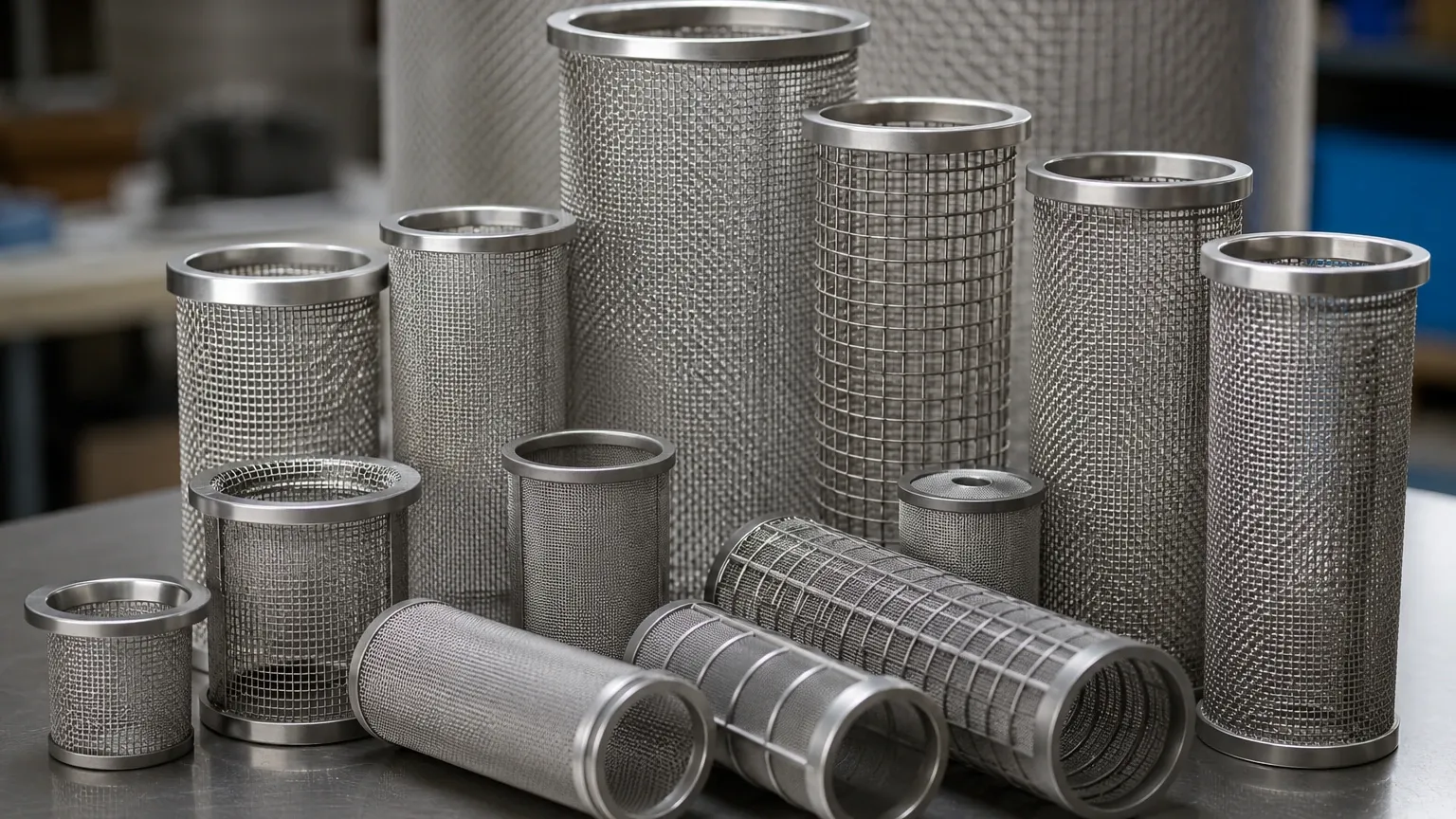
For engineers and procurement specialists, understanding the technical nuances of coarse mesh is vital. These components are frequently fabricated into Wire Mesh Filter Cylinders & Tubes to provide structural support or primary debris removal. This guide explores the technical specifications, engineering considerations, and application-specific benefits of utilizing a 3 mesh configuration in industrial environments.
Understanding 3 Mesh Filter Specifications and Geometry
The term "mesh" in industrial wire cloth refers to the number of openings per linear inch, measured from the center of one wire to the center of the next. A 3 mesh filter contains three openings in every 25.4mm of length. However, the mesh count alone does not fully define the filter's performance; the wire diameter is an equally important variable.
Opening Size and Wire Diameter
The clear opening (aperture) of a 3 mesh screen depends heavily on the gauge of the wire used. For instance, if a 3 mesh screen uses a wire diameter of 0.063 inches (1.6mm), the resulting opening size is approximately 0.270 inches (6.86mm). If a heavier wire of 0.080 inches (2.0mm) is used, the opening narrows to 0.253 inches (6.43mm).
Engineers must balance the need for a large open area with the structural requirement for durability. A larger wire diameter increases the weight and mechanical strength of the filter but reduces the percentage of open area, which can impact flow rates and pressure drop.
Percentage of Open Area
The open area is the ratio of the total area of the openings to the total area of the screen. For a standard 3 mesh configuration, the open area typically ranges between 65% and 80%. This high percentage of open area is one of the primary reasons why these filters are selected for high-volume flow applications where minimal resistance is required.
Structural Design of Wire Mesh Filter Cylinders & Tubes
When a 3 mesh screen is integrated into industrial systems, it is rarely used as a flat sheet. Instead, it is most commonly formed into Wire Mesh Filter Cylinders & Tubes. These geometries are preferred because they provide a high surface-area-to-volume ratio and can be easily integrated into existing piping systems.
Fabrication Techniques
Manufacturing a reliable cylindrical filter from 3 mesh requires precision welding and forming. Because the wire used in 3 mesh is typically thicker than that used in fine mesh, specialized rolling equipment is needed to ensure the cylinder remains perfectly round.
* Seam Welding: For 3 mesh cylinders, longitudinal seams are usually joined via resistance welding or TIG (Tungsten Inert Gas) welding to ensure the joint is as strong as the base material.
* Reinforcement: In high-pressure applications, a 3 mesh tube may serve as an internal or external support core (a "backup tube") for a finer mesh layer. This "multi-layer" construction allows the fine mesh to perform the filtration while the 3 mesh provides the necessary mechanical rigidity to prevent collapse under differential pressure.
End Fittings and Customization
To ensure a leak-proof bypass-free installation, these cylinders are often fitted with custom end caps, flanges, or threaded connectors. Common configurations include:
* DOE (Double Open End): Allows flow through both ends of the tube.
* SOE (Single Open End): One end is capped, often with a handle or a bolt-down fitting for easy removal.
* Flanged Ends: Used for bolting the filter directly into a housing or vessel wall.
Material Selection for Industrial Environments
Industrial filtration environments are often chemically aggressive or subject to high temperatures. Therefore, the material of the 3 mesh filter is a primary consideration during the design phase. Stainless steel is the industry standard due to its corrosion resistance and mechanical properties.
SS304 vs. SS316L
* Stainless Steel 304: This is the most common grade for general industrial use. It offers excellent strength and good corrosion resistance for water treatment and standard hydraulic applications.
* Stainless Steel 316L: Containing molybdenum, 316L provides superior resistance to chlorides and pitting. It is the preferred choice for chemical processing, marine environments, and pharmaceutical applications where high-purity and resistance to aggressive cleaning agents are required.
Specialty Alloys
In extreme cases, such as highly acidic environments or high-temperature exhaust filtration, specialty alloys like Monel, Inconel, or Hastelloy may be used. These materials ensure that the filter maintains its structural integrity and filtration accuracy even when exposed to temperatures exceeding 500°C or highly caustic fluids.
Key Performance Factors: Flow Rate and Pressure Drop
In B2B industrial procurement, the "Total Cost of Ownership" is often dictated by how the filter affects the overall system efficiency. A 3 mesh filter is designed for low-pressure-drop performance.
Minimizing Differential Pressure
Differential pressure (ΔP) is the difference in pressure between the upstream and downstream sides of the filter. Because a 3 mesh screen has large apertures and a high open area, the initial pressure drop is negligible, even at high flow velocities. This makes it an ideal "trash strainer" or "pre-filter" that protects downstream pumps, valves, and finer filters without taxing the system's energy consumption.
Dirt Holding Capacity
While coarse filters do not capture fine particulates, they are highly effective at capturing large debris like scale, stones, and wood chips. The "dirt holding capacity" for a 3 mesh cylinder is significant because the large openings take longer to bridge and clog compared to finer meshes. This results in longer service intervals and reduced downtime for cleaning.
Customization Options for OEM Applications
Every industrial process has unique constraints, and off-the-shelf solutions rarely provide the optimal balance of performance and fit. Customizing Wire Mesh Filter Cylinders & Tubes allows engineers to tailor the component to the specific fluid dynamics of their machinery.
Multi-Layer Sintered Structures
For applications requiring both the robustness of 3 mesh and the precision of fine filtration, sintering is an excellent option. By diffusion-bonding a 3 mesh support layer to several layers of finer mesh, manufacturers can create a single, monolithic filter element. This structure eliminates the risk of wire migration and provides a much higher burst pressure rating than a single-layer mesh.
Dimensional Precision
In OEM equipment, tolerances are often tight. Custom fabrication allows for the production of cylinders with precise diameters and lengths to fit specialized housings. Whether it is a small 1-inch diameter tube for a hydraulic line or a large 24-inch diameter basket for a water intake system, custom manufacturing ensures a perfect seal.
Applications Across Industrial Sectors
The versatility of the 3 mesh filter makes it a staple in various sectors. Its primary role is usually the removal of large-scale contaminants that could cause catastrophic failure in downstream equipment.
Chemical and Petrochemical Processing
In chemical plants, these filters are used in intake lines to prevent large debris from entering reactors or heat exchangers. They also serve as catalyst support grids, where the 3 mesh provides the physical structure to hold catalyst pellets while allowing the process fluid to pass through with minimal resistance.
Food and Beverage Industry
In food processing, 3 mesh strainers are used during the initial stages of raw material processing—such as straining large pulp from juices or protecting pumps from solid ingredients. When manufactured from food-grade 316L stainless steel, these filters meet stringent hygiene standards and can withstand frequent Clean-in-Place (CIP) cycles.
Hydraulic and Lubrication Systems
Large hydraulic reservoirs often utilize 3 mesh suction strainers. These components protect the hydraulic pump from large contaminants that may have entered the tank during maintenance or through breathers. By capturing these large particles, the 3 mesh filter prevents immediate pump damage, while finer return-line filters handle the smaller wear particles.
Maintenance and Cleaning Protocols
One of the greatest advantages of stainless steel Wire Mesh Filter Cylinders & Tubes is their cleanability. Unlike disposable synthetic filters, metal mesh can be cleaned and reused multiple times, significantly reducing the long-term operational cost.
Cleaning Methods
* Backwashing: Reversing the flow of the fluid can often dislodge particles trapped on the surface of the 3 mesh.
* Ultrasonic Cleaning: For stubborn contaminants or when the 3 mesh is part of a sintered composite, ultrasonic baths use high-frequency sound waves to remove particles from deep within the mesh structure.
* Chemical Cleaning: Soaking the filter in compatible solvents or acids can remove scale or organic buildup without damaging the stainless steel substrate.
Inspection and Replacement Cycles
While durable, 3 mesh filters should be inspected regularly for signs of mechanical wear, such as "wire fraying" or seam separation. In high-vibration environments, the points where the wires cross can experience fretting. A regular maintenance schedule ensures that the filter is replaced before a structural failure allows bypass to occur.
Conclusion: Choosing the Right Filtration Partner
Selecting a 3 mesh filter involves more than just picking a mesh count; it requires a deep understanding of material science, fluid dynamics, and mechanical design. When integrated into professionally engineered Wire Mesh Filter Cylinders & Tubes, these components provide a robust and cost-effective solution for coarse filtration needs.
For engineers and purchasing teams, partnering with a manufacturer that offers extensive OEM and customization capabilities is essential. By focusing on quality material selection, precise welding, and tailored designs, Kaifil ensures that every filtration component meets the rigorous demands of industrial applications, providing reliable performance and long-term durability in the field.
