


Filter Wire Mesh 60 Micron: An Engineering Guide to Industrial Filtration Performance
In the landscape of industrial separation and fluid conditioning, the selection of a specific filtration grade is a decision that balances particle retention efficiency with system throughput. A filter wire mesh 60 micron specification represents a critical threshold in many processes, often serving as the primary defense for sensitive downstream equipment or as a final polishing stage in liquid purification.
For engineers and procurement specialists, understanding the technical nuances of 60-micron stainless steel mesh is essential for optimizing the lifecycle and performance of filtration systems. This guide examines the engineering principles, material considerations, and structural configurations—specifically focusing on Wire Mesh Filter Cylinders & Tubes—required to implement effective 60-micron filtration in demanding industrial environments.
Understanding the Technical Specifications of 60 Micron Wire Mesh
The term "60 micron" refers to the nominal or absolute size of the aperture (opening) between the woven wires. In the context of industrial wire cloth, 60 microns is approximately equivalent to a 230 to 250 mesh count, depending on the wire diameter used during the weaving process.
Micron to Mesh Conversion and Aperture Precision
While "mesh" refers to the number of openings per linear inch, the micron rating defines the physical distance between adjacent wires. For a 60-micron filter, the precision of the weave is paramount. At this level of fineness, even slight deviations in wire spacing can lead to "bypass," where particles larger than the target size pass through the media.
When specifying a filter wire mesh 60 micron component, engineers must distinguish between:
* Nominal Rating: An approximate value indicating the ability of the mesh to retain the majority of particles at that size.
* Absolute Rating: A guaranteed value where no particle larger than the specified micron size can pass through the mesh under controlled conditions.
Weave Types for 60 Micron Applications
For a 60-micron aperture, two primary weave patterns are typically employed:
1. Plain Weave: The most common industrial weave where each warp wire crosses alternately over and under each shute wire. It provides high flow rates and is easy to clean.
2. Twilled Weave: Used when the wire diameter is too thick relative to the aperture size for a plain weave. This allows for a more robust mesh that can withstand higher mechanical stresses while maintaining the 60-micron opening.
The Role of Wire Mesh Filter Cylinders & Tubes in Industrial Systems
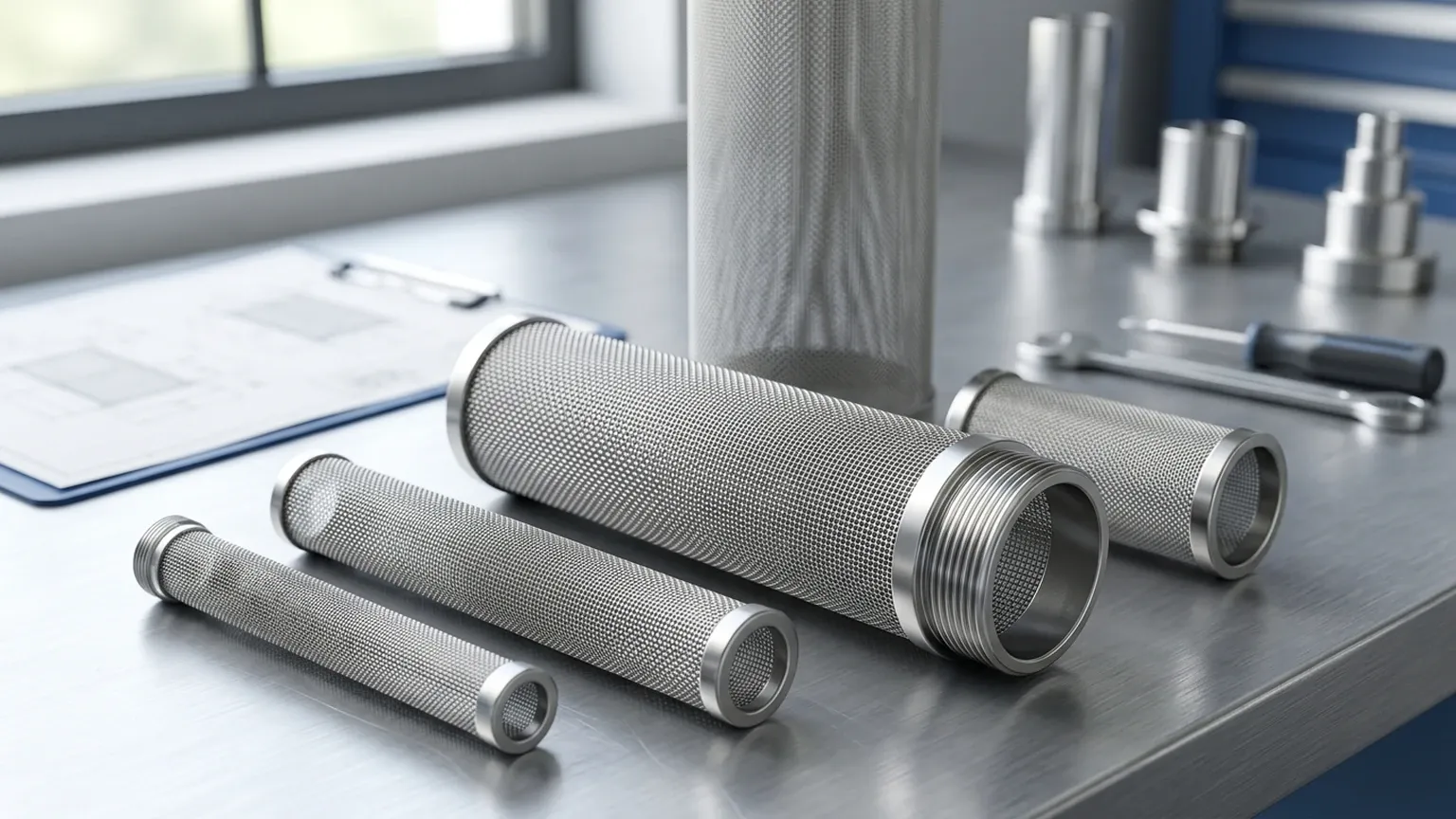
While flat mesh sheets are used in some applications, the most efficient geometry for industrial filtration is often the cylindrical form. Wire Mesh Filter Cylinders & Tubes provide a significantly higher effective filtration area (EFA) within a compact footprint compared to flat screens.
Structural Advantages of Cylindrical Designs
Cylindrical filters are inherently stronger under internal or external pressure. In high-pressure hydraulic systems or chemical processing lines, the hoop strength of a tube prevents the mesh from deforming or collapsing. Kaifil specializes in the precision fabrication of these components, ensuring that the longitudinal seams are welded—often using plasma or TIG welding—to maintain the integrity of the 60-micron rating across the entire surface.
Flow Dynamics and Surface Filtration
60-micron mesh functions primarily through surface filtration. Unlike depth media (such as felt or sand), particles are trapped on the surface of the mesh. This makes cylindrical filters ideal for applications where backwashing or mechanical cleaning is required. The uniform geometry of a tube allows for consistent fluid velocity across the media, reducing the likelihood of localized clogging and extending the interval between maintenance cycles.
Material Selection and Chemical Compatibility
The performance of a filter wire mesh 60 micron element is inextricably linked to its material composition. In industrial engineering, stainless steel is the standard due to its mechanical strength and resistance to environmental degradation.
Stainless Steel 304 vs. 316L
* Grade 304: Suitable for general industrial applications, including water filtration and some food processing. It offers good strength and basic corrosion resistance.
* Grade 316L: The preferred choice for chemical processing, pharmaceutical manufacturing, and marine environments. The addition of molybdenum and a lower carbon content provides superior resistance to pitting and crevice corrosion, particularly in the presence of chlorides.
Specialized Alloys
In extreme cases involving highly acidic or alkaline fluids, or high-temperature gas filtration, exotic alloys like Hastelloy, Inconel, or Monel may be required. However, for the vast majority of 60-micron applications, SS316L provides the optimal balance of cost and durability.
Engineering Considerations: Flow Rate and Pressure Drop
One of the most common challenges in specifying a 60-micron filter is managing the clean pressure drop ($ΔP$). As the aperture size decreases, the resistance to flow increases.
Calculating the Open Area
The "Open Area" percentage is a critical metric. It is calculated based on the wire diameter and the mesh count. For a 60-micron mesh, the open area typically ranges between 30% and 40%. A lower open area means a higher initial pressure drop but often results in a more mechanically robust filter.
Viscosity and Temperature Effects
Engineers must account for the operating temperature and the viscosity of the fluid. High-viscosity fluids (such as heavy oils or polymers) require a larger filtration surface area to maintain the same flow rate through a 60-micron mesh compared to water. If the pressure drop exceeds the system's design limits, the filter may bypass (if a relief valve is present) or suffer mechanical failure.
Installation Constraints and Structural Support Requirements
A 60-micron stainless steel mesh is relatively delicate. At this fineness, the wire diameter is often less than 0.05 mm. Consequently, the mesh cannot usually support the weight of the fluid column or the force of high-pressure surges on its own.
Multi-Layer and Pleated Constructions
To address this, Wire Mesh Filter Cylinders & Tubes are often constructed using multiple layers:
* Filtration Layer: The 60-micron mesh that performs the actual separation.
* Support Layer: A coarser mesh (e.g., 20 mesh) that provides mechanical rigidity.
* Perforated Core: A heavy-duty stainless steel perforated tube that acts as the internal skeleton for the filter, allowing it to withstand high differential pressures without bursting or collapsing.
Sealing and Gasketing
Proper installation requires a leak-proof seal at the ends of the cylinder. Common configurations include double open ends (DOE) with gaskets, or single open ends (SOE) with threaded fittings or O-ring seals. Any gap in the sealing surface effectively bypasses the 60-micron media, rendering the filtration system ineffective.
Maintenance, Cleaning, and Operational Risks
Unlike disposable polymer cartridges, stainless steel 60-micron filters are designed for longevity. However, their performance depends on a rigorous maintenance protocol.
Cleaning Methodologies
Because 60-micron mesh is a surface filtration medium, it can be cleaned using several methods:
* Ultrasonic Cleaning: High-frequency sound waves create cavitation bubbles that dislodge fine particles trapped in the mesh openings. This is the most effective method for 60-micron filters.
* Backpulsing/Backwashing: Reversing the flow of fluid to push contaminants off the surface. This is common in automated self-cleaning systems.
* Chemical Cleaning: Using solvents or acids to dissolve organic or mineral deposits that cannot be removed mechanically.
Risks of Improper Maintenance
The primary risk in 60-micron filtration is "blinding." This occurs when particles become wedged so deeply in the mesh that they cannot be removed, permanently increasing the pressure drop. Additionally, aggressive manual cleaning with brushes can distort the wire spacing, enlarging the 60-micron apertures and compromising the filtration accuracy.
Procurement Checklist for International Buyers
When sourcing filter wire mesh 60 micron components from a manufacturer like Kaifil, providing detailed technical data is essential for ensuring the final product meets application requirements. International buyers should confirm the following parameters:
1. Micron Rating Validation: Is the 60-micron rating nominal or absolute? Request a bubble point test report if absolute filtration is required.
2. Material Certification: Ensure the stainless steel (304 or 316L) is verified by mill test reports (MTRs) to prevent premature corrosion.
3. Mechanical Load Limits: Define the maximum operating pressure and the maximum allowable differential pressure ($ΔP$) before the filter must be cleaned or replaced.
4. Dimensional Tolerances: For cylindrical filters, precise outer diameter (OD), inner diameter (ID), and length measurements are critical for fitting into existing housings.
5. End Fitting Compatibility: Specify the exact type of flange, thread, or gasket surface required for a secure installation.
By focusing on these technical boundaries, engineers can leverage the durability and precision of stainless steel filtration to protect their industrial processes. Whether used in hydraulic systems, water treatment, or chemical refining, a well-engineered 60-micron filter remains a cornerstone of industrial fluid management.
