


Mesh Cylinder Filter
In industrial filtration, the mesh cylinder filter serves as a fundamental component for separating solids from liquids and gases. These cylindrical components are engineered to withstand high differential pressures, extreme temperatures, and corrosive environments while maintaining precise filtration accuracy. For engineers and procurement specialists, selecting the correct Wire Mesh Filter Cylinders & Tubes requires a deep understanding of material science, weave patterns, and structural integrity.
As a professional manufacturer specializing in custom stainless steel filtration solutions, Kaifil provides high-performance components tailored to the rigorous demands of chemical processing, food production, and hydraulic systems. This guide explores the technical considerations necessary for optimizing filtration performance through the strategic selection of mesh cylinder filters.
Understanding the Fundamentals of Mesh Cylinder Filters
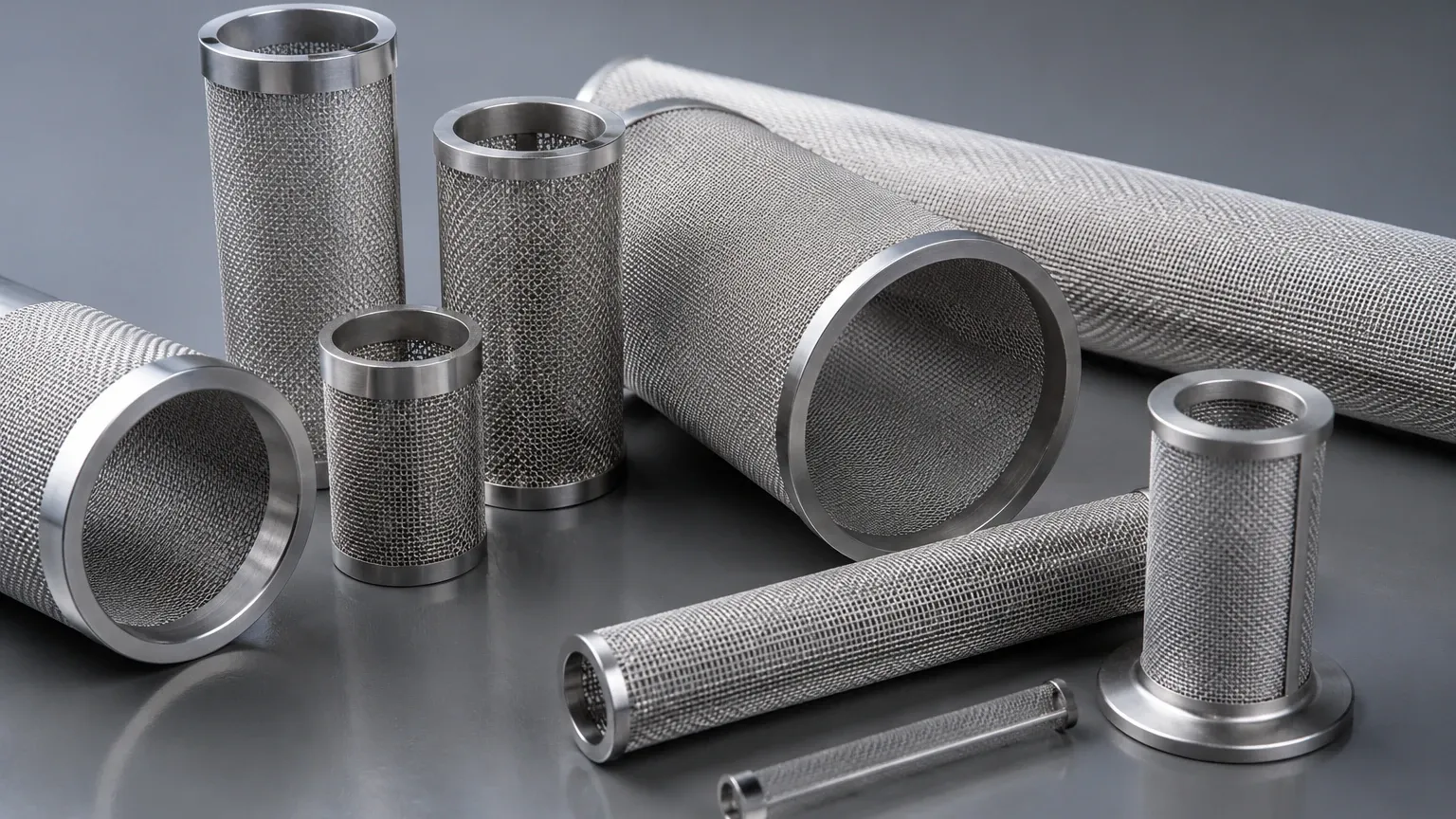
A mesh cylinder filter is a tubular filtration element constructed primarily from woven wire mesh. Unlike disposable polymer filters, these metal components are designed for durability and reusability. The cylindrical geometry is preferred in industrial applications because it provides a high surface area relative to the installation footprint, allowing for efficient flow rates and high dirt-holding capacity.
The performance of a mesh cylinder filter is dictated by the specifications of the wire mesh used in its construction. This includes the wire diameter, the aperture size (the clear distance between wires), and the type of weave. In industrial settings, these filters are often integrated into housing units where the fluid flows either from the inside out or the outside in, depending on the specific system design and the nature of the contaminants being removed.
Material Selection and Engineering Standards
The choice of material is the first critical decision in the engineering process. Stainless steel is the industry standard due to its mechanical strength and resistance to oxidation. Kaifil utilizes several grades of stainless steel to meet specific environmental challenges:
* AISI 304: The most common grade, offering excellent strength and basic corrosion resistance. It is suitable for general industrial use, water treatment, and food processing where high acidity is not a factor.
* AISI 316: Contains molybdenum, which significantly enhances resistance to chlorides and pitting. This is the preferred choice for marine environments and chemical processing.
* AISI 316L: A low-carbon version of 316, which is essential for components that require extensive welding. The low carbon content prevents carbide precipitation during the welding process, ensuring that the heat-affected zones remain as corrosion-resistant as the rest of the mesh.
Beyond stainless steel, specialized applications may require exotic alloys like Monel or Inconel for extreme temperature or chemical resistance. However, for the majority of B2B industrial applications, 316L provides the optimal balance between cost and performance.
Structural Design: Single-Layer vs. Multi-Layer Sintered Mesh
The structural configuration of a mesh cylinder filter determines its mechanical stability under pressure. Depending on the application, engineers may choose between several construction methods:
Single-Layer Mesh Cylinders
These are constructed from a single sheet of woven wire mesh, rolled into a cylinder and joined by a longitudinal seam (usually via TIG or plasma welding). While cost-effective, single-layer filters are best suited for low-pressure applications or as secondary strainers. They often require an internal or external support core, such as a perforated metal tube, to prevent collapsing or bursting under flow surges.
Multi-Layer Sintered Mesh
For high-pressure or high-precision requirements, multiple layers of wire mesh are bonded together through a process called vacuum sintering. This involves heat and pressure to fuse the contact points of the wires without melting them. A typical five-layer sintered mesh includes a fine filtration layer, two protection layers, and two reinforcement layers. This creates a robust, monolithic structure that offers fixed pore sizes and exceptional mechanical strength, eliminating the need for additional support structures in many cases.
Performance Metrics: Filtration Rating and Pressure Drop
When evaluating a mesh cylinder filter, two primary metrics define its efficiency: the filtration rating and the pressure drop.
Filtration Rating (Micron Rating)
* Absolute Rating: This refers to the diameter of the largest hard spherical particle that will pass through the filter under specified test conditions. For critical applications like pharmaceutical processing, an absolute rating is mandatory.
* Nominal Rating: This is an arbitrary value indicating a percentage of particles of a certain size that the filter can retain (e.g., 90% of 10-micron particles). This is more common in general industrial straining.
Pressure Drop ($ΔP$)
The pressure drop is the difference in total pressure between the upstream and downstream sides of the filter. A high initial pressure drop limits the throughput of the system and shortens the interval between cleaning cycles. Engineers must calculate the Effective Filtration Area (EFA) to ensure that the flow velocity through the mesh remains within limits that do not cause premature clogging or structural deformation.
Weave Types and Their Impact on Filtration
The pattern in which the wires are woven significantly influences the flow characteristics and particle retention of the cylinder:
1. Plain Weave: The simplest pattern where each shute wire passes over and under each warp wire. It provides the highest open area and lowest pressure drop but is limited in how fine the filtration can go.
2. Twill Weave: Each wire passes over and under two wires, allowing for a heavier wire diameter in a given mesh count. This increases the strength of the filter.
3. Dutch Weave (Plain and Twill): This weave uses a larger diameter for the warp wires and a smaller diameter for the shute wires, which are driven close together. This creates a "tortuous path" for the fluid, allowing for very fine filtration ratings (down to 5-10 microns) while maintaining high mechanical strength.
Industrial Applications and Operating Environments
Mesh cylinder filters are utilized across a spectrum of industries, each with unique operational demands:
* Chemical and Petrochemical: Used for catalyst recovery and the removal of impurities from aggressive solvents. The corrosion resistance of stainless steel is vital here.
* Food and Beverage: These filters must meet FDA and 3-A sanitary standards. Smooth surface finishes and the absence of "dead spots" where bacteria can grow are critical. Mesh cylinders are often used in the filtration of syrups, oils, and beverages.
* Hydraulic Systems: Protecting sensitive valves and pumps from particulate contamination. These filters must handle high-frequency pressure pulsations without fatigue failure.
* Water Treatment: Serving as pre-filters for Reverse Osmosis (RO) systems or as self-cleaning strainers in cooling water loops.
Customization and OEM Manufacturing Considerations
Standard off-the-shelf filters rarely meet the specific needs of complex industrial machinery. Customization is often necessary to ensure seamless integration. Key customization factors include:
* End Cap Configurations: Options include threaded fittings (NPT/BSP), flange mounts, 222/226 O-ring plug-ins, or simple open ends. The sealing method is critical to prevent bypass, where unfiltered fluid escapes around the edges of the filter.
* Reinforcement: For high-viscosity fluids or high-pressure differentials, the mesh cylinder can be reinforced with an internal perforated core or an outer shroud.
* Dimensions: Precise control over length, outer diameter (OD), and inner diameter (ID) is required to fit existing filter housings.
Kaifil’s manufacturing process emphasizes precision welding and finishing. Techniques such as plasma welding ensure that the seams are as strong as the parent material, while ultrasonic cleaning removes any manufacturing residues, ensuring the filter is ready for high-purity applications.
Maintenance and Lifecycle Management
One of the primary B2B advantages of stainless steel mesh cylinder filters is their cleanability. Unlike disposable cartridges, which contribute to waste and recurring costs, metal filters can be restored to near-original performance through several methods:
* Backwashing: Reversing the flow of the fluid to dislodge particles trapped on the surface of the mesh.
* Ultrasonic Cleaning: Using high-frequency sound waves in a cleaning solvent to remove fine particles embedded deep within the weave or sintered layers.
* Chemical Cleaning: Utilizing specific acids or alkalis to dissolve organic or inorganic scaling, provided the chemical is compatible with the stainless steel grade.
Determining the replacement cycle depends on the "terminal pressure drop"—the point at which the filter is so loaded with contaminants that cleaning no longer restores sufficient flow. Regular monitoring of the differential pressure allows maintenance teams to schedule cleanings before a failure occurs, optimizing the total cost of ownership.
Technical Checklist for Procurement
Before finalizing a specification for a mesh cylinder filter, engineers should confirm the following data points with the manufacturer:
1. Fluid Characteristics: Viscosity, temperature, and chemical composition.
2. Contaminant Profile: Particle size distribution and the nature of the solids (e.g., hard, deformable, or fibrous).
3. Flow Requirements: Minimum and maximum flow rates and the allowable initial pressure drop.
4. Mechanical Constraints: Maximum operating pressure and potential for pressure spikes or reverse flow.
5. Compliance Needs: Requirements for material certifications (MTRs), food-grade compliance, or specific industry standards.
By focusing on these technical boundaries, organizations can ensure they select a filtration solution that provides reliable performance and long-term durability. For those seeking specialized designs or high-volume OEM production, partnering with an experienced manufacturer like Kaifil ensures that the final product meets the exact engineering tolerances required for demanding industrial environments.
