


Engineering Guide to Metal Mesh Dust Filters: Selection and Industrial Application
In industrial air pollution control and process gas cleaning, the choice of filtration media significantly impacts system efficiency, maintenance frequency, and operational lifespan. While fabric bags and synthetic cartridges are common, the metal mesh dust filter has emerged as a critical solution for demanding environments characterized by high temperatures, corrosive gases, or high-pressure differentials. Engineered from stainless steel or specialized alloys, these filters provide a rigid, reusable, and highly precise alternative to traditional disposable media.
For engineers and procurement teams, understanding the technical nuances of Wire Mesh Filter Cylinders & Tubes is essential for optimizing filtration performance. This guide explores the engineering fundamentals, material considerations, and selection criteria necessary for implementing metal mesh filtration in industrial dust collection systems.
Engineering Fundamentals of Metal Mesh Dust Filtration
The primary function of a metal mesh dust filter is to separate solid particulates from a gas stream through mechanical interception. Unlike depth filtration media, which trap particles within a thick matrix of fibers, metal mesh primarily operates on the principle of surface filtration.
Particle Capture Mechanisms
In a metal mesh system, dust particles are captured through several physical mechanisms:
1. Direct Interception: Occurs when a particle follows a gas streamline and comes within one particle radius of a mesh wire.
2. Inertial Impaction: Larger, heavier particles with significant momentum fail to follow the gas streamlines as they curve around the wires, instead striking the mesh surface.
3. Diffusion (Brownian Motion): Very fine sub-micron particles move erratically due to gas molecule collisions, eventually contacting the mesh surface.
As the filtration cycle progresses, a "dust cake" forms on the upstream side of the mesh. In many industrial applications, this cake itself becomes the primary filtering medium, often achieving higher efficiency than the clean mesh alone. However, the structural integrity of the underlying metal support is what allows for the periodic cleaning and removal of this cake without damaging the filter element.
Material Selection and Environmental Compatibility
One of the most significant advantages of a metal mesh dust filter is its resistance to environmental stressors that would degrade polymer-based filters. Material selection is the first boundary in engineering a successful filtration solution.
Stainless Steel Grades
* AISI 304/304L: The standard choice for general industrial applications. It offers excellent mechanical strength and basic corrosion resistance suitable for dry dust collection in non-corrosive environments.
* AISI 316/316L: Contains molybdenum, providing superior resistance to pitting and crevice corrosion. This is the preferred material for chemical processing or applications where the gas stream contains chlorides or acidic vapors.
* Specialty Alloys: For extreme environments, materials like Inconel or Monel may be used to withstand temperatures exceeding 500°C or highly aggressive chemical reactions.
Thermal and Chemical Resistance
Unlike polyester or aramid fibers, which have strict glass transition temperatures and chemical limitations, stainless steel maintains its structural properties across a wide thermal range. This makes metal mesh filters indispensable in smelting, cement production, and waste-to-energy plants where gas temperatures often fluctuate or remain consistently high.
Performance Metrics: Efficiency and Pressure Drop
When evaluating a metal mesh dust filter, engineers must balance filtration efficiency (micron rating) with the pressure drop (ΔP) across the media.
Micron Rating and Pore Geometry
Metal mesh is characterized by its precise pore size. Whether using plain square weave, twilled weave, or Dutch weave, the aperture size is fixed. This provides a "nominal" or "absolute" rating that ensures no particle larger than the pore can pass through the clean mesh. For dust applications, fine Dutch weaves are often employed to provide high surface area and fine filtration while maintaining the strength of heavier wires.
Managing Pressure Drop
The resistance to airflow is a critical factor in energy consumption. A high initial pressure drop requires larger fan motors and increases operational costs. Metal mesh filters are designed with high open-area ratios to minimize this resistance. In a B2B industrial context, the goal is to select a mesh that provides the required emission levels while maintaining the lowest possible stable pressure drop over repeated cleaning cycles.
Design and Customization of Filter Elements
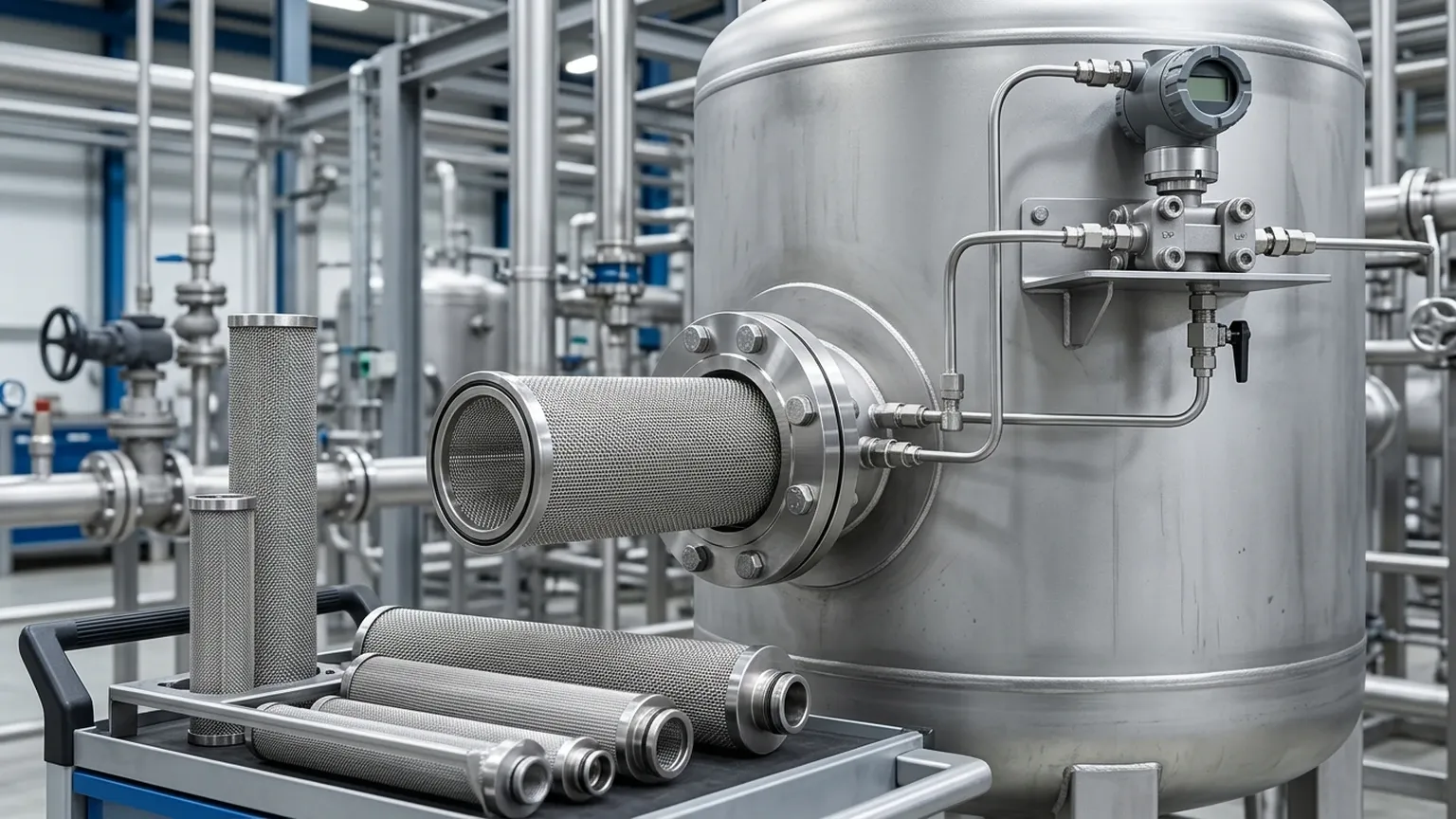
Industrial dust collectors vary widely in their housing designs, requiring customized filter geometries. The most common configurations involve Wire Mesh Filter Cylinders & Tubes which can be integrated into existing baghouses or new specialized vessels.
Structural Reinforcement
Because dust filtration often involves high-velocity gas streams and pulse-jet cleaning, the mesh must be supported. A typical construction includes:
* Inner Support Core: A perforated metal tube or heavy-duty wire cage that prevents the mesh from collapsing under external pressure.
* Multi-Layer Sintered Mesh: In some high-pressure applications, multiple layers of mesh are sintered together. This process bonds the wires at their contact points, creating a rigid plate that combines a fine filtration layer with coarser, protective drainage and support layers.
* Pleated vs. Plain Cylinders: To increase the available filtration surface area within a fixed footprint, the metal mesh can be pleated. Pleating significantly reduces the air-to-cloth ratio, which can extend the time between cleaning cycles and lower the effective velocity through the media.
End Fittings and Sealing
Proper sealing is mandatory to prevent bypass. Custom metal mesh filters can be manufactured with various end-cap configurations, including flange tops, threaded connections, or gasketed seals using high-temperature materials like silicone, Viton, or PTFE.
Maintenance, Cleaning, and Longevity
The total cost of ownership (TCO) for a metal mesh dust filter is often lower than disposable options due to its cleanability. In industrial settings, three primary cleaning methods are used:
1. Pulse-Jet Cleaning: A high-pressure burst of compressed air is directed down the center of the filter tube, causing the mesh to flex slightly and dislodge the dust cake. The rigidity of stainless steel ensures that the filter maintains its shape during these pulses.
2. Ultrasonic Cleaning: For deep-seated particulates or "blinded" mesh, the filter elements can be removed and placed in an ultrasonic bath. This is highly effective for restoring the original pressure drop of the media.
3. Chemical Backwashing: In applications where the dust is sticky or chemically bonded to the mesh, compatible solvents or detergents can be used to wash the elements without risking the fiber degradation common in fabric filters.
Replacement Cycles
While a fabric bag might be replaced every 6 to 18 months, a well-maintained stainless steel filter can last for several years. The primary failure modes for metal mesh are mechanical fatigue from excessive pulsing or localized erosion from high-velocity abrasive dust. Regular inspection of the mesh integrity and seal points is recommended to maximize service life.
Strategic Procurement: What Buyers Must Confirm
For international buyers and engineers, specifying a metal mesh dust filter requires a detailed technical data sheet to ensure the component is fit for purpose. Before finalizing a purchase, the following parameters should be confirmed with the manufacturer:
* Gas Stream Composition: Identify any corrosive elements (SOx, NOx, chlorides) to determine the correct alloy grade.
* Operating and Peak Temperatures: Ensure the filter and its seals can withstand the maximum possible temperature excursions.
* Particle Size Distribution (PSD): Providing the PSD allows the manufacturer to recommend the optimal micron rating and weave type to prevent premature blinding.
* Flow Rate and Face Velocity: This determines the required surface area and whether a pleated or plain cylindrical design is necessary.
* Cleaning System Compatibility: Confirm that the mesh thickness and support structure are rated for the intended pulse-jet pressure.
Conclusion
The metal mesh dust filter represents a high-performance solution for industrial sectors that cannot tolerate the limitations of disposable media. By utilizing Wire Mesh Filter Cylinders & Tubes, facilities can achieve precise particulate control, withstand extreme process conditions, and reduce long-term waste. Whether for chemical processing, power generation, or specialized manufacturing, the engineering of the filter element—from alloy selection to structural reinforcement—is the key to reliable and cost-effective filtration performance.
Working with an experienced manufacturer like Kaifil allows engineering teams to customize these components to exact specifications, ensuring that the filtration system supports both operational efficiency and environmental compliance goals.
