


Engineering Guide to Wire Mesh Drain Filters: Selection, Performance, and Industrial Application
In industrial fluid management, the integrity of downstream equipment—such as pumps, heat exchangers, and sensitive instrumentation—depends heavily on the efficiency of primary filtration stages. A wire mesh drain filter serves as a critical mechanical barrier, designed to capture solid contaminants from liquid streams before they can cause mechanical wear or system blockages. Unlike disposable polymer filters, these stainless steel components offer high structural rigidity, thermal stability, and the ability to be cleaned and reused, making them a staple in heavy industry, chemical processing, and water treatment.
Selecting the appropriate filtration media requires a deep understanding of fluid dynamics, material science, and the specific mechanical constraints of the drainage system. This guide examines the technical specifications of Wire Mesh Filter Cylinders & Tubes and provides actionable insights for engineers and purchasing teams tasked with optimizing industrial drainage performance.
1. Operating Principles of Wire Mesh Drain Filters
The primary function of a wire mesh drain filter is surface filtration through mechanical straining. As fluid passes through the precision-woven mesh, particles larger than the pore size (aperture) are retained on the upstream side of the media.
Mechanical Straining and Flow Dynamics
In industrial drainage applications, flow is often driven by gravity or low-pressure pumps. The efficiency of the filter is governed by the "open area" percentage—the ratio of the total area of the openings to the total area of the mesh. A higher open area reduces the initial pressure drop (clean $\Delta P$), which is vital for gravity-fed drains where head pressure is limited.
However, as debris accumulates, the effective open area decreases, leading to an increase in differential pressure. Engineers must balance the required filtration fineness (micron rating) with the allowable pressure drop to prevent system backups or pump cavitation.
Depth vs. Surface Filtration
While wire mesh is primarily a surface filtration medium, multi-layer sintered mesh configurations can provide a degree of depth filtration. In a standard wire mesh drain filter, the single-layer design is preferred for ease of cleaning, whereas multi-layer tubes are utilized when high-pressure surges or extremely fine particulate removal (below 50 microns) are required.
2. Engineering Selection Criteria: Materials and Weave Types
The performance of a filter is only as reliable as the material from which it is constructed. In industrial environments involving corrosive chemicals or high temperatures, material selection is the first technical hurdle.
Stainless Steel Grades
* AISI 304: The standard choice for general industrial applications, providing excellent strength and basic corrosion resistance for water and mild chemical service.
* AISI 316/316L: Contains molybdenum, which significantly enhances resistance to pitting and crevice corrosion in chloride-rich environments (e.g., seawater or chemical processing). The "L" (low carbon) variant is preferred for welded components to prevent carbide precipitation during the welding process, ensuring the structural integrity of the filter seams.
* Specialty Alloys: For extreme environments, alloys like Monel or Hastelloy may be used, though 316L remains the industry standard for the majority of B2B filtration needs.
Weave Patterns and Their Impact
The geometry of the wire mesh determines the filter's strength and precision:
* Plain Weave: The most common and cost-effective, offering a high open area and predictable flow characteristics.
* Twill Weave: Allows for the use of heavier wires in a given mesh count, increasing the physical durability of the filter tube.
* Dutch Weave (Plain or Twill): Features a dense, compact structure with higher mechanical strength and finer filtration ratings, often used in high-pressure hydraulic drains.
3. Structural Design: Wire Mesh Filter Cylinders & Tubes
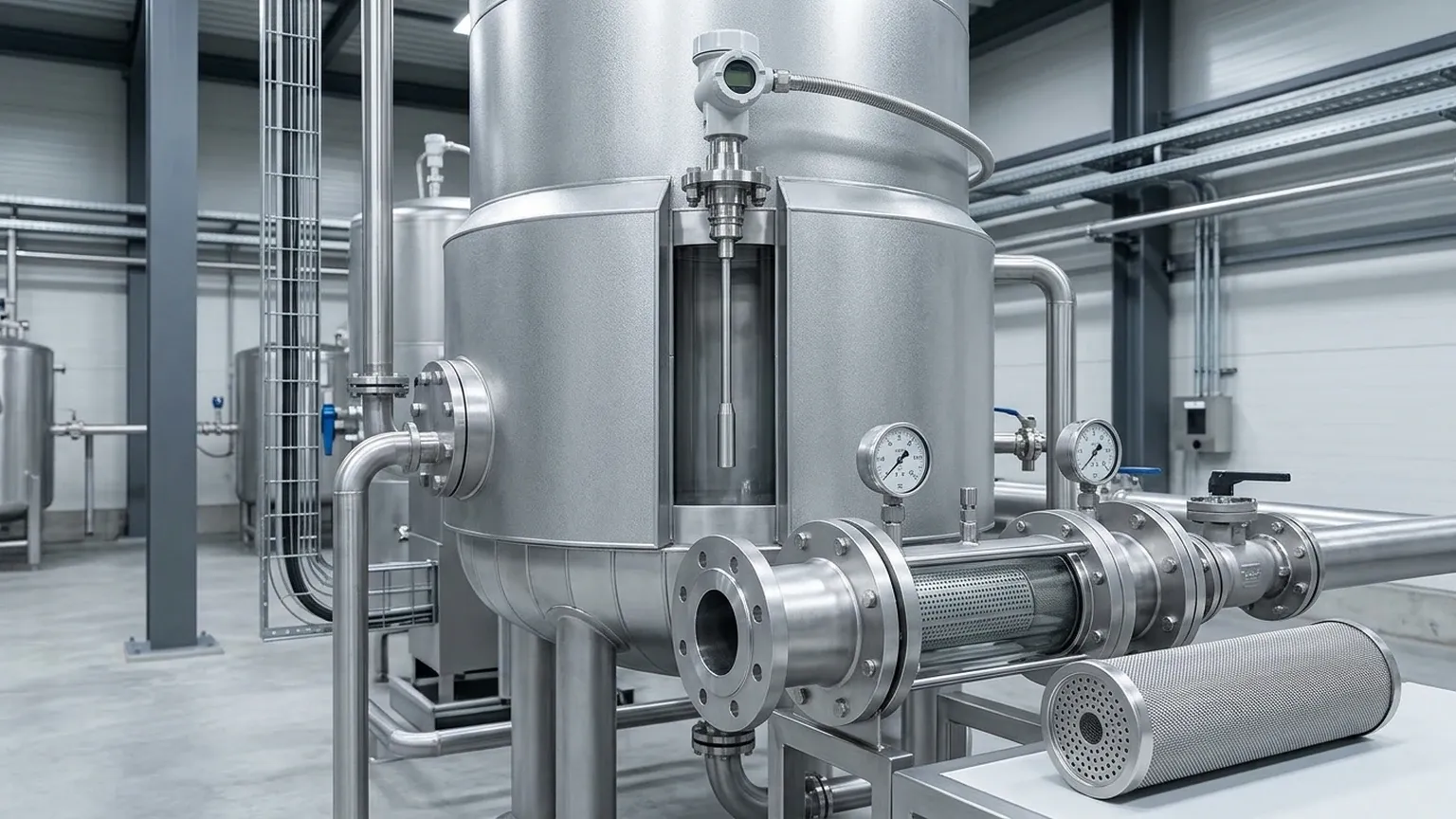
For a wire mesh drain filter to function effectively within a housing or a pipe, it must maintain its shape under hydraulic load. This is where the structural design of Wire Mesh Filter Cylinders & Tubes becomes paramount.
Reinforcement and Support
In high-flow or high-viscosity applications, a single layer of mesh may collapse. To prevent this, industrial filters often incorporate:
1. Perforated Metal Cores: An internal or external support tube made of perforated stainless steel provides the necessary hoop strength to withstand differential pressure.
2. Sintered Layers: Multiple layers of mesh are diffusion-bonded (sintered) to create a single, rigid plate that combines fine filtration with high mechanical strength.
3. End Caps and Fittings: Custom flanges, NPT threads, or O-ring grooves are integrated to ensure a bypass-free seal within the drainage assembly.
Dimensional Tolerances
Precision in manufacturing is essential. Inconsistent diameters or poorly finished seams can lead to "bypass," where fluid avoids the filter media entirely. High-quality industrial tubes utilize plasma or laser welding to ensure that the seam strength matches the strength of the parent mesh, preventing failure at the joint.
4. Installation Constraints and Best Practices
Correct installation is as important as filter selection. Engineers must consider the following constraints when integrating a wire mesh drain filter into an existing system:
Orientation and Accessibility
Filters should be installed in a location that allows for easy removal and inspection. For gravity drains, the filter is typically oriented vertically. In pressurized lines, horizontal installation may be necessary, but this requires a design that prevents the accumulation of heavy solids at the bottom of the housing, which can create localized blinding of the mesh.
Sealing Mechanisms
To ensure 100% filtration, the interface between the filter tube and the housing must be airtight (or watertight). Common sealing methods include:
* Metal-to-Metal Seats: Requires high-precision machining of both the filter end cap and the housing.
* Gaskets and O-Rings: Viton, EPDM, or PTFE gaskets are selected based on the chemical compatibility of the fluid.
Flow Direction
Most wire mesh cylinders are designed for "outside-to-inside" flow, where contaminants accumulate on the exterior surface. This makes visual inspection easier and allows for simpler mechanical cleaning (scraping or hosing down). However, "inside-to-outside" designs are used in specific basket-style drain filters to trap debris within the cylinder for easy removal.
5. Application Risks and Mitigation
Industrial filtration is not without risks. Understanding potential failure modes allows engineers to implement proactive mitigation strategies.
Clogging and Blinding
"Blinding" occurs when particles that are nearly the same size as the mesh openings become wedged in the pores. This is common in applications with irregular, needle-like particulates. To mitigate this, engineers may select a "Dutch Weave" which has a more complex pore structure, or implement a pre-filtration stage.
Corrosion and Erosion
High-velocity fluid streams containing abrasive solids can lead to wire erosion, thinning the mesh over time and eventually causing a breakthrough. Reducing the entry velocity by increasing the surface area of the filter (using a longer or wider tube) can extend the service life of the component.
Pressure Surges (Water Hammer)
Sudden valve closures can create pressure spikes that exceed the burst strength of unsupported mesh. In systems prone to water hammer, utilizing a reinforced perforated core is a mandatory safety requirement.
6. Maintenance and Replacement Cycles
One of the primary advantages of a stainless steel wire mesh drain filter is its cleanability. However, cleaning must be performed correctly to avoid damaging the precision weave.
Cleaning Methodologies
1. Backwashing: Reversing the flow of clean fluid through the filter to dislodge surface cake. This is effective for large particulates.
2. Ultrasonic Cleaning: Using high-frequency sound waves in a detergent bath to remove fine particles lodged deep within the mesh. This is the gold standard for restoring filters to "near-new" pressure drop levels.
3. Chemical Cleaning: Using acids or alkalis to dissolve organic or mineral scaling. The chemical must be compatible with the stainless steel grade (e.g., avoiding hydrochloric acid on 304/316 steel).
Identifying the Replacement Point
While reusable, wire mesh filters eventually reach the end of their economic life. Signs that a filter requires replacement rather than cleaning include:
* Permanent Deformation: Visible bulging or crushing of the mesh or support core.
* Fraying or Broken Wires: Any breach in the weave allows bypass, rendering the filter ineffective.
* Non-Recoverable Pressure Drop: When cleaning no longer returns the differential pressure to acceptable levels, it indicates deep-seated blinding or scaling.
7. Buyer’s Checklist: Confirming Specifications for International Procurement
When sourcing custom filtration components from an OEM manufacturer like Kaifil, providing precise technical data ensures the final product meets the application's demands. International buyers should confirm the following:
* Micron Rating: Specify whether you require an "absolute" or "nominal" rating.
* Operating Conditions: Provide the maximum operating temperature, pressure, and the chemical composition of the fluid.
* Mechanical Interface: Detail the required end-cap style (e.g., open both ends, closed one end with a handle, threaded fitting).
* Certification Requirements: Does the application require FDA compliance for food/beverage or specific material test reports (MTRs) for traceability?
* Quantity and Lead Time: For large-scale industrial projects, verify the manufacturer's capacity for consistent batch production and their quality control protocols (e.g., bubble point testing for pore integrity).
Conclusion
The wire mesh drain filter is a deceptively simple component that requires rigorous engineering to perform reliably in demanding industrial environments. By selecting the correct material, weave type, and structural reinforcement, facilities can significantly reduce maintenance costs and protect expensive downstream assets. Whether you are designing a new system or upgrading an existing drainage line, focusing on the technical fundamentals of Wire Mesh Filter Cylinders & Tubes ensures a balance between filtration precision and long-term durability.
As industrial processes become more complex, the move toward high-quality, customizable stainless steel filtration solutions remains the most effective strategy for managing fluid purity and system uptime.
