


Engineering Guide to Metal Mesh Hose Filters in Industrial Systems
In industrial fluid handling, the integrity of downstream components—such as pumps, valves, and precision nozzles—depends heavily on the removal of particulate contaminants. A metal mesh hose filter serves as a critical inline protection device, typically integrated into flexible hose assemblies or rigid piping systems to capture solids before they can cause mechanical wear or process contamination. Unlike disposable synthetic filters, these stainless steel components offer high mechanical strength, thermal stability, and the ability to be cleaned and reused, making them a staple in heavy industrial applications.
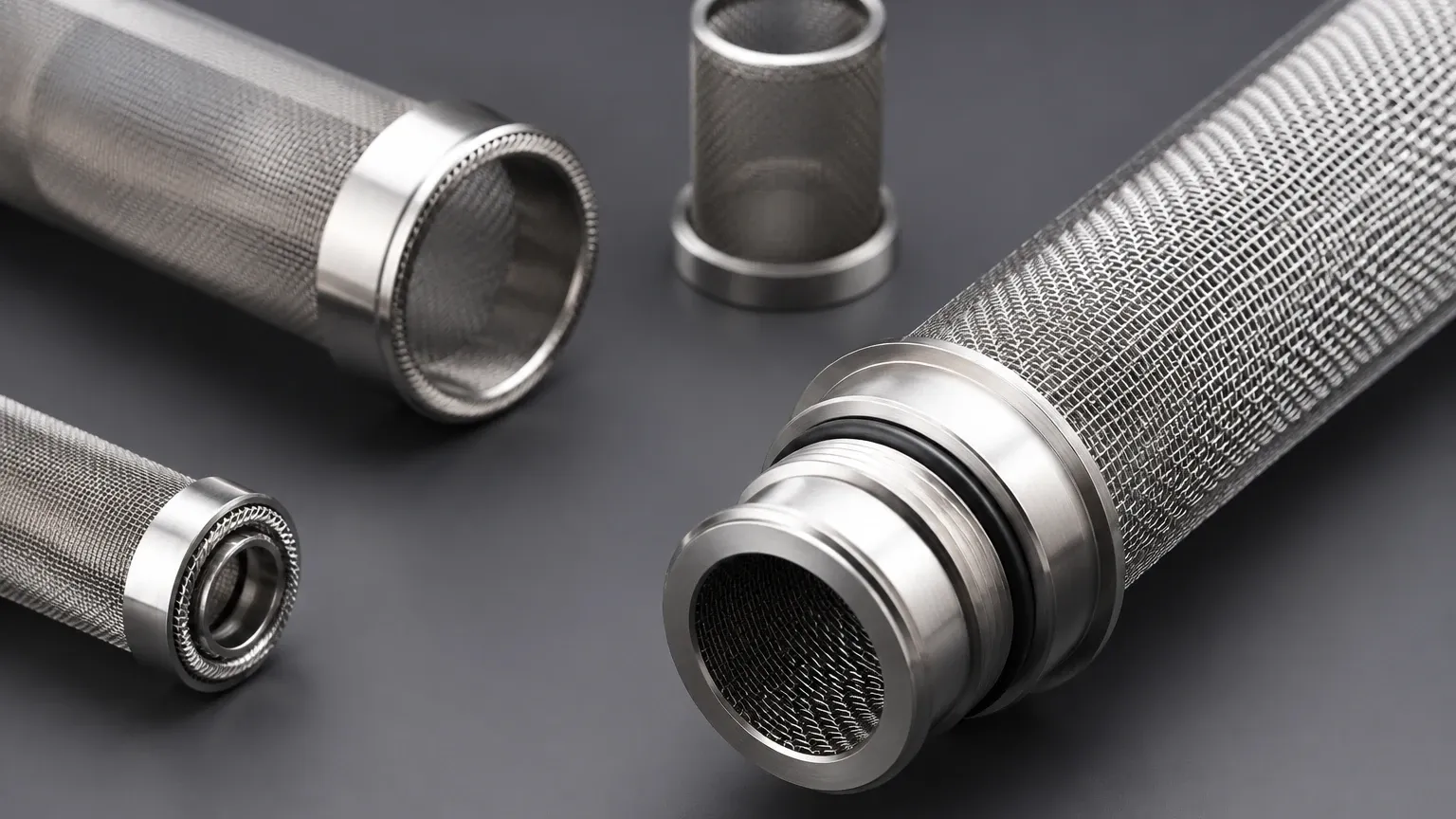
When selecting Wire Mesh Filter Cylinders & Tubes for use as hose filters, engineers must balance filtration efficiency with system pressure requirements. This guide explores the technical specifications, material considerations, and engineering criteria necessary for optimizing filtration performance in demanding B2B environments.
Operating Principles of Metal Mesh Hose Filters
At its core, a metal mesh hose filter operates on the principle of surface filtration. The fluid passes through a woven wire cloth where particles larger than the pore size are physically blocked and retained on the upstream surface of the mesh.
In a hose assembly, these filters are often designed as cylindrical inserts or pleated cartridges. The cylindrical geometry is preferred for its structural stability under flow-induced stress. As fluid enters the hose, it is directed through the mesh tube. The clean filtrate continues through the system, while the debris accumulates. Because the filtration occurs at the surface, the pressure drop across the filter increases as the mesh becomes loaded with contaminants. Monitoring this differential pressure is essential for determining the maintenance cycle and preventing hose failure due to excessive backpressure.
Material Selection and Engineering Properties
Material choice is the most significant factor in the longevity of a metal mesh hose filter. Industrial environments often involve corrosive chemicals, high temperatures, or high-pressure surges that would degrade polymer-based filters.
Stainless Steel Grades
* Type 304 Stainless Steel: The standard choice for general industrial use. It provides excellent strength and good corrosion resistance for water-based fluids, oils, and mild chemicals.
* Type 316L Stainless Steel: Specified for more aggressive environments. The addition of molybdenum enhances resistance to pitting and crevice corrosion, particularly in chloride-rich environments or chemical processing. The "L" (low carbon) variant is critical if the filter requires welding during customization, as it prevents carbide precipitation that can lead to intergranular corrosion.
* Specialty Alloys: For extreme conditions involving high-concentration acids or temperatures exceeding 800°F, alloys such as Monel, Inconel, or Hastelloy may be utilized in the construction of wire mesh filter cylinders & tubes.
Mechanical Strength and Support
In high-pressure hose applications, the wire mesh alone may lack the structural rigidity to withstand the force of the fluid flow. Engineers often specify a multi-layer construction. This typically involves a fine filtration mesh layered over a coarser, heavier support mesh or a perforated metal core. This reinforcement prevents the mesh from collapsing or "ballooning" under pressure spikes, ensuring the filter maintains its shape and pore integrity throughout its service life.
Weave Types and Filtration Accuracy
The performance of a metal mesh hose filter is largely defined by the weave of the wire cloth. Different weaving patterns offer varying levels of flow capacity and particle retention.
1. Plain Weave: The most common pattern where each warp wire crosses over and under each shute wire. It offers the highest open area and lowest pressure drop, making it ideal for high-flow applications where coarse filtration (above 100 microns) is sufficient.
2. Twill Weave: Each wire passes over two and under two wires. This allows for the use of heavier wires in a given mesh count, providing greater strength and the ability to achieve finer filtration ratings than plain weave.
3. Dutch Weave (Plain and Twill): This weave uses a higher density of shute wires than warp wires. The result is a "tortuous path" for the fluid, which provides superior strength and very fine filtration (down to 5-10 microns). Dutch weave filters are excellent for high-pressure hose systems where fine particulate removal is mandatory.
Design and Customization for Hose Integration
Integrating a filter into a hose system requires precise mechanical design to ensure a leak-proof fit and minimal flow restriction. Customization options for wire mesh filter cylinders & tubes include:
* End Fittings: Filters can be manufactured with various end configurations, such as NPT threads, JIC fittings, flanges, or simple open/closed ends with gaskets. Proper sealing at the connection point is vital to prevent fluid bypass.
* Pleated vs. Cylindrical: While a simple cylindrical tube is easier to clean, a pleated design significantly increases the Effective Filtration Area (EFA). A higher EFA results in a lower initial pressure drop and a longer service life between cleanings, which is beneficial for systems with high dirt loads.
* Dimensions: Custom lengths and diameters are necessary to fit within the specific bore of the hose or the housing assembly. Engineers must account for the "annular space"—the area between the filter OD and the hose ID—to ensure fluid can bypass the filter if it is designed as a partial-flow bypass or to ensure even flow distribution in full-flow models.
Application Risks and Installation Constraints
When implementing a metal mesh hose filter, several engineering risks must be addressed:
Pressure Drop ($ΔP$)
Every filter introduces a restriction. If the mesh is too fine for the fluid's viscosity or flow rate, the resulting pressure drop can starve downstream pumps (leading to cavitation) or cause the hose to burst. Engineers should calculate the clean pressure drop using the fluid's specific gravity and viscosity before finalizing the mesh selection.
Velocity and Erosion
High-velocity fluid streams can cause erosion of the wire mesh, especially if the fluid contains abrasive particles. In these cases, a "diffuser" or a heavier gauge outer mesh layer is recommended to break the direct impact of the fluid on the fine filtration layer.
Installation Orientation
For hose filters, orientation matters. In vertical installations with upward flow, heavy particles may settle at the base of the filter, potentially clogging the inlet. In horizontal installations, debris may settle along the bottom of the cylinder. Designing the filter with a "sump" area or ensuring sufficient clearance can mitigate these issues.
Maintenance, Cleaning, and Replacement Cycles
One of the primary B2B advantages of a metal mesh hose filter is its cleanability. Unlike synthetic media that must be discarded, stainless steel mesh can be restored to near-original performance through several methods:
* Ultrasonic Cleaning: The most effective method for fine Dutch weave meshes. High-frequency sound waves create cavitation bubbles that dislodge deeply embedded particles.
* Backwashing: Reversing the flow of clean fluid through the filter to flush out surface-loaded contaminants. This is often integrated into automated systems.
* Chemical Cleaning: Using compatible solvents or acids to dissolve organic or mineral deposits that have scaled onto the mesh.
Replacement Indicators: While reusable, these filters are not infinite. They should be replaced if there is evidence of "wire shifting" (where the pores have enlarged due to mechanical stress), fatigue cracking at the weld points, or if the permanent pressure drop (the $ΔP$ after cleaning) exceeds 20-30% of the original clean $ΔP$.
Buyer’s Checklist: What to Confirm Before Purchasing
For procurement teams and engineers, providing the manufacturer with a complete technical profile ensures the delivered filter meets the application requirements. Before ordering a metal mesh hose filter, confirm the following:
1. Micron Rating: Specify whether you require an "absolute" or "nominal" rating. Absolute ratings are critical for protecting precision components.
2. Fluid Compatibility: Provide the chemical composition and pH of the fluid to ensure the correct stainless steel grade (304 vs 316L) is selected.
3. Operating Temperature: Confirm the maximum and continuous operating temperatures, as this affects the choice of gaskets and welding methods.
4. Maximum Differential Pressure: Define the pressure at which the filter must remain structurally sound without collapsing.
5. Flow Rate and Viscosity: Essential data for calculating the required surface area and preventing excessive pressure drop.
6. Connection Standards: Ensure the end fittings match existing hose couplings (e.g., BSP, NPT, or SAE standards).
Conclusion
The selection of a metal mesh hose filter is a balance of material science and mechanical engineering. By understanding the nuances of weave types, material grades, and structural support, industrial operators can significantly extend the life of their equipment and reduce the total cost of ownership. Whether used in chemical processing, hydraulic power units, or food production, high-quality wire mesh filter cylinders & tubes provide the durability and precision necessary for modern industrial fluid systems. For customized solutions that meet specific micron requirements and pressure constraints, working with an experienced manufacturer ensures that the filtration component is optimized for the unique demands of the application.
