


Understanding the Technical and Regulatory Aspects of Stainless Steel Mesh Filters
In the landscape of industrial engineering, the selection of filtration components is a critical decision that impacts process efficiency, equipment longevity, and product purity. Among the most versatile and durable solutions available are Wire Mesh Filter Cylinders & Tubes. These components are engineered to withstand harsh chemical environments, high temperatures, and significant pressure differentials, making them indispensable in sectors ranging from petrochemical processing to food and beverage production.
However, for procurement teams and engineers operating on a global scale, technical performance is only one side of the coin. Navigating the international trade landscape requires a precise understanding of the stainless steel mesh filter hs code to ensure smooth customs clearance and accurate duty assessment. This article provides a comprehensive technical overview of stainless steel mesh filtration solutions, their engineering specifications, and the logistical considerations essential for international procurement.
The Engineering of Wire Mesh Filter Cylinders & Tubes
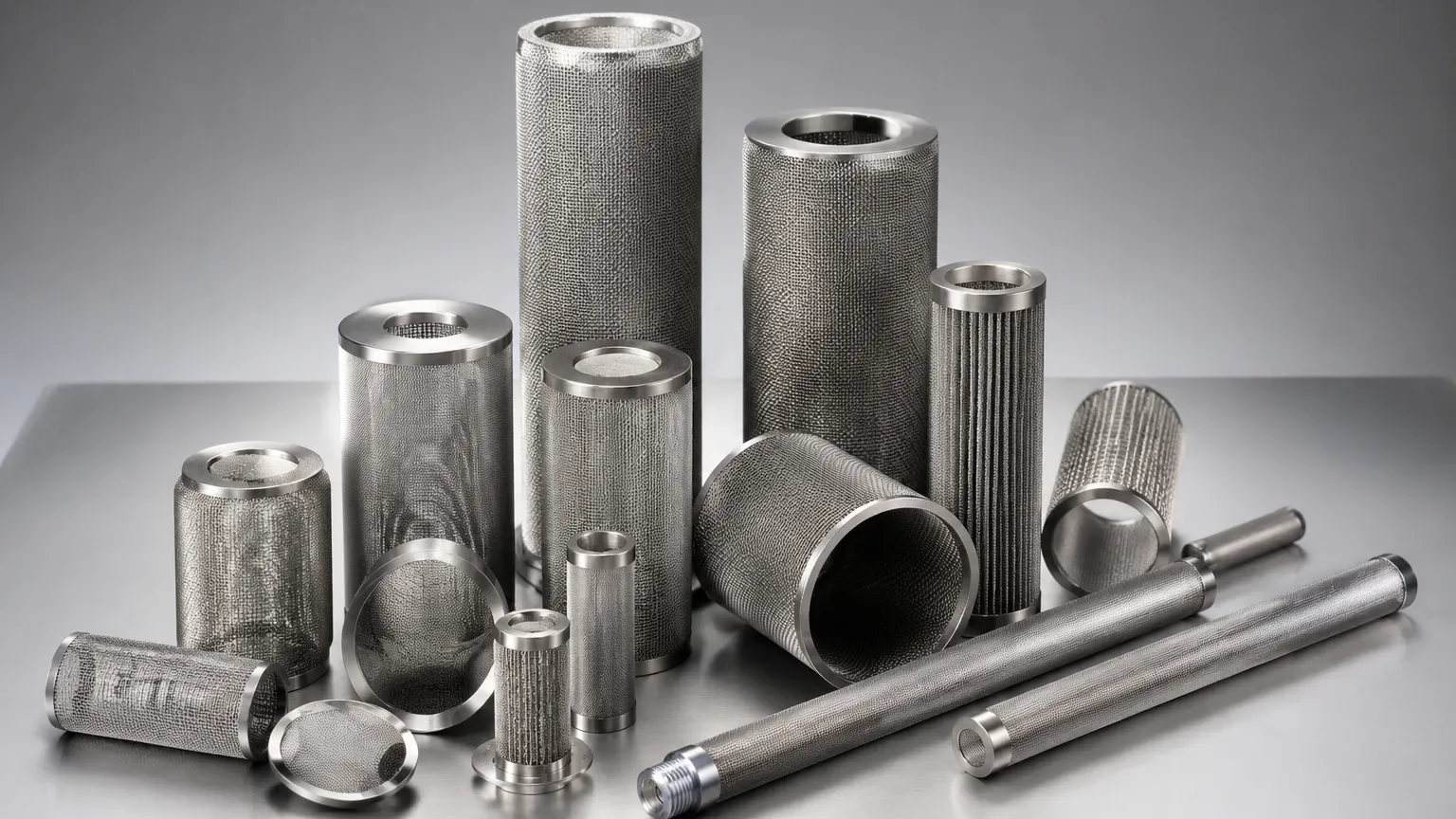
Wire Mesh Filter Cylinders & Tubes are structural filtration elements fabricated from woven wire cloth. Unlike disposable synthetic filters, these stainless steel components offer a rigid, reusable, and highly customizable alternative for liquid and gas separation.
Structural Composition
The design of a filter cylinder typically involves one or more layers of stainless steel mesh. In multi-layer configurations, a fine filtration mesh is often supported by a coarser mesh or a perforated metal core. This architecture provides the necessary mechanical strength to resist collapsing under high-pressure flow while maintaining the precise pore size required for effective particle retention.
Material Selection: 304 vs. 316L
The choice of alloy is the primary determinant of the filter's service life.
- AISI 304 Stainless Steel: Suitable for general industrial applications where basic corrosion resistance is required. It is commonly used in water treatment and hydraulic systems.
- AISI 316L Stainless Steel: Contains molybdenum, which significantly enhances resistance to pitting and crevice corrosion in chloride-rich environments. This is the standard for pharmaceutical, chemical, and marine applications where hygiene and chemical stability are paramount.
Navigating the Stainless Steel Mesh Filter HS Code
For international trade, the Harmonized System (HS) provides a standardized numerical method of classifying traded products. Identifying the correct stainless steel mesh filter hs code is vital for determining tariff rates, verifying trade compliance, and avoiding costly delays at customs.
Common Classifications for Filtration Equipment
While specific codes can vary slightly by country (such as HTSUS in the United States or CN codes in the European Union), the primary heading for filtration machinery and parts is 8421.
1. HS Code 8421.29: This is a broad category covering "Filtering or purifying machinery and apparatus for liquids, other than water." Many industrial stainless steel mesh filters used in oil, chemical, or hydraulic systems fall under this classification.
2. HS Code 8421.21: Specifically designated for the filtration or purification of water. If the wire mesh cylinders are intended for water treatment plants or residential water systems, this code is often applicable.
3. HS Code 8421.39: Used for filtering or purifying gases. This applies to stainless steel tubes used in exhaust systems, air intake filtration, or gas processing.
4. HS Code 7314.14: In some instances, if the product is imported as simple woven cloth (not yet fabricated into a finished machinery part), it might be classified under Chapter 73 (Articles of iron or steel). However, finished Wire Mesh Filter Cylinders & Tubes are almost always classified under Chapter 84 as parts of machinery.
Why Classification Matters for Engineers
Misclassification can lead to the application of incorrect anti-dumping duties or the failure to meet regulatory standards (such as the EU's REACH or RoHS). When requesting quotes from manufacturers like Kaifil, it is standard practice to confirm the HS code provided on the proforma invoice to ensure it aligns with your local customs authority's interpretations.
Technical Performance Metrics: Micron Ratings and Porosity
When specifying Wire Mesh Filter Cylinders & Tubes, engineers must balance filtration fineness with flow capacity. This is defined by two key metrics: micron rating and open area percentage.
Absolute vs. Nominal Filtration
- Nominal Rating: Refers to the ability of the filter to retain a majority of particles at a specific micron size (e.g., 95% of 20-micron particles). This is suitable for non-critical applications where some bypass is acceptable.
- Absolute Rating: Refers to the diameter of the largest hard spherical particle that will pass through the filter under specified test conditions. For critical pharmaceutical or aerospace applications, absolute-rated mesh ensures that no particle larger than the specified size can pass through the medium.
Open Area and Pressure Drop
The "open area" is the ratio of the total area of the holes to the total area of the mesh. A higher open area results in a lower initial pressure drop (ΔP) and higher flow rates. However, increasing the open area often requires thinner wires, which can compromise the structural integrity of the cylinder. Engineering a filter requires a calculation of the "dirt-holding capacity"—the amount of contaminant the filter can collect before the pressure drop reaches a critical threshold requiring cleaning or replacement.
Application-Specific Designs and Customization
Industrial filtration is rarely a one-size-fits-all field. Customization is often necessary to integrate a filter into existing housing or to meet specific process parameters.
Pleated vs. Cylindrical Designs
Standard cylindrical filters are easy to clean and robust. However, if an application requires a large filtration surface area within a compact footprint, pleated wire mesh tubes are used. Pleating increases the available surface area by 3 to 5 times compared to a smooth cylinder, significantly extending the time between cleaning cycles.
End Cap Configurations
To ensure a leak-proof seal within the filter housing, the ends of the wire mesh tubes must be finished correctly. Common configurations include:
- DOE (Double Open End): Both ends are open, usually requiring gaskets for sealing.
- SOE (Single Open End): One end is capped, often featuring a threaded fitting (like NPT or BSP) or a specialized connector (like a 222 or 226 O-ring plug).
- Flanged Ends: Used for high-pressure industrial pipelines where the filter is bolted directly into the flow path.
Maintenance, Cleaning, and Total Cost of Ownership
One of the primary B2B advantages of stainless steel filtration is the low total cost of ownership (TCO). While the initial capital expenditure for a stainless steel mesh filter hs code compliant component is higher than that of a polymer-based disposable filter, the long-term savings are substantial.
Cleaning Methodologies
Stainless steel filters can be cleaned and returned to service multiple times. Common methods include:
- Backwashing: Reversing the flow of fluid to dislodge particles trapped on the surface of the mesh.
- Ultrasonic Cleaning: Using high-frequency sound waves in a cleaning solvent to remove fine particles embedded deep within the mesh pores.
- Chemical Cleaning: Using acids or alkalis to dissolve organic or inorganic scaling, provided the chemical is compatible with the 304 or 316L alloy.
Replacement Indicators
Engineers should monitor the differential pressure across the filter. A consistent rise in the "clean" pressure drop after multiple cleaning cycles indicates that the mesh is becoming permanently blinded or that the structural integrity of the wire is degrading. At this point, replacement is necessary to prevent potential mesh failure and downstream contamination.
Conclusion: Selecting a Reliable Filtration Partner
Procuring industrial filtration components involves a complex intersection of mechanical engineering, material science, and international trade law. By understanding the technical nuances of Wire Mesh Filter Cylinders & Tubes and ensuring the correct application of the stainless steel mesh filter hs code, businesses can optimize their supply chains and process reliability.
Kaifil specializes in bridging the gap between complex engineering requirements and high-quality manufacturing. Whether you require a custom-designed pleated cartridge for a chemical reactor or a standard wire mesh tube for hydraulic oil filtration, focusing on material traceability, precision manufacturing, and regulatory compliance is essential. When selecting a manufacturer, always verify their ability to provide technical documentation, material mill certificates, and accurate trade classifications to support your global operations.
